
Tiling with Congruent Trapezoids
2016-04-27 14:31
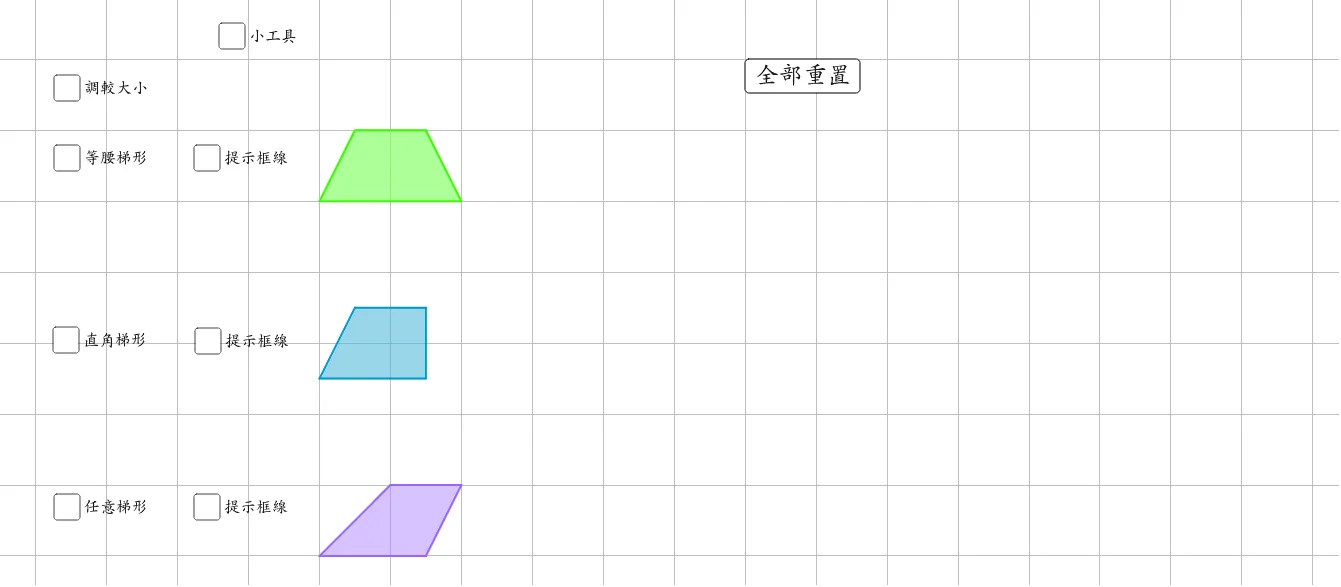
This applet demonstrates the tiling of the plane using congruent trapezoids. Through the geometric construction tools in GeoGebra, including segments, polygons, and rotation transformations, it illustrates how identical trapezoidal shapes can be arranged seamlessly to cover a plane without gaps or overlaps.
The applet allows users to manipulate and explore the properties of a single trapezoid and then observe how repeated application of geometric transformations such as rotations, reflections, and translations generates an interconnected tessellation pattern across the entire plane. By adjusting the dimensions of the initial trapezoid, students can see how variations in side lengths and angles affect the resulting tiling pattern, deepening their understanding of the relationship between shape properties and tessellation feasibility.
The demonstration covers key geometric concepts including congruence, rotational symmetry, translational periodicity, and the angle sum conditions required for a polygon to tile the plane. Students observe that the sum of angles meeting at each vertex in the tessellation equals 360 degrees, and that congruent trapezoids naturally satisfy this condition due to their supplementary adjacent angles along the parallel sides. The applet visually reinforces the mathematical principle that certain quadrilaterals, including all trapezoids, can always tessellate the plane.
Interactions include the ability to trace the tiling step by step, revealing how each new tile is derived from the original through a specific transformation. Users can toggle visibility of individual components, pause the animation, and inspect angle measures and side lengths at any stage. This interactivity supports inquiry-based learning, enabling students to formulate hypotheses about tessellation patterns and verify them through direct manipulation.
Educationally, this applet serves as a powerful visual tool for middle school and high school geometry courses. It helps students move from concrete visual intuition to abstract geometric reasoning about tiling, symmetry, and congruence. By actively engaging with the construction, learners develop spatial reasoning skills and gain a deeper appreciation for the elegant structure underlying plane tessellations. The applet is particularly valuable for visual and kinesthetic learners who benefit from dynamic manipulation of geometric objects rather than static textbook diagrams.
Loading the math board and drawing, please wait…
<?xml version="1.0" encoding="utf-8"?>
<geogebra format="5.0" version="5.0.231.0" id="a13342a5-84b1-481b-a467-e990c9e71d86" xsi:noNamespaceSchemaLocation="http://www.geogebra.org/ggb.xsd" xmlns="" xmlns:xsi="http://www.w3.org/2001/XMLSchema-instance" >
<gui>
<window width="1366" height="768" />
<perspectives>
<perspective id="tmp">
<panes>
<pane location="" divider="0.18301610541727673" orientation="1" />
</panes>
<views>
<view id="4097" visible="false" inframe="true" stylebar="true" location="1,1,1,1" size="400" window="516,274,700,601" />
<view id="512" toolbar="0 | 1 501 5 19 , 67 | 2 15 45 18 , 7 37 | 514 3 9 , 13 44 , 47 | 16 | 551 550 11 , 20 22 21 23 , 55 56 57 , 12 | 69 | 510 511 , 512 513 | 533 531 , 534 532 , 522 523 , 537 536 , 535 | 521 520 | 36 , 38 49 560 | 571 30 29 570 31 33 | 17 | 540 40 41 42 , 27 28 35 , 6 , 502" visible="false" inframe="false" stylebar="false" location="1,1,1" size="500" window="100,100,600,400" />
<view id="4" toolbar="0 || 2020 , 2021 , 2022 , 66 || 2001 , 2003 , 2002 , 2004 , 2005 || 2040 , 2041 , 2042 , 2044 , 2043" visible="false" inframe="false" stylebar="false" location="1,1" size="300" window="100,100,600,400" />
<view id="8" toolbar="1001 | 1002 | 1003 || 1005 | 1004 || 1006 | 1007 | 1010 || 1008 1009 || 66 68 || 6" visible="false" inframe="false" stylebar="false" location="1,3" size="300" window="100,100,600,400" />
<view id="1" visible="true" inframe="false" stylebar="true" location="1" size="1339" window="100,100,600,400" />
<view id="2" visible="false" inframe="false" stylebar="false" location="3" size="250" window="100,100,250,400" />
<view id="16" visible="false" inframe="false" stylebar="false" location="1" size="150" window="50,50,500,500" />
<view id="32" visible="false" inframe="false" stylebar="true" location="1" size="150" window="50,50,500,500" />
<view id="64" toolbar="0" visible="false" inframe="true" stylebar="true" location="1" size="150" window="50,50,500,500" />
<view id="70" toolbar="0 || 2020 || 2021 || 2022" visible="false" inframe="true" stylebar="true" location="1" size="150" window="50,50,500,500" />
</views>
<toolbar show="true" items="0 39 | 1 501 67 , 5 19 , 72 75 76 | 2 15 45 , 18 65 , 7 37 | 4 3 8 9 , 13 44 , 58 , 47 | 16 51 64 , 70 | 10 34 53 11 , 24 20 22 , 21 23 | 55 56 57 , 12 | 36 46 , 38 49 50 , 71 | 30 29 54 32 31 33 | 17 26 62 73 , 14 68 | 25 52 60 61 | 40 41 42 , 27 28 35 , 6" position="1" help="false" />
<input show="true" cmd="true" top="algebra" />
<dockBar show="true" east="true" />
</perspective>
</perspectives>
<labelingStyle val="0"/>
<font size="16"/>
</gui>
<euclidianView>
<viewNumber viewNo="1"/>
<size width="1339" height="585"/>
<coordSystem xZero="248.5051073352584" yZero="555.9796368115435" scale="35.478362789327605" yscale="35.47836278932815"/>
<evSettings axes="false" grid="true" gridIsBold="false" pointCapturing="3" rightAngleStyle="1" checkboxSize="26" gridType="0"/>
<bgColor r="255" g="255" b="255"/>
<axesColor r="0" g="0" b="0"/>
<gridColor r="192" g="192" b="192"/>
<lineStyle axes="1" grid="0"/>
<axis id="0" show="false" label="" unitLabel="" tickStyle="1" showNumbers="true"/>
<axis id="1" show="false" label="" unitLabel="" tickStyle="1" showNumbers="true"/>
</euclidianView>
<kernel>
<continuous val="false"/>
<usePathAndRegionParameters val="true"/>
<decimals val="2"/>
<angleUnit val="degree"/>
<algebraStyle val="0" spreadsheet="0"/>
<coordStyle val="0"/>
<angleFromInvTrig val="false"/>
</kernel>
<scripting blocked="false" disabled="false"/>
<construction title="相同圖形的拼砌(梯形)" author="" date="">
<element type="point" label="A">
<show object="false" label="true" ev="4"/>
<objColor r="0" g="0" b="255" alpha="0.0"/>
<layer val="0"/>
<labelMode val="0"/>
<animation step="0.1" speed="1" type="1" playing="false"/>
<coords x="2.0" y="10.0" z="1.0"/>
<pointSize val="5"/>
<pointStyle val="0"/>
</element>
<expression label ="B" exp="(6, 10)" type="point"/>
<element type="point" label="B">
<show object="true" label="false" ev="4"/>
<condition showObject="w_5"/>
<objColor r="0" g="0" b="255" alpha="0.0"/>
<layer val="0"/>
<labelMode val="0"/>
<animation step="1" speed="1" type="1" playing="false"/>
<coords x="6.0" y="10.0" z="1.0"/>
<pointSize val="5"/>
<pointStyle val="0"/>
</element>
<command name="Segment">
<input a0="A" a1="B"/>
<output a0="a"/>
</command>
<element type="segment" label="a">
<show object="false" label="true"/>
<objColor r="0" g="0" b="0" alpha="0.0"/>
<layer val="0"/>
<labelMode val="0"/>
<coords x="0.0" y="4.0" z="-40.0"/>
<lineStyle thickness="2" type="0" typeHidden="1"/>
<outlyingIntersections val="false"/>
<keepTypeOnTransform val="true"/>
</element>
<expression label ="C" exp="(3, 12)" type="point"/>
<element type="point" label="C">
<show object="true" label="false" ev="4"/>
<condition showObject="w_5"/>
<objColor r="0" g="0" b="255" alpha="0.0"/>
<layer val="0"/>
<labelMode val="0"/>
<animation step="1" speed="1" type="1" playing="false"/>
<coords x="3.0" y="12.0" z="1.0"/>
<pointSize val="5"/>
<pointStyle val="0"/>
</element>
<command name="Line">
<input a0="C" a1="a"/>
<output a0="b"/>
</command>
<element type="line" label="b">
<show object="false" label="true"/>
<objColor r="0" g="0" b="0" alpha="0.0"/>
<layer val="0"/>
<labelMode val="0"/>
<coords x="0.0" y="4.0" z="-48.0"/>
<lineStyle thickness="2" type="0" typeHidden="1"/>
<eqnStyle style="implicit"/>
</element>
<command name="Segment">
<input a0="A" a1="C"/>
<output a0="c"/>
</command>
<element type="segment" label="c">
<show object="false" label="true"/>
<objColor r="0" g="0" b="0" alpha="0.0"/>
<layer val="0"/>
<labelMode val="0"/>
<coords x="-2.0" y="1.0" z="-6.0"/>
<lineStyle thickness="2" type="0" typeHidden="1"/>
<outlyingIntersections val="false"/>
<keepTypeOnTransform val="true"/>
</element>
<command name="Circle">
<input a0="A" a1="C"/>
<output a0="d"/>
</command>
<element type="conic" label="d">
<show object="false" label="true"/>
<objColor r="0" g="0" b="0" alpha="0.0"/>
<layer val="0"/>
<labelMode val="0"/>
<lineStyle thickness="2" type="0" typeHidden="1"/>
<eigenvectors x0="1.0" y0="0.0" z0="1.0" x1="-0.0" y1="1.0" z1="1.0"/>
<matrix A0="1.0" A1="1.0" A2="99.0" A3="0.0" A4="-2.0" A5="-10.0"/>
<eqnStyle style="specific"/>
</element>
<command name="Circle">
<input a0="B" a1="c"/>
<output a0="e"/>
</command>
<element type="conic" label="e">
<show object="false" label="true"/>
<objColor r="0" g="0" b="0" alpha="0.0"/>
<layer val="0"/>
<labelMode val="0"/>
<lineStyle thickness="2" type="0" typeHidden="1"/>
<eigenvectors x0="1.0" y0="0.0" z0="1.0" x1="-0.0" y1="1.0" z1="1.0"/>
<matrix A0="1.0" A1="1.0" A2="131.0" A3="0.0" A4="-6.0" A5="-10.0"/>
<eqnStyle style="specific"/>
</element>
<command name="Intersect">
<input a0="e" a1="b" a2="1"/>
<output a0="D"/>
</command>
<element type="point" label="D">
<show object="false" label="true"/>
<objColor r="68" g="68" b="68" alpha="0.0"/>
<layer val="0"/>
<labelMode val="0"/>
<coords x="5.0" y="12.0" z="1.0"/>
<pointSize val="3"/>
<pointStyle val="0"/>
</element>
<command name="Segment">
<input a0="B" a1="D"/>
<output a0="f"/>
</command>
<element type="segment" label="f">
<show object="false" label="true"/>
<objColor r="0" g="0" b="0" alpha="0.0"/>
<layer val="0"/>
<labelMode val="0"/>
<coords x="-2.0" y="-1.0" z="22.0"/>
<lineStyle thickness="2" type="0" typeHidden="1"/>
<outlyingIntersections val="false"/>
<keepTypeOnTransform val="true"/>
</element>
<command name="Polygon">
<input a0="A" a1="B" a2="D" a3="C"/>
<output a0="poly1" a1="a_1" a2="b_1" a3="d_1" a4="c_1"/>
</command>
<element type="polygon" label="poly1">
<lineStyle thickness="4" type="0" typeHidden="1"/>
<show object="true" label="false" ev="4"/>
<objColor r="51" g="255" b="0" alpha="0.4"/>
<layer val="0"/>
<labelMode val="0"/>
<fixed val="true"/>
</element>
<element type="segment" label="a_1">
<show object="true" label="false" ev="4"/>
<objColor r="51" g="255" b="0" alpha="0.0"/>
<layer val="0"/>
<labelMode val="0"/>
<fixed val="true"/>
<auxiliary val="false"/>
<coords x="0.0" y="4.0" z="-40.0"/>
<lineStyle thickness="4" type="0" typeHidden="1"/>
<outlyingIntersections val="false"/>
<keepTypeOnTransform val="true"/>
</element>
<element type="segment" label="b_1">
<show object="true" label="false" ev="4"/>
<objColor r="51" g="255" b="0" alpha="0.0"/>
<layer val="0"/>
<labelMode val="0"/>
<fixed val="true"/>
<auxiliary val="false"/>
<coords x="-2.0" y="-1.0" z="22.0"/>
<lineStyle thickness="4" type="0" typeHidden="1"/>
<outlyingIntersections val="false"/>
<keepTypeOnTransform val="true"/>
</element>
<element type="segment" label="d_1">
<show object="true" label="false" ev="4"/>
<objColor r="51" g="255" b="0" alpha="0.0"/>
<layer val="0"/>
<labelMode val="0"/>
<fixed val="true"/>
<auxiliary val="false"/>
<coords x="0.0" y="-2.0" z="24.0"/>
<lineStyle thickness="4" type="0" typeHidden="1"/>
<outlyingIntersections val="false"/>
<keepTypeOnTransform val="true"/>
</element>
<element type="segment" label="c_1">
<show object="true" label="false" ev="4"/>
<objColor r="51" g="255" b="0" alpha="0.0"/>
<layer val="0"/>
<labelMode val="0"/>
<fixed val="true"/>
<auxiliary val="false"/>
<coords x="2.0" y="-1.0" z="6.0"/>
<lineStyle thickness="4" type="0" typeHidden="1"/>
<outlyingIntersections val="false"/>
<keepTypeOnTransform val="true"/>
</element>
<expression label ="E" exp="(9, 10)" type="point"/>
<element type="point" label="E">
<show object="false" label="true"/>
<objColor r="0" g="0" b="255" alpha="0.0"/>
<layer val="0"/>
<labelMode val="0"/>
<animation step="1" speed="1" type="0" playing="false"/>
<coords x="9.0" y="10.0" z="1.0"/>
<pointSize val="5"/>
<pointStyle val="0"/>
</element>
<command name="Point">
<input a0="Circle[E, Segment[A, B]]"/>
<output a0="F"/>
</command>
<element type="point" label="F">
<show object="true" label="false" ev="4"/>
<condition showObject="q_1"/>
<objColor r="125" g="125" b="255" alpha="0.0"/>
<layer val="0"/>
<labelMode val="0"/>
<animation step="0.1" speed="1" type="1" playing="false"/>
<coords x="13.0" y="10.0" z="1.0"/>
<pointSize val="5"/>
<pointStyle val="0"/>
</element>
<command name="Rotate">
<input a0="F + (Segment[B, D], 0)" a1="Angle[D - B] + Angle[F - E] - Angle[B - A]" a2="F"/>
<output a0="G"/>
</command>
<element type="point" label="G">
<show object="false" label="true"/>
<objColor r="68" g="68" b="68" alpha="0.0"/>
<layer val="0"/>
<labelMode val="0"/>
<coords x="12.0" y="12.0" z="1.0"/>
<pointSize val="3"/>
<pointStyle val="0"/>
</element>
<command name="Rotate">
<input a0="G + (Segment[D, C], 0)" a1="Angle[C - D] + Angle[G - F] - Angle[D - B]" a2="G"/>
<output a0="H"/>
</command>
<element type="point" label="H">
<show object="false" label="true"/>
<objColor r="68" g="68" b="68" alpha="0.0"/>
<layer val="0"/>
<labelMode val="0"/>
<coords x="10.0" y="12.0" z="1.0"/>
<pointSize val="3"/>
<pointStyle val="0"/>
</element>
<command name="Polygon">
<input a0="E" a1="F" a2="G" a3="H"/>
<output a0="poly2" a1="e_1" a2="f_1" a3="g" a4="h"/>
</command>
<element type="polygon" label="poly2">
<lineStyle thickness="2" type="0" typeHidden="1"/>
<show object="true" label="false" ev="4"/>
<condition showObject="q_1"/>
<objColor r="153" g="51" b="0" alpha="0.1"/>
<layer val="0"/>
<labelMode val="0"/>
</element>
<element type="segment" label="e_1">
<show object="true" label="false"/>
<condition showObject="q_1"/>
<objColor r="153" g="51" b="0" alpha="0.0"/>
<layer val="0"/>
<labelMode val="0"/>
<auxiliary val="false"/>
<coords x="0.0" y="4.0" z="-40.0"/>
<lineStyle thickness="2" type="0" typeHidden="1"/>
<outlyingIntersections val="false"/>
<keepTypeOnTransform val="true"/>
</element>
<element type="segment" label="f_1">
<show object="true" label="false"/>
<condition showObject="q_1"/>
<objColor r="153" g="51" b="0" alpha="0.0"/>
<layer val="0"/>
<labelMode val="0"/>
<auxiliary val="false"/>
<coords x="-2.0" y="-1.0" z="36.0"/>
<lineStyle thickness="2" type="0" typeHidden="1"/>
<outlyingIntersections val="false"/>
<keepTypeOnTransform val="true"/>
</element>
<element type="segment" label="g">
<show object="true" label="false"/>
<condition showObject="q_1"/>
<objColor r="153" g="51" b="0" alpha="0.0"/>
<layer val="0"/>
<labelMode val="0"/>
<auxiliary val="false"/>
<coords x="0.0" y="-2.0" z="24.0"/>
<lineStyle thickness="2" type="0" typeHidden="1"/>
<outlyingIntersections val="false"/>
<keepTypeOnTransform val="true"/>
</element>
<element type="segment" label="h">
<show object="true" label="false"/>
<condition showObject="q_1"/>
<objColor r="153" g="51" b="0" alpha="0.0"/>
<layer val="0"/>
<labelMode val="0"/>
<auxiliary val="false"/>
<coords x="2.0" y="-1.0" z="-8.0"/>
<lineStyle thickness="2" type="0" typeHidden="1"/>
<outlyingIntersections val="false"/>
<keepTypeOnTransform val="true"/>
</element>
<expression label ="I" exp="(9, 10)" type="point"/>
<element type="point" label="I">
<show object="false" label="true"/>
<objColor r="0" g="0" b="255" alpha="0.0"/>
<layer val="0"/>
<labelMode val="0"/>
<animation step="1" speed="1" type="0" playing="false"/>
<coords x="9.0" y="10.0" z="1.0"/>
<pointSize val="5"/>
<pointStyle val="0"/>
</element>
<command name="Point">
<input a0="Circle[I, Segment[A, B]]"/>
<output a0="J"/>
</command>
<element type="point" label="J">
<show object="true" label="false" ev="4"/>
<condition showObject="q_1"/>
<objColor r="125" g="125" b="255" alpha="0.0"/>
<layer val="0"/>
<labelMode val="0"/>
<animation step="0.1" speed="1" type="1" playing="false"/>
<coords x="13.0" y="10.0" z="1.0"/>
<pointSize val="5"/>
<pointStyle val="0"/>
</element>
<command name="Rotate">
<input a0="J + (Segment[B, D], 0)" a1="Angle[D - B] + Angle[J - I] - Angle[B - A]" a2="J"/>
<output a0="K"/>
</command>
<element type="point" label="K">
<show object="false" label="true"/>
<objColor r="68" g="68" b="68" alpha="0.0"/>
<layer val="0"/>
<labelMode val="0"/>
<coords x="12.0" y="12.0" z="1.0"/>
<pointSize val="3"/>
<pointStyle val="0"/>
</element>
<command name="Rotate">
<input a0="K + (Segment[D, C], 0)" a1="Angle[C - D] + Angle[K - J] - Angle[D - B]" a2="K"/>
<output a0="L"/>
</command>
<element type="point" label="L">
<show object="false" label="true"/>
<objColor r="68" g="68" b="68" alpha="0.0"/>
<layer val="0"/>
<labelMode val="0"/>
<coords x="10.0" y="12.0" z="1.0"/>
<pointSize val="3"/>
<pointStyle val="0"/>
</element>
<command name="Polygon">
<input a0="I" a1="J" a2="K" a3="L"/>
<output a0="poly3" a1="i" a2="j" a3="k" a4="l"/>
</command>
<element type="polygon" label="poly3">
<lineStyle thickness="2" type="0" typeHidden="1"/>
<show object="true" label="false" ev="4"/>
<condition showObject="q_1"/>
<objColor r="153" g="51" b="0" alpha="0.1"/>
<layer val="0"/>
<labelMode val="0"/>
</element>
<element type="segment" label="i">
<show object="true" label="false"/>
<condition showObject="q_1"/>
<objColor r="153" g="51" b="0" alpha="0.0"/>
<layer val="0"/>
<labelMode val="0"/>
<auxiliary val="false"/>
<coords x="0.0" y="4.0" z="-40.0"/>
<lineStyle thickness="2" type="0" typeHidden="1"/>
<outlyingIntersections val="false"/>
<keepTypeOnTransform val="true"/>
</element>
<element type="segment" label="j">
<show object="true" label="false"/>
<condition showObject="q_1"/>
<objColor r="153" g="51" b="0" alpha="0.0"/>
<layer val="0"/>
<labelMode val="0"/>
<auxiliary val="false"/>
<coords x="-2.0" y="-1.0" z="36.0"/>
<lineStyle thickness="2" type="0" typeHidden="1"/>
<outlyingIntersections val="false"/>
<keepTypeOnTransform val="true"/>
</element>
<element type="segment" label="k">
<show object="true" label="false"/>
<condition showObject="q_1"/>
<objColor r="153" g="51" b="0" alpha="0.0"/>
<layer val="0"/>
<labelMode val="0"/>
<auxiliary val="false"/>
<coords x="0.0" y="-2.0" z="24.0"/>
<lineStyle thickness="2" type="0" typeHidden="1"/>
<outlyingIntersections val="false"/>
<keepTypeOnTransform val="true"/>
</element>
<element type="segment" label="l">
<show object="true" label="false"/>
<condition showObject="q_1"/>
<objColor r="153" g="51" b="0" alpha="0.0"/>
<layer val="0"/>
<labelMode val="0"/>
<auxiliary val="false"/>
<coords x="2.0" y="-1.0" z="-8.0"/>
<lineStyle thickness="2" type="0" typeHidden="1"/>
<outlyingIntersections val="false"/>
<keepTypeOnTransform val="true"/>
</element>
<expression label ="M" exp="(9, 10)" type="point"/>
<element type="point" label="M">
<show object="false" label="true"/>
<objColor r="0" g="0" b="255" alpha="0.0"/>
<layer val="0"/>
<labelMode val="0"/>
<animation step="1" speed="1" type="0" playing="false"/>
<coords x="9.0" y="10.0" z="1.0"/>
<pointSize val="5"/>
<pointStyle val="0"/>
</element>
<command name="Point">
<input a0="Circle[M, Segment[A, B]]"/>
<output a0="N"/>
</command>
<element type="point" label="N">
<show object="true" label="false" ev="4"/>
<condition showObject="q_1"/>
<objColor r="125" g="125" b="255" alpha="0.0"/>
<layer val="0"/>
<labelMode val="0"/>
<animation step="0.1" speed="1" type="1" playing="false"/>
<coords x="13.0" y="10.0" z="1.0"/>
<pointSize val="5"/>
<pointStyle val="0"/>
</element>
<command name="Rotate">
<input a0="N + (Segment[B, D], 0)" a1="Angle[D - B] + Angle[N - M] - Angle[B - A]" a2="N"/>
<output a0="O"/>
</command>
<element type="point" label="O">
<show object="false" label="true"/>
<objColor r="68" g="68" b="68" alpha="0.0"/>
<layer val="0"/>
<labelMode val="0"/>
<coords x="12.0" y="12.0" z="1.0"/>
<pointSize val="3"/>
<pointStyle val="0"/>
</element>
<command name="Rotate">
<input a0="O + (Segment[D, C], 0)" a1="Angle[C - D] + Angle[O - N] - Angle[D - B]" a2="O"/>
<output a0="P"/>
</command>
<element type="point" label="P">
<show object="false" label="true"/>
<objColor r="68" g="68" b="68" alpha="0.0"/>
<layer val="0"/>
<labelMode val="0"/>
<coords x="10.0" y="12.0" z="1.0"/>
<pointSize val="3"/>
<pointStyle val="0"/>
</element>
<command name="Polygon">
<input a0="M" a1="N" a2="O" a3="P"/>
<output a0="poly4" a1="m" a2="n" a3="o" a4="p"/>
</command>
<element type="polygon" label="poly4">
<lineStyle thickness="2" type="0" typeHidden="1"/>
<show object="true" label="false" ev="4"/>
<condition showObject="q_1"/>
<objColor r="153" g="51" b="0" alpha="0.1"/>
<layer val="0"/>
<labelMode val="0"/>
</element>
<element type="segment" label="m">
<show object="true" label="false"/>
<condition showObject="q_1"/>
<objColor r="153" g="51" b="0" alpha="0.0"/>
<layer val="0"/>
<labelMode val="0"/>
<auxiliary val="false"/>
<coords x="0.0" y="4.0" z="-40.0"/>
<lineStyle thickness="2" type="0" typeHidden="1"/>
<outlyingIntersections val="false"/>
<keepTypeOnTransform val="true"/>
</element>
<element type="segment" label="n">
<show object="true" label="false" ev="4"/>
<condition showObject="q_1"/>
<objColor r="153" g="51" b="0" alpha="0.0"/>
<layer val="0"/>
<labelMode val="0"/>
<auxiliary val="false"/>
<coords x="-2.0" y="-1.0" z="36.0"/>
<lineStyle thickness="2" type="0" typeHidden="1"/>
<outlyingIntersections val="false"/>
<keepTypeOnTransform val="true"/>
</element>
<element type="segment" label="o">
<show object="true" label="false"/>
<condition showObject="q_1"/>
<objColor r="153" g="51" b="0" alpha="0.0"/>
<layer val="0"/>
<labelMode val="0"/>
<auxiliary val="false"/>
<coords x="0.0" y="-2.0" z="24.0"/>
<lineStyle thickness="2" type="0" typeHidden="1"/>
<outlyingIntersections val="false"/>
<keepTypeOnTransform val="true"/>
</element>
<element type="segment" label="p">
<show object="true" label="false"/>
<condition showObject="q_1"/>
<objColor r="153" g="51" b="0" alpha="0.0"/>
<layer val="0"/>
<labelMode val="0"/>
<auxiliary val="false"/>
<coords x="2.0" y="-1.0" z="-8.0"/>
<lineStyle thickness="2" type="0" typeHidden="1"/>
<outlyingIntersections val="false"/>
<keepTypeOnTransform val="true"/>
</element>
<expression label ="Q" exp="(9, 10)" type="point"/>
<element type="point" label="Q">
<show object="false" label="true" ev="4"/>
<objColor r="0" g="0" b="255" alpha="0.0"/>
<layer val="0"/>
<labelMode val="0"/>
<animation step="0.1" speed="1" type="0" playing="false"/>
<coords x="9.0" y="10.0" z="1.0"/>
<pointSize val="5"/>
<pointStyle val="0"/>
</element>
<command name="Point">
<input a0="Circle[Q, Segment[A, B]]"/>
<output a0="R"/>
</command>
<element type="point" label="R">
<show object="true" label="false" ev="4"/>
<condition showObject="q_1"/>
<objColor r="125" g="125" b="255" alpha="0.0"/>
<layer val="0"/>
<labelMode val="0"/>
<animation step="0.1" speed="1" type="1" playing="false"/>
<coords x="13.0" y="10.0" z="1.0"/>
<pointSize val="5"/>
<pointStyle val="0"/>
</element>
<command name="Rotate">
<input a0="R + (Segment[B, D], 0)" a1="Angle[D - B] + Angle[R - Q] - Angle[B - A]" a2="R"/>
<output a0="S"/>
</command>
<element type="point" label="S">
<show object="false" label="true"/>
<objColor r="68" g="68" b="68" alpha="0.0"/>
<layer val="0"/>
<labelMode val="0"/>
<coords x="12.0" y="12.0" z="1.0"/>
<pointSize val="3"/>
<pointStyle val="0"/>
</element>
<command name="Rotate">
<input a0="S + (Segment[D, C], 0)" a1="Angle[C - D] + Angle[S - R] - Angle[D - B]" a2="S"/>
<output a0="T"/>
</command>
<element type="point" label="T">
<show object="false" label="true"/>
<objColor r="68" g="68" b="68" alpha="0.0"/>
<layer val="0"/>
<labelMode val="0"/>
<coords x="10.0" y="12.0" z="1.0"/>
<pointSize val="3"/>
<pointStyle val="0"/>
</element>
<command name="Polygon">
<input a0="Q" a1="R" a2="S" a3="T"/>
<output a0="poly5" a1="q" a2="r" a3="s" a4="t"/>
</command>
<element type="polygon" label="poly5">
<lineStyle thickness="2" type="0" typeHidden="1"/>
<show object="true" label="false" ev="4"/>
<condition showObject="q_1"/>
<objColor r="153" g="51" b="0" alpha="0.1"/>
<layer val="0"/>
<labelMode val="0"/>
</element>
<element type="segment" label="q">
<show object="true" label="false"/>
<condition showObject="q_1"/>
<objColor r="153" g="51" b="0" alpha="0.0"/>
<layer val="0"/>
<labelMode val="0"/>
<auxiliary val="false"/>
<coords x="0.0" y="4.0" z="-40.0"/>
<lineStyle thickness="2" type="0" typeHidden="1"/>
<outlyingIntersections val="false"/>
<keepTypeOnTransform val="true"/>
</element>
<element type="segment" label="r">
<show object="true" label="false"/>
<condition showObject="q_1"/>
<objColor r="153" g="51" b="0" alpha="0.0"/>
<layer val="0"/>
<labelMode val="0"/>
<auxiliary val="false"/>
<coords x="-2.0" y="-1.0" z="36.0"/>
<lineStyle thickness="2" type="0" typeHidden="1"/>
<outlyingIntersections val="false"/>
<keepTypeOnTransform val="true"/>
</element>
<element type="segment" label="s">
<show object="true" label="false"/>
<condition showObject="q_1"/>
<objColor r="153" g="51" b="0" alpha="0.0"/>
<layer val="0"/>
<labelMode val="0"/>
<auxiliary val="false"/>
<coords x="0.0" y="-2.0" z="24.0"/>
<lineStyle thickness="2" type="0" typeHidden="1"/>
<outlyingIntersections val="false"/>
<keepTypeOnTransform val="true"/>
</element>
<element type="segment" label="t">
<show object="true" label="false"/>
<condition showObject="q_1"/>
<objColor r="153" g="51" b="0" alpha="0.0"/>
<layer val="0"/>
<labelMode val="0"/>
<auxiliary val="false"/>
<coords x="2.0" y="-1.0" z="-8.0"/>
<lineStyle thickness="2" type="0" typeHidden="1"/>
<outlyingIntersections val="false"/>
<keepTypeOnTransform val="true"/>
</element>
<expression label ="U" exp="(9, 10)" type="point"/>
<element type="point" label="U">
<show object="false" label="true" ev="4"/>
<objColor r="0" g="0" b="255" alpha="0.0"/>
<layer val="0"/>
<labelMode val="0"/>
<animation step="0.1" speed="1" type="0" playing="false"/>
<coords x="9.0" y="10.0" z="1.0"/>
<pointSize val="5"/>
<pointStyle val="0"/>
</element>
<command name="Point">
<input a0="Circle[U, Segment[A, B]]"/>
<output a0="V"/>
</command>
<element type="point" label="V">
<show object="true" label="false" ev="4"/>
<condition showObject="q_1"/>
<objColor r="125" g="125" b="255" alpha="0.0"/>
<layer val="0"/>
<labelMode val="0"/>
<animation step="0.1" speed="1" type="1" playing="false"/>
<coords x="13.0" y="10.0" z="1.0"/>
<pointSize val="5"/>
<pointStyle val="0"/>
</element>
<command name="Rotate">
<input a0="V + (Segment[B, D], 0)" a1="Angle[D - B] + Angle[V - U] - Angle[B - A]" a2="V"/>
<output a0="W"/>
</command>
<element type="point" label="W">
<show object="false" label="true"/>
<objColor r="68" g="68" b="68" alpha="0.0"/>
<layer val="0"/>
<labelMode val="0"/>
<coords x="12.0" y="12.0" z="1.0"/>
<pointSize val="3"/>
<pointStyle val="0"/>
</element>
<command name="Rotate">
<input a0="W + (Segment[D, C], 0)" a1="Angle[C - D] + Angle[W - V] - Angle[D - B]" a2="W"/>
<output a0="Z"/>
</command>
<element type="point" label="Z">
<show object="false" label="true"/>
<objColor r="68" g="68" b="68" alpha="0.0"/>
<layer val="0"/>
<labelMode val="0"/>
<coords x="10.0" y="12.0" z="1.0"/>
<pointSize val="3"/>
<pointStyle val="0"/>
</element>
<command name="Polygon">
<input a0="U" a1="V" a2="W" a3="Z"/>
<output a0="poly6" a1="u" a2="v" a3="w" a4="z_1"/>
</command>
<element type="polygon" label="poly6">
<lineStyle thickness="2" type="0" typeHidden="1"/>
<show object="true" label="false" ev="4"/>
<condition showObject="q_1"/>
<objColor r="153" g="51" b="0" alpha="0.1"/>
<layer val="0"/>
<labelMode val="0"/>
</element>
<element type="segment" label="u">
<show object="true" label="false"/>
<condition showObject="q_1"/>
<objColor r="153" g="51" b="0" alpha="0.0"/>
<layer val="0"/>
<labelMode val="0"/>
<auxiliary val="false"/>
<coords x="0.0" y="4.0" z="-40.0"/>
<lineStyle thickness="2" type="0" typeHidden="1"/>
<outlyingIntersections val="false"/>
<keepTypeOnTransform val="true"/>
</element>
<element type="segment" label="v">
<show object="true" label="false"/>
<condition showObject="q_1"/>
<objColor r="153" g="51" b="0" alpha="0.0"/>
<layer val="0"/>
<labelMode val="0"/>
<auxiliary val="false"/>
<coords x="-2.0" y="-1.0" z="36.0"/>
<lineStyle thickness="2" type="0" typeHidden="1"/>
<outlyingIntersections val="false"/>
<keepTypeOnTransform val="true"/>
</element>
<element type="segment" label="w">
<show object="true" label="false"/>
<condition showObject="q_1"/>
<objColor r="153" g="51" b="0" alpha="0.0"/>
<layer val="0"/>
<labelMode val="0"/>
<auxiliary val="false"/>
<coords x="0.0" y="-2.0" z="24.0"/>
<lineStyle thickness="2" type="0" typeHidden="1"/>
<outlyingIntersections val="false"/>
<keepTypeOnTransform val="true"/>
</element>
<element type="segment" label="z_1">
<show object="true" label="false"/>
<condition showObject="q_1"/>
<objColor r="153" g="51" b="0" alpha="0.0"/>
<layer val="0"/>
<labelMode val="0"/>
<auxiliary val="false"/>
<coords x="2.0" y="-1.0" z="-8.0"/>
<lineStyle thickness="2" type="0" typeHidden="1"/>
<outlyingIntersections val="false"/>
<keepTypeOnTransform val="true"/>
</element>
<expression label ="A_1" exp="(9, 10)" type="point"/>
<element type="point" label="A_1">
<show object="false" label="true" ev="4"/>
<objColor r="0" g="0" b="255" alpha="0.0"/>
<layer val="0"/>
<labelMode val="0"/>
<animation step="0.1" speed="1" type="0" playing="false"/>
<coords x="9.0" y="10.0" z="1.0"/>
<pointSize val="5"/>
<pointStyle val="0"/>
</element>
<command name="Point">
<input a0="Circle[A_1, Segment[A, B]]"/>
<output a0="B_1"/>
</command>
<element type="point" label="B_1">
<show object="true" label="false" ev="4"/>
<condition showObject="q_1"/>
<objColor r="125" g="125" b="255" alpha="0.0"/>
<layer val="0"/>
<labelMode val="0"/>
<animation step="0.1" speed="1" type="1" playing="false"/>
<coords x="13.0" y="10.0" z="1.0"/>
<pointSize val="5"/>
<pointStyle val="0"/>
</element>
<command name="Rotate">
<input a0="B_1 + (Segment[B, D], 0)" a1="Angle[D - B] + Angle[B_1 - A_1] - Angle[B - A]" a2="B_1"/>
<output a0="C_1"/>
</command>
<element type="point" label="C_1">
<show object="false" label="true"/>
<objColor r="68" g="68" b="68" alpha="0.0"/>
<layer val="0"/>
<labelMode val="0"/>
<coords x="12.0" y="12.0" z="1.0"/>
<pointSize val="3"/>
<pointStyle val="0"/>
</element>
<command name="Rotate">
<input a0="C_1 + (Segment[D, C], 0)" a1="Angle[C - D] + Angle[C_1 - B_1] - Angle[D - B]" a2="C_1"/>
<output a0="D_1"/>
</command>
<element type="point" label="D_1">
<show object="false" label="true"/>
<objColor r="68" g="68" b="68" alpha="0.0"/>
<layer val="0"/>
<labelMode val="0"/>
<coords x="10.0" y="12.0" z="1.0"/>
<pointSize val="3"/>
<pointStyle val="0"/>
</element>
<command name="Polygon">
<input a0="A_1" a1="B_1" a2="C_1" a3="D_1"/>
<output a0="poly7" a1="a_2" a2="b_2" a3="c_2" a4="d_2"/>
</command>
<element type="polygon" label="poly7">
<lineStyle thickness="2" type="0" typeHidden="1"/>
<show object="true" label="false" ev="4"/>
<condition showObject="q_1"/>
<objColor r="153" g="51" b="0" alpha="0.1"/>
<layer val="0"/>
<labelMode val="0"/>
</element>
<element type="segment" label="a_2">
<show object="true" label="false"/>
<condition showObject="q_1"/>
<objColor r="153" g="51" b="0" alpha="0.0"/>
<layer val="0"/>
<labelMode val="0"/>
<auxiliary val="false"/>
<coords x="0.0" y="4.0" z="-40.0"/>
<lineStyle thickness="2" type="0" typeHidden="1"/>
<outlyingIntersections val="false"/>
<keepTypeOnTransform val="true"/>
</element>
<element type="segment" label="b_2">
<show object="true" label="false"/>
<condition showObject="q_1"/>
<objColor r="153" g="51" b="0" alpha="0.0"/>
<layer val="0"/>
<labelMode val="0"/>
<auxiliary val="false"/>
<coords x="-2.0" y="-1.0" z="36.0"/>
<lineStyle thickness="2" type="0" typeHidden="1"/>
<outlyingIntersections val="false"/>
<keepTypeOnTransform val="true"/>
</element>
<element type="segment" label="c_2">
<show object="true" label="false"/>
<condition showObject="q_1"/>
<objColor r="153" g="51" b="0" alpha="0.0"/>
<layer val="0"/>
<labelMode val="0"/>
<auxiliary val="false"/>
<coords x="0.0" y="-2.0" z="24.0"/>
<lineStyle thickness="2" type="0" typeHidden="1"/>
<outlyingIntersections val="false"/>
<keepTypeOnTransform val="true"/>
</element>
<element type="segment" label="d_2">
<show object="true" label="false"/>
<condition showObject="q_1"/>
<objColor r="153" g="51" b="0" alpha="0.0"/>
<layer val="0"/>
<labelMode val="0"/>
<auxiliary val="false"/>
<coords x="2.0" y="-1.0" z="-8.0"/>
<lineStyle thickness="2" type="0" typeHidden="1"/>
<outlyingIntersections val="false"/>
<keepTypeOnTransform val="true"/>
</element>
<expression label ="E_1" exp="(9, 10)" type="point"/>
<element type="point" label="E_1">
<show object="false" label="true"/>
<objColor r="0" g="0" b="255" alpha="0.0"/>
<layer val="0"/>
<labelMode val="0"/>
<animation step="1" speed="1" type="0" playing="false"/>
<coords x="9.0" y="10.0" z="1.0"/>
<pointSize val="5"/>
<pointStyle val="0"/>
</element>
<command name="Point">
<input a0="Circle[E_1, Segment[A, B]]"/>
<output a0="F_1"/>
</command>
<element type="point" label="F_1">
<show object="true" label="false" ev="4"/>
<condition showObject="q_1"/>
<objColor r="125" g="125" b="255" alpha="0.0"/>
<layer val="0"/>
<labelMode val="0"/>
<animation step="0.1" speed="1" type="1" playing="false"/>
<coords x="13.0" y="10.0" z="1.0"/>
<pointSize val="5"/>
<pointStyle val="0"/>
</element>
<command name="Rotate">
<input a0="F_1 + (Segment[B, D], 0)" a1="Angle[D - B] + Angle[F_1 - E_1] - Angle[B - A]" a2="F_1"/>
<output a0="G_1"/>
</command>
<element type="point" label="G_1">
<show object="false" label="true"/>
<objColor r="68" g="68" b="68" alpha="0.0"/>
<layer val="0"/>
<labelMode val="0"/>
<coords x="12.0" y="12.0" z="1.0"/>
<pointSize val="3"/>
<pointStyle val="0"/>
</element>
<command name="Rotate">
<input a0="G_1 + (Segment[D, C], 0)" a1="Angle[C - D] + Angle[G_1 - F_1] - Angle[D - B]" a2="G_1"/>
<output a0="H_1"/>
</command>
<element type="point" label="H_1">
<show object="false" label="true"/>
<objColor r="68" g="68" b="68" alpha="0.0"/>
<layer val="0"/>
<labelMode val="0"/>
<coords x="10.0" y="12.0" z="1.0"/>
<pointSize val="3"/>
<pointStyle val="0"/>
</element>
<command name="Polygon">
<input a0="E_1" a1="F_1" a2="G_1" a3="H_1"/>
<output a0="poly8" a1="e_2" a2="f_2" a3="g_1" a4="h_1"/>
</command>
<element type="polygon" label="poly8">
<lineStyle thickness="2" type="0" typeHidden="1"/>
<show object="true" label="false" ev="4"/>
<condition showObject="q_1"/>
<objColor r="153" g="51" b="0" alpha="0.1"/>
<layer val="0"/>
<labelMode val="0"/>
</element>
<element type="segment" label="e_2">
<show object="true" label="false"/>
<condition showObject="q_1"/>
<objColor r="153" g="51" b="0" alpha="0.0"/>
<layer val="0"/>
<labelMode val="0"/>
<auxiliary val="false"/>
<coords x="0.0" y="4.0" z="-40.0"/>
<lineStyle thickness="2" type="0" typeHidden="1"/>
<outlyingIntersections val="false"/>
<keepTypeOnTransform val="true"/>
</element>
<element type="segment" label="f_2">
<show object="true" label="false"/>
<condition showObject="q_1"/>
<objColor r="153" g="51" b="0" alpha="0.0"/>
<layer val="0"/>
<labelMode val="0"/>
<auxiliary val="false"/>
<coords x="-2.0" y="-1.0" z="36.0"/>
<lineStyle thickness="2" type="0" typeHidden="1"/>
<outlyingIntersections val="false"/>
<keepTypeOnTransform val="true"/>
</element>
<element type="segment" label="g_1">
<show object="true" label="false"/>
<condition showObject="q_1"/>
<objColor r="153" g="51" b="0" alpha="0.0"/>
<layer val="0"/>
<labelMode val="0"/>
<auxiliary val="false"/>
<coords x="0.0" y="-2.0" z="24.0"/>
<lineStyle thickness="2" type="0" typeHidden="1"/>
<outlyingIntersections val="false"/>
<keepTypeOnTransform val="true"/>
</element>
<element type="segment" label="h_1">
<show object="true" label="false"/>
<condition showObject="q_1"/>
<objColor r="153" g="51" b="0" alpha="0.0"/>
<layer val="0"/>
<labelMode val="0"/>
<auxiliary val="false"/>
<coords x="2.0" y="-1.0" z="-8.0"/>
<lineStyle thickness="2" type="0" typeHidden="1"/>
<outlyingIntersections val="false"/>
<keepTypeOnTransform val="true"/>
</element>
<expression label ="I_1" exp="(9, 10)" type="point"/>
<element type="point" label="I_1">
<show object="false" label="true"/>
<objColor r="0" g="0" b="255" alpha="0.0"/>
<layer val="0"/>
<labelMode val="0"/>
<animation step="1" speed="1" type="0" playing="false"/>
<coords x="9.0" y="10.0" z="1.0"/>
<pointSize val="5"/>
<pointStyle val="0"/>
</element>
<command name="Point">
<input a0="Circle[I_1, Segment[A, B]]"/>
<output a0="J_1"/>
</command>
<element type="point" label="J_1">
<show object="true" label="false" ev="4"/>
<condition showObject="q_1"/>
<objColor r="125" g="125" b="255" alpha="0.0"/>
<layer val="0"/>
<labelMode val="0"/>
<animation step="0.1" speed="1" type="1" playing="false"/>
<coords x="13.0" y="10.0" z="1.0"/>
<pointSize val="5"/>
<pointStyle val="0"/>
</element>
<command name="Rotate">
<input a0="J_1 + (Segment[B, D], 0)" a1="Angle[D - B] + Angle[J_1 - I_1] - Angle[B - A]" a2="J_1"/>
<output a0="K_1"/>
</command>
<element type="point" label="K_1">
<show object="false" label="true"/>
<objColor r="68" g="68" b="68" alpha="0.0"/>
<layer val="0"/>
<labelMode val="0"/>
<coords x="12.0" y="12.0" z="1.0"/>
<pointSize val="3"/>
<pointStyle val="0"/>
</element>
<command name="Rotate">
<input a0="K_1 + (Segment[D, C], 0)" a1="Angle[C - D] + Angle[K_1 - J_1] - Angle[D - B]" a2="K_1"/>
<output a0="L_1"/>
</command>
<element type="point" label="L_1">
<show object="false" label="true"/>
<objColor r="68" g="68" b="68" alpha="0.0"/>
<layer val="0"/>
<labelMode val="0"/>
<coords x="10.0" y="12.0" z="1.0"/>
<pointSize val="3"/>
<pointStyle val="0"/>
</element>
<command name="Polygon">
<input a0="I_1" a1="J_1" a2="K_1" a3="L_1"/>
<output a0="poly9" a1="i_1" a2="j_1" a3="k_1" a4="l_1"/>
</command>
<element type="polygon" label="poly9">
<lineStyle thickness="2" type="0" typeHidden="1"/>
<show object="true" label="false" ev="4"/>
<condition showObject="q_1"/>
<objColor r="153" g="51" b="0" alpha="0.1"/>
<layer val="0"/>
<labelMode val="0"/>
</element>
<element type="segment" label="i_1">
<show object="true" label="false"/>
<condition showObject="q_1"/>
<objColor r="153" g="51" b="0" alpha="0.0"/>
<layer val="0"/>
<labelMode val="0"/>
<auxiliary val="false"/>
<coords x="0.0" y="4.0" z="-40.0"/>
<lineStyle thickness="2" type="0" typeHidden="1"/>
<outlyingIntersections val="false"/>
<keepTypeOnTransform val="true"/>
</element>
<element type="segment" label="j_1">
<show object="true" label="false"/>
<condition showObject="q_1"/>
<objColor r="153" g="51" b="0" alpha="0.0"/>
<layer val="0"/>
<labelMode val="0"/>
<auxiliary val="false"/>
<coords x="-2.0" y="-1.0" z="36.0"/>
<lineStyle thickness="2" type="0" typeHidden="1"/>
<outlyingIntersections val="false"/>
<keepTypeOnTransform val="true"/>
</element>
<element type="segment" label="k_1">
<show object="true" label="false"/>
<condition showObject="q_1"/>
<objColor r="153" g="51" b="0" alpha="0.0"/>
<layer val="0"/>
<labelMode val="0"/>
<auxiliary val="false"/>
<coords x="0.0" y="-2.0" z="24.0"/>
<lineStyle thickness="2" type="0" typeHidden="1"/>
<outlyingIntersections val="false"/>
<keepTypeOnTransform val="true"/>
</element>
<element type="segment" label="l_1">
<show object="true" label="false"/>
<condition showObject="q_1"/>
<objColor r="153" g="51" b="0" alpha="0.0"/>
<layer val="0"/>
<labelMode val="0"/>
<auxiliary val="false"/>
<coords x="2.0" y="-1.0" z="-8.0"/>
<lineStyle thickness="2" type="0" typeHidden="1"/>
<outlyingIntersections val="false"/>
<keepTypeOnTransform val="true"/>
</element>
<expression label ="M_1" exp="(9, 10)" type="point"/>
<element type="point" label="M_1">
<show object="false" label="true"/>
<objColor r="0" g="0" b="255" alpha="0.0"/>
<layer val="0"/>
<labelMode val="0"/>
<animation step="1" speed="1" type="0" playing="false"/>
<coords x="9.0" y="10.0" z="1.0"/>
<pointSize val="5"/>
<pointStyle val="0"/>
</element>
<command name="Point">
<input a0="Circle[M_1, Segment[A, B]]"/>
<output a0="N_1"/>
</command>
<element type="point" label="N_1">
<show object="true" label="false" ev="4"/>
<condition showObject="q_1"/>
<objColor r="125" g="125" b="255" alpha="0.0"/>
<layer val="0"/>
<labelMode val="0"/>
<animation step="0.1" speed="1" type="1" playing="false"/>
<coords x="13.0" y="10.0" z="1.0"/>
<pointSize val="5"/>
<pointStyle val="0"/>
</element>
<command name="Rotate">
<input a0="N_1 + (Segment[B, D], 0)" a1="Angle[D - B] + Angle[N_1 - M_1] - Angle[B - A]" a2="N_1"/>
<output a0="O_1"/>
</command>
<element type="point" label="O_1">
<show object="false" label="true"/>
<objColor r="68" g="68" b="68" alpha="0.0"/>
<layer val="0"/>
<labelMode val="0"/>
<coords x="12.0" y="12.0" z="1.0"/>
<pointSize val="3"/>
<pointStyle val="0"/>
</element>
<command name="Rotate">
<input a0="O_1 + (Segment[D, C], 0)" a1="Angle[C - D] + Angle[O_1 - N_1] - Angle[D - B]" a2="O_1"/>
<output a0="P_1"/>
</command>
<element type="point" label="P_1">
<show object="false" label="true"/>
<objColor r="68" g="68" b="68" alpha="0.0"/>
<layer val="0"/>
<labelMode val="0"/>
<coords x="10.0" y="12.0" z="1.0"/>
<pointSize val="3"/>
<pointStyle val="0"/>
</element>
<command name="Polygon">
<input a0="M_1" a1="N_1" a2="O_1" a3="P_1"/>
<output a0="poly10" a1="m_1" a2="n_1" a3="o_1" a4="p_1"/>
</command>
<element type="polygon" label="poly10">
<lineStyle thickness="2" type="0" typeHidden="1"/>
<show object="true" label="false" ev="4"/>
<condition showObject="q_1"/>
<objColor r="153" g="51" b="0" alpha="0.1"/>
<layer val="0"/>
<labelMode val="0"/>
</element>
<element type="segment" label="m_1">
<show object="true" label="false"/>
<condition showObject="q_1"/>
<objColor r="153" g="51" b="0" alpha="0.0"/>
<layer val="0"/>
<labelMode val="0"/>
<auxiliary val="false"/>
<coords x="0.0" y="4.0" z="-40.0"/>
<lineStyle thickness="2" type="0" typeHidden="1"/>
<outlyingIntersections val="false"/>
<keepTypeOnTransform val="true"/>
</element>
<element type="segment" label="n_1">
<show object="true" label="false"/>
<condition showObject="q_1"/>
<objColor r="153" g="51" b="0" alpha="0.0"/>
<layer val="0"/>
<labelMode val="0"/>
<auxiliary val="false"/>
<coords x="-2.0" y="-1.0" z="36.0"/>
<lineStyle thickness="2" type="0" typeHidden="1"/>
<outlyingIntersections val="false"/>
<keepTypeOnTransform val="true"/>
</element>
<element type="segment" label="o_1">
<show object="true" label="false"/>
<condition showObject="q_1"/>
<objColor r="153" g="51" b="0" alpha="0.0"/>
<layer val="0"/>
<labelMode val="0"/>
<auxiliary val="false"/>
<coords x="0.0" y="-2.0" z="24.0"/>
<lineStyle thickness="2" type="0" typeHidden="1"/>
<outlyingIntersections val="false"/>
<keepTypeOnTransform val="true"/>
</element>
<element type="segment" label="p_1">
<show object="true" label="false"/>
<condition showObject="q_1"/>
<objColor r="153" g="51" b="0" alpha="0.0"/>
<layer val="0"/>
<labelMode val="0"/>
<auxiliary val="false"/>
<coords x="2.0" y="-1.0" z="-8.0"/>
<lineStyle thickness="2" type="0" typeHidden="1"/>
<outlyingIntersections val="false"/>
<keepTypeOnTransform val="true"/>
</element>
<element type="button" label="button1">
<show object="true" label="true"/>
<objColor r="0" g="0" b="0" alpha="0.0"/>
<layer val="0"/>
<labelOffset x="745" y="59"/>
<labelMode val="0"/>
<fixed val="true"/>
<auxiliary val="true"/>
<ggbscript val="SetValue(B,(6,10)) SetValue(C,(3,12)) SetValue(I,(9,10)) SetValue(A_1,(9,10)) SetValue(E,(9,10)) SetValue(E_1,(9,10)) SetValue(U,(9,10)) SetValue(M,(9,10)) SetValue(Q,(9,10)) SetValue(M_1,(9,10)) SetValue(I_1,(9,10)) SetValue(J,(13,10)) SetValue(B_1,(13,10)) SetValue(F,(13,10)) SetValue(F_1,(13,10)) SetValue(V,(13,10)) SetValue(N,(13,10)) SetValue(R,(13,10)) SetValue(N_1,(13,10)) SetValue(J_1,(13,10)) SetValue(S_1,(3,7)) SetValue(R_1,(5,5)) SetValue(U_1,(9,5)) SetValue(E_3,(9,5)) SetValue(A_3,(9,5)) SetValue(U_2,(9,5)) SetValue(Q_2,(9,5)) SetValue(M_2,(9,5)) SetValue(I_2,(9,5)) SetValue(E_2,(9,5)) SetValue(A_2,(9,5)) SetValue(V_1,(12,5)) SetValue(F_3,(12,5)) SetValue(B_3,(12,5)) SetValue(V_2,(12,5)) SetValue(R_2,(12,5)) SetValue(N_2,(12,5)) SetValue(J_2,(12,5)) SetValue(F_2,(12,5)) SetValue(B_2,(12,5)) SetValue(J_3,(5,0)) SetValue(K_3,(4,2)) SetValue(L_3,(6,2)) SetValue(M_3,(9,0)) SetValue(U_3,(9,0)) SetValue(Q_3,(9,0)) SetValue(M_4,(9,0)) SetValue(I_4,(9,0)) SetValue(E_4,(9,0)) SetValue(A_4,(9,0)) SetValue(U_4,(9,0)) SetValue(Q_4,(9,0)) SetValue(N_3,(12,0)) SetValue(V_4,(12,0)) SetValue(R_4,(12,0)) SetValue(N_4,(12,0)) SetValue(J_4,(12,0)) SetValue(F_4,(12,0)) SetValue(B_4,(12,0)) SetValue(V_3,(12,0)) SetValue(R_3,(12,0)) SetValue(N_8,(2,15)) SetValue(P_8,(8,15)) SetValue(O_8,(8,15)) SetValue(Q_8,(12,15)) SetValue(R_8,(6,15)) SetValue(J_8,(2,14)) SetValue(K_8,(12,14)) SetValue(L_8,(2,13.5))"/>
<font serif="false" sizeM="2.0" size="16" style="0"/>
<caption val="全部重置"/>
</element>
<element type="boolean" label="q_1">
<value val="false"/>
<show object="true" label="true"/>
<objColor r="0" g="0" b="0" alpha="0.0"/>
<layer val="0"/>
<labelOffset x="49" y="140"/>
<labelMode val="0"/>
<checkbox fixed="true"/>
<caption val="等腰梯形"/>
</element>
<element type="point" label="Q_1">
<show object="false" label="true" ev="4"/>
<objColor r="0" g="0" b="255" alpha="0.0"/>
<layer val="0"/>
<labelMode val="0"/>
<animation step="0.1" speed="1" type="1" playing="false"/>
<coords x="2.0" y="5.0" z="1.0"/>
<pointSize val="5"/>
<pointStyle val="0"/>
</element>
<expression label ="R_1" exp="(5, 5)" type="point"/>
<element type="point" label="R_1">
<show object="true" label="false" ev="4"/>
<condition showObject="w_5"/>
<objColor r="0" g="0" b="255" alpha="0.0"/>
<layer val="0"/>
<labelMode val="0"/>
<animation step="1" speed="1" type="1" playing="false"/>
<coords x="5.0" y="5.0" z="1.0"/>
<pointSize val="5"/>
<pointStyle val="0"/>
</element>
<command name="Segment">
<input a0="Q_1" a1="R_1"/>
<output a0="r_1"/>
</command>
<element type="segment" label="r_1">
<show object="false" label="true" ev="4"/>
<objColor r="0" g="0" b="0" alpha="0.0"/>
<layer val="0"/>
<labelMode val="0"/>
<coords x="0.0" y="3.0" z="-15.0"/>
<lineStyle thickness="2" type="0" typeHidden="1"/>
<outlyingIntersections val="false"/>
<keepTypeOnTransform val="true"/>
</element>
<expression label ="S_1" exp="(3, 7)" type="point"/>
<element type="point" label="S_1">
<show object="true" label="false" ev="4"/>
<condition showObject="w_5"/>
<objColor r="0" g="0" b="255" alpha="0.0"/>
<layer val="0"/>
<labelMode val="0"/>
<animation step="1" speed="1" type="1" playing="false"/>
<coords x="3.0" y="7.0" z="1.0"/>
<pointSize val="5"/>
<pointStyle val="0"/>
</element>
<command name="Line">
<input a0="S_1" a1="r_1"/>
<output a0="s_1"/>
</command>
<element type="line" label="s_1">
<show object="false" label="true"/>
<objColor r="0" g="0" b="0" alpha="0.0"/>
<layer val="0"/>
<labelMode val="0"/>
<coords x="0.0" y="3.0" z="-21.0"/>
<lineStyle thickness="2" type="0" typeHidden="1"/>
<eqnStyle style="implicit"/>
</element>
<command name="OrthogonalLine">
<input a0="R_1" a1="r_1"/>
<output a0="t_1"/>
</command>
<element type="line" label="t_1">
<show object="false" label="true"/>
<objColor r="0" g="0" b="0" alpha="0.0"/>
<layer val="0"/>
<labelMode val="0"/>
<coords x="-3.0" y="0.0" z="15.0"/>
<lineStyle thickness="2" type="0" typeHidden="1"/>
<eqnStyle style="implicit"/>
</element>
<command name="Intersect">
<input a0="s_1" a1="t_1"/>
<output a0="T_1"/>
</command>
<element type="point" label="T_1">
<show object="false" label="true" ev="4"/>
<objColor r="68" g="68" b="68" alpha="0.0"/>
<layer val="0"/>
<labelMode val="0"/>
<coords x="45.0" y="63.0" z="9.0"/>
<pointSize val="3"/>
<pointStyle val="0"/>
</element>
<command name="Polygon">
<input a0="Q_1" a1="R_1" a2="T_1" a3="S_1"/>
<output a0="poly11" a1="q_2" a2="r_2" a3="t_2" a4="s_2"/>
</command>
<element type="polygon" label="poly11">
<lineStyle thickness="4" type="0" typeHidden="1"/>
<show object="true" label="false" ev="4"/>
<objColor r="0" g="153" b="204" alpha="0.4"/>
<layer val="0"/>
<labelMode val="0"/>
<fixed val="true"/>
</element>
<element type="segment" label="q_2">
<show object="true" label="false" ev="4"/>
<objColor r="0" g="153" b="204" alpha="0.0"/>
<layer val="0"/>
<labelMode val="0"/>
<fixed val="true"/>
<auxiliary val="false"/>
<coords x="0.0" y="3.0" z="-15.0"/>
<lineStyle thickness="4" type="0" typeHidden="1"/>
<outlyingIntersections val="false"/>
<keepTypeOnTransform val="true"/>
</element>
<element type="segment" label="r_2">
<show object="true" label="false" ev="4"/>
<objColor r="0" g="153" b="204" alpha="0.0"/>
<layer val="0"/>
<labelMode val="0"/>
<fixed val="true"/>
<auxiliary val="false"/>
<coords x="-2.0" y="0.0" z="10.0"/>
<lineStyle thickness="4" type="0" typeHidden="1"/>
<outlyingIntersections val="false"/>
<keepTypeOnTransform val="true"/>
</element>
<element type="segment" label="t_2">
<show object="true" label="false" ev="4"/>
<objColor r="0" g="153" b="204" alpha="0.0"/>
<layer val="0"/>
<labelMode val="0"/>
<fixed val="true"/>
<auxiliary val="false"/>
<coords x="0.0" y="-2.0" z="14.0"/>
<lineStyle thickness="4" type="0" typeHidden="1"/>
<outlyingIntersections val="false"/>
<keepTypeOnTransform val="true"/>
</element>
<element type="segment" label="s_2">
<show object="true" label="false" ev="4"/>
<objColor r="0" g="153" b="204" alpha="0.0"/>
<layer val="0"/>
<labelMode val="0"/>
<fixed val="true"/>
<auxiliary val="false"/>
<coords x="2.0" y="-1.0" z="1.0"/>
<lineStyle thickness="4" type="0" typeHidden="1"/>
<outlyingIntersections val="false"/>
<keepTypeOnTransform val="true"/>
</element>
<expression label ="U_1" exp="(9, 5)" type="point"/>
<element type="point" label="U_1">
<show object="false" label="true"/>
<objColor r="0" g="0" b="255" alpha="0.0"/>
<layer val="0"/>
<labelMode val="0"/>
<animation step="1" speed="1" type="0" playing="false"/>
<coords x="9.0" y="5.0" z="1.0"/>
<pointSize val="5"/>
<pointStyle val="0"/>
</element>
<command name="Point">
<input a0="Circle[U_1, Segment[Q_1, R_1]]"/>
<output a0="V_1"/>
</command>
<element type="point" label="V_1">
<show object="true" label="false" ev="4"/>
<condition showObject="i_3"/>
<objColor r="125" g="125" b="255" alpha="0.0"/>
<layer val="0"/>
<labelMode val="0"/>
<animation step="1" speed="1" type="1" playing="false"/>
<coords x="12.0" y="5.0" z="1.0"/>
<pointSize val="5"/>
<pointStyle val="0"/>
</element>
<command name="Rotate">
<input a0="V_1 + (Segment[R_1, T_1], 0)" a1="Angle[T_1 - R_1] + Angle[V_1 - U_1] - Angle[R_1 - Q_1]" a2="V_1"/>
<output a0="W_1"/>
</command>
<element type="point" label="W_1">
<show object="false" label="true"/>
<objColor r="68" g="68" b="68" alpha="0.0"/>
<layer val="0"/>
<labelMode val="0"/>
<coords x="12.0" y="7.0" z="1.0"/>
<pointSize val="3"/>
<pointStyle val="0"/>
</element>
<command name="Rotate">
<input a0="W_1 + (Segment[T_1, S_1], 0)" a1="Angle[S_1 - T_1] + Angle[W_1 - V_1] - Angle[T_1 - R_1]" a2="W_1"/>
<output a0="Z_1"/>
</command>
<element type="point" label="Z_1">
<show object="false" label="true"/>
<objColor r="68" g="68" b="68" alpha="0.0"/>
<layer val="0"/>
<labelMode val="0"/>
<coords x="10.0" y="7.0" z="1.0"/>
<pointSize val="3"/>
<pointStyle val="0"/>
</element>
<command name="Polygon">
<input a0="U_1" a1="V_1" a2="W_1" a3="Z_1"/>
<output a0="poly12" a1="u_1" a2="v_1" a3="w_1" a4="z_2"/>
</command>
<element type="polygon" label="poly12">
<lineStyle thickness="2" type="0" typeHidden="1"/>
<show object="true" label="false" ev="4"/>
<condition showObject="i_3"/>
<objColor r="153" g="51" b="0" alpha="0.1"/>
<layer val="0"/>
<labelOffset x="-7" y="80"/>
<labelMode val="0"/>
</element>
<element type="segment" label="u_1">
<show object="true" label="false"/>
<condition showObject="i_3"/>
<objColor r="153" g="51" b="0" alpha="0.0"/>
<layer val="0"/>
<labelMode val="0"/>
<auxiliary val="false"/>
<coords x="0.0" y="3.0" z="-15.0"/>
<lineStyle thickness="2" type="0" typeHidden="1"/>
<outlyingIntersections val="false"/>
<keepTypeOnTransform val="true"/>
</element>
<element type="segment" label="v_1">
<show object="true" label="false"/>
<condition showObject="i_3"/>
<objColor r="153" g="51" b="0" alpha="0.0"/>
<layer val="0"/>
<labelMode val="0"/>
<auxiliary val="false"/>
<coords x="-2.0" y="0.0" z="24.0"/>
<lineStyle thickness="2" type="0" typeHidden="1"/>
<outlyingIntersections val="false"/>
<keepTypeOnTransform val="true"/>
</element>
<element type="segment" label="w_1">
<show object="true" label="false"/>
<condition showObject="i_3"/>
<objColor r="153" g="51" b="0" alpha="0.0"/>
<layer val="0"/>
<labelMode val="0"/>
<auxiliary val="false"/>
<coords x="0.0" y="-2.0" z="14.0"/>
<lineStyle thickness="2" type="0" typeHidden="1"/>
<outlyingIntersections val="false"/>
<keepTypeOnTransform val="true"/>
</element>
<element type="segment" label="z_2">
<show object="true" label="false"/>
<condition showObject="i_3"/>
<objColor r="153" g="51" b="0" alpha="0.0"/>
<layer val="0"/>
<labelMode val="0"/>
<auxiliary val="false"/>
<coords x="2.0" y="-1.0" z="-13.0"/>
<lineStyle thickness="2" type="0" typeHidden="1"/>
<outlyingIntersections val="false"/>
<keepTypeOnTransform val="true"/>
</element>
<expression label ="A_2" exp="(9, 5)" type="point"/>
<element type="point" label="A_2">
<show object="false" label="true"/>
<objColor r="0" g="0" b="255" alpha="0.0"/>
<layer val="0"/>
<labelMode val="0"/>
<animation step="1" speed="1" type="0" playing="false"/>
<coords x="9.0" y="5.0" z="1.0"/>
<pointSize val="5"/>
<pointStyle val="0"/>
</element>
<command name="Point">
<input a0="Circle[A_2, Segment[Q_1, R_1]]"/>
<output a0="B_2"/>
</command>
<element type="point" label="B_2">
<show object="true" label="false" ev="4"/>
<condition showObject="i_3"/>
<objColor r="125" g="125" b="255" alpha="0.0"/>
<layer val="0"/>
<labelMode val="0"/>
<animation step="1" speed="1" type="1" playing="false"/>
<coords x="12.0" y="5.0" z="1.0"/>
<pointSize val="5"/>
<pointStyle val="0"/>
</element>
<command name="Rotate">
<input a0="B_2 + (Segment[R_1, T_1], 0)" a1="Angle[T_1 - R_1] + Angle[B_2 - A_2] - Angle[R_1 - Q_1]" a2="B_2"/>
<output a0="C_2"/>
</command>
<element type="point" label="C_2">
<show object="false" label="true"/>
<objColor r="68" g="68" b="68" alpha="0.0"/>
<layer val="0"/>
<labelMode val="0"/>
<coords x="12.0" y="7.0" z="1.0"/>
<pointSize val="3"/>
<pointStyle val="0"/>
</element>
<command name="Rotate">
<input a0="C_2 + (Segment[T_1, S_1], 0)" a1="Angle[S_1 - T_1] + Angle[C_2 - B_2] - Angle[T_1 - R_1]" a2="C_2"/>
<output a0="D_2"/>
</command>
<element type="point" label="D_2">
<show object="false" label="true"/>
<objColor r="68" g="68" b="68" alpha="0.0"/>
<layer val="0"/>
<labelMode val="0"/>
<coords x="10.0" y="7.0" z="1.0"/>
<pointSize val="3"/>
<pointStyle val="0"/>
</element>
<command name="Polygon">
<input a0="A_2" a1="B_2" a2="C_2" a3="D_2"/>
<output a0="poly13" a1="a_3" a2="b_3" a3="c_3" a4="d_3"/>
</command>
<element type="polygon" label="poly13">
<lineStyle thickness="2" type="0" typeHidden="1"/>
<show object="true" label="false" ev="4"/>
<condition showObject="i_3"/>
<objColor r="153" g="51" b="0" alpha="0.1"/>
<layer val="0"/>
<labelMode val="0"/>
</element>
<element type="segment" label="a_3">
<show object="true" label="false"/>
<condition showObject="i_3"/>
<objColor r="153" g="51" b="0" alpha="0.0"/>
<layer val="0"/>
<labelMode val="0"/>
<auxiliary val="false"/>
<coords x="0.0" y="3.0" z="-15.0"/>
<lineStyle thickness="2" type="0" typeHidden="1"/>
<outlyingIntersections val="false"/>
<keepTypeOnTransform val="true"/>
</element>
<element type="segment" label="b_3">
<show object="true" label="false"/>
<condition showObject="i_3"/>
<objColor r="153" g="51" b="0" alpha="0.0"/>
<layer val="0"/>
<labelMode val="0"/>
<auxiliary val="false"/>
<coords x="-2.0" y="0.0" z="24.0"/>
<lineStyle thickness="2" type="0" typeHidden="1"/>
<outlyingIntersections val="false"/>
<keepTypeOnTransform val="true"/>
</element>
<element type="segment" label="c_3">
<show object="true" label="false"/>
<condition showObject="i_3"/>
<objColor r="153" g="51" b="0" alpha="0.0"/>
<layer val="0"/>
<labelMode val="0"/>
<auxiliary val="false"/>
<coords x="0.0" y="-2.0" z="14.0"/>
<lineStyle thickness="2" type="0" typeHidden="1"/>
<outlyingIntersections val="false"/>
<keepTypeOnTransform val="true"/>
</element>
<element type="segment" label="d_3">
<show object="true" label="false"/>
<condition showObject="i_3"/>
<objColor r="153" g="51" b="0" alpha="0.0"/>
<layer val="0"/>
<labelMode val="0"/>
<auxiliary val="false"/>
<coords x="2.0" y="-1.0" z="-13.0"/>
<lineStyle thickness="2" type="0" typeHidden="1"/>
<outlyingIntersections val="false"/>
<keepTypeOnTransform val="true"/>
</element>
<expression label ="E_2" exp="(9, 5)" type="point"/>
<element type="point" label="E_2">
<show object="false" label="true"/>
<objColor r="0" g="0" b="255" alpha="0.0"/>
<layer val="0"/>
<labelMode val="0"/>
<animation step="1" speed="1" type="0" playing="false"/>
<coords x="9.0" y="5.0" z="1.0"/>
<pointSize val="5"/>
<pointStyle val="0"/>
</element>
<command name="Point">
<input a0="Circle[E_2, Segment[Q_1, R_1]]"/>
<output a0="F_2"/>
</command>
<element type="point" label="F_2">
<show object="true" label="false" ev="4"/>
<condition showObject="i_3"/>
<objColor r="125" g="125" b="255" alpha="0.0"/>
<layer val="0"/>
<labelMode val="0"/>
<animation step="1" speed="1" type="1" playing="false"/>
<coords x="12.0" y="5.0" z="1.0"/>
<pointSize val="5"/>
<pointStyle val="0"/>
</element>
<command name="Rotate">
<input a0="F_2 + (Segment[R_1, T_1], 0)" a1="Angle[T_1 - R_1] + Angle[F_2 - E_2] - Angle[R_1 - Q_1]" a2="F_2"/>
<output a0="G_2"/>
</command>
<element type="point" label="G_2">
<show object="false" label="true"/>
<objColor r="68" g="68" b="68" alpha="0.0"/>
<layer val="0"/>
<labelMode val="0"/>
<coords x="12.0" y="7.0" z="1.0"/>
<pointSize val="3"/>
<pointStyle val="0"/>
</element>
<command name="Rotate">
<input a0="G_2 + (Segment[T_1, S_1], 0)" a1="Angle[S_1 - T_1] + Angle[G_2 - F_2] - Angle[T_1 - R_1]" a2="G_2"/>
<output a0="H_2"/>
</command>
<element type="point" label="H_2">
<show object="false" label="true"/>
<objColor r="68" g="68" b="68" alpha="0.0"/>
<layer val="0"/>
<labelMode val="0"/>
<coords x="10.0" y="7.0" z="1.0"/>
<pointSize val="3"/>
<pointStyle val="0"/>
</element>
<command name="Polygon">
<input a0="E_2" a1="F_2" a2="G_2" a3="H_2"/>
<output a0="poly14" a1="e_3" a2="f_3" a3="g_2" a4="h_2"/>
</command>
<element type="polygon" label="poly14">
<lineStyle thickness="2" type="0" typeHidden="1"/>
<show object="true" label="false" ev="4"/>
<condition showObject="i_3"/>
<objColor r="153" g="51" b="0" alpha="0.1"/>
<layer val="0"/>
<labelMode val="0"/>
</element>
<element type="segment" label="e_3">
<show object="true" label="false"/>
<condition showObject="i_3"/>
<objColor r="153" g="51" b="0" alpha="0.0"/>
<layer val="0"/>
<labelMode val="0"/>
<auxiliary val="false"/>
<coords x="0.0" y="3.0" z="-15.0"/>
<lineStyle thickness="2" type="0" typeHidden="1"/>
<outlyingIntersections val="false"/>
<keepTypeOnTransform val="true"/>
</element>
<element type="segment" label="f_3">
<show object="true" label="false"/>
<condition showObject="i_3"/>
<objColor r="153" g="51" b="0" alpha="0.0"/>
<layer val="0"/>
<labelMode val="0"/>
<auxiliary val="false"/>
<coords x="-2.0" y="0.0" z="24.0"/>
<lineStyle thickness="2" type="0" typeHidden="1"/>
<outlyingIntersections val="false"/>
<keepTypeOnTransform val="true"/>
</element>
<element type="segment" label="g_2">
<show object="true" label="false"/>
<condition showObject="i_3"/>
<objColor r="153" g="51" b="0" alpha="0.0"/>
<layer val="0"/>
<labelMode val="0"/>
<auxiliary val="false"/>
<coords x="0.0" y="-2.0" z="14.0"/>
<lineStyle thickness="2" type="0" typeHidden="1"/>
<outlyingIntersections val="false"/>
<keepTypeOnTransform val="true"/>
</element>
<element type="segment" label="h_2">
<show object="true" label="false"/>
<condition showObject="i_3"/>
<objColor r="153" g="51" b="0" alpha="0.0"/>
<layer val="0"/>
<labelMode val="0"/>
<auxiliary val="false"/>
<coords x="2.0" y="-1.0" z="-13.0"/>
<lineStyle thickness="2" type="0" typeHidden="1"/>
<outlyingIntersections val="false"/>
<keepTypeOnTransform val="true"/>
</element>
<expression label ="I_2" exp="(9, 5)" type="point"/>
<element type="point" label="I_2">
<show object="false" label="true"/>
<objColor r="0" g="0" b="255" alpha="0.0"/>
<layer val="0"/>
<labelMode val="0"/>
<animation step="1" speed="1" type="0" playing="false"/>
<coords x="9.0" y="5.0" z="1.0"/>
<pointSize val="5"/>
<pointStyle val="0"/>
</element>
<command name="Point">
<input a0="Circle[I_2, Segment[Q_1, R_1]]"/>
<output a0="J_2"/>
</command>
<element type="point" label="J_2">
<show object="true" label="false" ev="4"/>
<condition showObject="i_3"/>
<objColor r="125" g="125" b="255" alpha="0.0"/>
<layer val="0"/>
<labelMode val="0"/>
<animation step="1" speed="1" type="1" playing="false"/>
<coords x="12.0" y="5.0" z="1.0"/>
<pointSize val="5"/>
<pointStyle val="0"/>
</element>
<command name="Rotate">
<input a0="J_2 + (Segment[R_1, T_1], 0)" a1="Angle[T_1 - R_1] + Angle[J_2 - I_2] - Angle[R_1 - Q_1]" a2="J_2"/>
<output a0="K_2"/>
</command>
<element type="point" label="K_2">
<show object="false" label="true"/>
<objColor r="68" g="68" b="68" alpha="0.0"/>
<layer val="0"/>
<labelMode val="0"/>
<coords x="12.0" y="7.0" z="1.0"/>
<pointSize val="3"/>
<pointStyle val="0"/>
</element>
<command name="Rotate">
<input a0="K_2 + (Segment[T_1, S_1], 0)" a1="Angle[S_1 - T_1] + Angle[K_2 - J_2] - Angle[T_1 - R_1]" a2="K_2"/>
<output a0="L_2"/>
</command>
<element type="point" label="L_2">
<show object="false" label="true"/>
<objColor r="68" g="68" b="68" alpha="0.0"/>
<layer val="0"/>
<labelMode val="0"/>
<coords x="10.0" y="7.0" z="1.0"/>
<pointSize val="3"/>
<pointStyle val="0"/>
</element>
<command name="Polygon">
<input a0="I_2" a1="J_2" a2="K_2" a3="L_2"/>
<output a0="poly15" a1="i_2" a2="j_2" a3="k_2" a4="l_2"/>
</command>
<element type="polygon" label="poly15">
<lineStyle thickness="2" type="0" typeHidden="1"/>
<show object="true" label="false" ev="4"/>
<condition showObject="i_3"/>
<objColor r="153" g="51" b="0" alpha="0.1"/>
<layer val="0"/>
<labelMode val="0"/>
</element>
<element type="segment" label="i_2">
<show object="true" label="false"/>
<condition showObject="i_3"/>
<objColor r="153" g="51" b="0" alpha="0.0"/>
<layer val="0"/>
<labelMode val="0"/>
<auxiliary val="false"/>
<coords x="0.0" y="3.0" z="-15.0"/>
<lineStyle thickness="2" type="0" typeHidden="1"/>
<outlyingIntersections val="false"/>
<keepTypeOnTransform val="true"/>
</element>
<element type="segment" label="j_2">
<show object="true" label="false"/>
<condition showObject="i_3"/>
<objColor r="153" g="51" b="0" alpha="0.0"/>
<layer val="0"/>
<labelMode val="0"/>
<auxiliary val="false"/>
<coords x="-2.0" y="0.0" z="24.0"/>
<lineStyle thickness="2" type="0" typeHidden="1"/>
<outlyingIntersections val="false"/>
<keepTypeOnTransform val="true"/>
</element>
<element type="segment" label="k_2">
<show object="true" label="false"/>
<condition showObject="i_3"/>
<objColor r="153" g="51" b="0" alpha="0.0"/>
<layer val="0"/>
<labelMode val="0"/>
<auxiliary val="false"/>
<coords x="0.0" y="-2.0" z="14.0"/>
<lineStyle thickness="2" type="0" typeHidden="1"/>
<outlyingIntersections val="false"/>
<keepTypeOnTransform val="true"/>
</element>
<element type="segment" label="l_2">
<show object="true" label="false"/>
<condition showObject="i_3"/>
<objColor r="153" g="51" b="0" alpha="0.0"/>
<layer val="0"/>
<labelMode val="0"/>
<auxiliary val="false"/>
<coords x="2.0" y="-1.0" z="-13.0"/>
<lineStyle thickness="2" type="0" typeHidden="1"/>
<outlyingIntersections val="false"/>
<keepTypeOnTransform val="true"/>
</element>
<expression label ="M_2" exp="(9, 5)" type="point"/>
<element type="point" label="M_2">
<show object="false" label="true"/>
<objColor r="0" g="0" b="255" alpha="0.0"/>
<layer val="0"/>
<labelMode val="0"/>
<animation step="1" speed="1" type="0" playing="false"/>
<coords x="9.0" y="5.0" z="1.0"/>
<pointSize val="5"/>
<pointStyle val="0"/>
</element>
<command name="Point">
<input a0="Circle[M_2, Segment[Q_1, R_1]]"/>
<output a0="N_2"/>
</command>
<element type="point" label="N_2">
<show object="true" label="false" ev="4"/>
<condition showObject="i_3"/>
<objColor r="125" g="125" b="255" alpha="0.0"/>
<layer val="0"/>
<labelMode val="0"/>
<animation step="1" speed="1" type="1" playing="false"/>
<coords x="12.0" y="5.0" z="1.0"/>
<pointSize val="5"/>
<pointStyle val="0"/>
</element>
<command name="Rotate">
<input a0="N_2 + (Segment[R_1, T_1], 0)" a1="Angle[T_1 - R_1] + Angle[N_2 - M_2] - Angle[R_1 - Q_1]" a2="N_2"/>
<output a0="O_2"/>
</command>
<element type="point" label="O_2">
<show object="false" label="true"/>
<objColor r="68" g="68" b="68" alpha="0.0"/>
<layer val="0"/>
<labelMode val="0"/>
<coords x="12.0" y="7.0" z="1.0"/>
<pointSize val="3"/>
<pointStyle val="0"/>
</element>
<command name="Rotate">
<input a0="O_2 + (Segment[T_1, S_1], 0)" a1="Angle[S_1 - T_1] + Angle[O_2 - N_2] - Angle[T_1 - R_1]" a2="O_2"/>
<output a0="P_2"/>
</command>
<element type="point" label="P_2">
<show object="false" label="true"/>
<objColor r="68" g="68" b="68" alpha="0.0"/>
<layer val="0"/>
<labelMode val="0"/>
<coords x="10.0" y="7.0" z="1.0"/>
<pointSize val="3"/>
<pointStyle val="0"/>
</element>
<command name="Polygon">
<input a0="M_2" a1="N_2" a2="O_2" a3="P_2"/>
<output a0="poly16" a1="m_2" a2="n_2" a3="o_2" a4="p_2"/>
</command>
<element type="polygon" label="poly16">
<lineStyle thickness="2" type="0" typeHidden="1"/>
<show object="true" label="false" ev="4"/>
<condition showObject="i_3"/>
<objColor r="153" g="51" b="0" alpha="0.1"/>
<layer val="0"/>
<labelMode val="0"/>
</element>
<element type="segment" label="m_2">
<show object="true" label="false"/>
<condition showObject="i_3"/>
<objColor r="153" g="51" b="0" alpha="0.0"/>
<layer val="0"/>
<labelMode val="0"/>
<auxiliary val="false"/>
<coords x="0.0" y="3.0" z="-15.0"/>
<lineStyle thickness="2" type="0" typeHidden="1"/>
<outlyingIntersections val="false"/>
<keepTypeOnTransform val="true"/>
</element>
<element type="segment" label="n_2">
<show object="true" label="false"/>
<condition showObject="i_3"/>
<objColor r="153" g="51" b="0" alpha="0.0"/>
<layer val="0"/>
<labelMode val="0"/>
<auxiliary val="false"/>
<coords x="-2.0" y="0.0" z="24.0"/>
<lineStyle thickness="2" type="0" typeHidden="1"/>
<outlyingIntersections val="false"/>
<keepTypeOnTransform val="true"/>
</element>
<element type="segment" label="o_2">
<show object="true" label="false"/>
<condition showObject="i_3"/>
<objColor r="153" g="51" b="0" alpha="0.0"/>
<layer val="0"/>
<labelMode val="0"/>
<auxiliary val="false"/>
<coords x="0.0" y="-2.0" z="14.0"/>
<lineStyle thickness="2" type="0" typeHidden="1"/>
<outlyingIntersections val="false"/>
<keepTypeOnTransform val="true"/>
</element>
<element type="segment" label="p_2">
<show object="true" label="false"/>
<condition showObject="i_3"/>
<objColor r="153" g="51" b="0" alpha="0.0"/>
<layer val="0"/>
<labelMode val="0"/>
<auxiliary val="false"/>
<coords x="2.0" y="-1.0" z="-13.0"/>
<lineStyle thickness="2" type="0" typeHidden="1"/>
<outlyingIntersections val="false"/>
<keepTypeOnTransform val="true"/>
</element>
<expression label ="Q_2" exp="(9, 5)" type="point"/>
<element type="point" label="Q_2">
<show object="false" label="true"/>
<objColor r="0" g="0" b="255" alpha="0.0"/>
<layer val="0"/>
<labelMode val="0"/>
<animation step="1" speed="1" type="0" playing="false"/>
<coords x="9.0" y="5.0" z="1.0"/>
<pointSize val="5"/>
<pointStyle val="0"/>
</element>
<command name="Point">
<input a0="Circle[Q_2, Segment[Q_1, R_1]]"/>
<output a0="R_2"/>
</command>
<element type="point" label="R_2">
<show object="true" label="false" ev="4"/>
<condition showObject="i_3"/>
<objColor r="125" g="125" b="255" alpha="0.0"/>
<layer val="0"/>
<labelMode val="0"/>
<animation step="1" speed="1" type="1" playing="false"/>
<coords x="12.0" y="5.0" z="1.0"/>
<pointSize val="5"/>
<pointStyle val="0"/>
</element>
<command name="Rotate">
<input a0="R_2 + (Segment[R_1, T_1], 0)" a1="Angle[T_1 - R_1] + Angle[R_2 - Q_2] - Angle[R_1 - Q_1]" a2="R_2"/>
<output a0="S_2"/>
</command>
<element type="point" label="S_2">
<show object="false" label="true"/>
<objColor r="68" g="68" b="68" alpha="0.0"/>
<layer val="0"/>
<labelMode val="0"/>
<coords x="12.0" y="7.0" z="1.0"/>
<pointSize val="3"/>
<pointStyle val="0"/>
</element>
<command name="Rotate">
<input a0="S_2 + (Segment[T_1, S_1], 0)" a1="Angle[S_1 - T_1] + Angle[S_2 - R_2] - Angle[T_1 - R_1]" a2="S_2"/>
<output a0="T_2"/>
</command>
<element type="point" label="T_2">
<show object="false" label="true"/>
<objColor r="68" g="68" b="68" alpha="0.0"/>
<layer val="0"/>
<labelMode val="0"/>
<coords x="10.0" y="7.0" z="1.0"/>
<pointSize val="3"/>
<pointStyle val="0"/>
</element>
<command name="Polygon">
<input a0="Q_2" a1="R_2" a2="S_2" a3="T_2"/>
<output a0="poly17" a1="q_3" a2="r_3" a3="s_3" a4="t_3"/>
</command>
<element type="polygon" label="poly17">
<lineStyle thickness="2" type="0" typeHidden="1"/>
<show object="true" label="false" ev="4"/>
<condition showObject="i_3"/>
<objColor r="153" g="51" b="0" alpha="0.1"/>
<layer val="0"/>
<labelMode val="0"/>
</element>
<element type="segment" label="q_3">
<show object="true" label="false"/>
<condition showObject="i_3"/>
<objColor r="153" g="51" b="0" alpha="0.0"/>
<layer val="0"/>
<labelMode val="0"/>
<auxiliary val="false"/>
<coords x="0.0" y="3.0" z="-15.0"/>
<lineStyle thickness="2" type="0" typeHidden="1"/>
<outlyingIntersections val="false"/>
<keepTypeOnTransform val="true"/>
</element>
<element type="segment" label="r_3">
<show object="true" label="false"/>
<condition showObject="i_3"/>
<objColor r="153" g="51" b="0" alpha="0.0"/>
<layer val="0"/>
<labelMode val="0"/>
<auxiliary val="false"/>
<coords x="-2.0" y="0.0" z="24.0"/>
<lineStyle thickness="2" type="0" typeHidden="1"/>
<outlyingIntersections val="false"/>
<keepTypeOnTransform val="true"/>
</element>
<element type="segment" label="s_3">
<show object="true" label="false"/>
<condition showObject="i_3"/>
<objColor r="153" g="51" b="0" alpha="0.0"/>
<layer val="0"/>
<labelMode val="0"/>
<auxiliary val="false"/>
<coords x="0.0" y="-2.0" z="14.0"/>
<lineStyle thickness="2" type="0" typeHidden="1"/>
<outlyingIntersections val="false"/>
<keepTypeOnTransform val="true"/>
</element>
<element type="segment" label="t_3">
<show object="true" label="false"/>
<condition showObject="i_3"/>
<objColor r="153" g="51" b="0" alpha="0.0"/>
<layer val="0"/>
<labelMode val="0"/>
<auxiliary val="false"/>
<coords x="2.0" y="-1.0" z="-13.0"/>
<lineStyle thickness="2" type="0" typeHidden="1"/>
<outlyingIntersections val="false"/>
<keepTypeOnTransform val="true"/>
</element>
<expression label ="U_2" exp="(9, 5)" type="point"/>
<element type="point" label="U_2">
<show object="false" label="true"/>
<objColor r="0" g="0" b="255" alpha="0.0"/>
<layer val="0"/>
<labelMode val="0"/>
<animation step="1" speed="1" type="0" playing="false"/>
<coords x="9.0" y="5.0" z="1.0"/>
<pointSize val="5"/>
<pointStyle val="0"/>
</element>
<command name="Point">
<input a0="Circle[U_2, Segment[Q_1, R_1]]"/>
<output a0="V_2"/>
</command>
<element type="point" label="V_2">
<show object="true" label="false" ev="4"/>
<condition showObject="i_3"/>
<objColor r="125" g="125" b="255" alpha="0.0"/>
<layer val="0"/>
<labelMode val="0"/>
<animation step="1" speed="1" type="1" playing="false"/>
<coords x="12.0" y="5.0" z="1.0"/>
<pointSize val="5"/>
<pointStyle val="0"/>
</element>
<command name="Rotate">
<input a0="V_2 + (Segment[R_1, T_1], 0)" a1="Angle[T_1 - R_1] + Angle[V_2 - U_2] - Angle[R_1 - Q_1]" a2="V_2"/>
<output a0="W_2"/>
</command>
<element type="point" label="W_2">
<show object="false" label="true"/>
<objColor r="68" g="68" b="68" alpha="0.0"/>
<layer val="0"/>
<labelMode val="0"/>
<coords x="12.0" y="7.0" z="1.0"/>
<pointSize val="3"/>
<pointStyle val="0"/>
</element>
<command name="Rotate">
<input a0="W_2 + (Segment[T_1, S_1], 0)" a1="Angle[S_1 - T_1] + Angle[W_2 - V_2] - Angle[T_1 - R_1]" a2="W_2"/>
<output a0="Z_2"/>
</command>
<element type="point" label="Z_2">
<show object="false" label="true"/>
<objColor r="68" g="68" b="68" alpha="0.0"/>
<layer val="0"/>
<labelMode val="0"/>
<coords x="10.0" y="7.0" z="1.0"/>
<pointSize val="3"/>
<pointStyle val="0"/>
</element>
<command name="Polygon">
<input a0="U_2" a1="V_2" a2="W_2" a3="Z_2"/>
<output a0="poly18" a1="u_2" a2="v_2" a3="w_2" a4="z_3"/>
</command>
<element type="polygon" label="poly18">
<lineStyle thickness="2" type="0" typeHidden="1"/>
<show object="true" label="false" ev="4"/>
<condition showObject="i_3"/>
<objColor r="153" g="51" b="0" alpha="0.1"/>
<layer val="0"/>
<labelMode val="0"/>
</element>
<element type="segment" label="u_2">
<show object="true" label="false"/>
<condition showObject="i_3"/>
<objColor r="153" g="51" b="0" alpha="0.0"/>
<layer val="0"/>
<labelMode val="0"/>
<auxiliary val="false"/>
<coords x="0.0" y="3.0" z="-15.0"/>
<lineStyle thickness="2" type="0" typeHidden="1"/>
<outlyingIntersections val="false"/>
<keepTypeOnTransform val="true"/>
</element>
<element type="segment" label="v_2">
<show object="true" label="false"/>
<condition showObject="i_3"/>
<objColor r="153" g="51" b="0" alpha="0.0"/>
<layer val="0"/>
<labelMode val="0"/>
<auxiliary val="false"/>
<coords x="-2.0" y="0.0" z="24.0"/>
<lineStyle thickness="2" type="0" typeHidden="1"/>
<outlyingIntersections val="false"/>
<keepTypeOnTransform val="true"/>
</element>
<element type="segment" label="w_2">
<show object="true" label="false"/>
<condition showObject="i_3"/>
<objColor r="153" g="51" b="0" alpha="0.0"/>
<layer val="0"/>
<labelMode val="0"/>
<auxiliary val="false"/>
<coords x="0.0" y="-2.0" z="14.0"/>
<lineStyle thickness="2" type="0" typeHidden="1"/>
<outlyingIntersections val="false"/>
<keepTypeOnTransform val="true"/>
</element>
<element type="segment" label="z_3">
<show object="true" label="false"/>
<condition showObject="i_3"/>
<objColor r="153" g="51" b="0" alpha="0.0"/>
<layer val="0"/>
<labelMode val="0"/>
<auxiliary val="false"/>
<coords x="2.0" y="-1.0" z="-13.0"/>
<lineStyle thickness="2" type="0" typeHidden="1"/>
<outlyingIntersections val="false"/>
<keepTypeOnTransform val="true"/>
</element>
<expression label ="A_3" exp="(9, 5)" type="point"/>
<element type="point" label="A_3">
<show object="false" label="true"/>
<objColor r="0" g="0" b="255" alpha="0.0"/>
<layer val="0"/>
<labelMode val="0"/>
<animation step="1" speed="1" type="0" playing="false"/>
<coords x="9.0" y="5.0" z="1.0"/>
<pointSize val="5"/>
<pointStyle val="0"/>
</element>
<command name="Point">
<input a0="Circle[A_3, Segment[Q_1, R_1]]"/>
<output a0="B_3"/>
</command>
<element type="point" label="B_3">
<show object="true" label="false" ev="4"/>
<condition showObject="i_3"/>
<objColor r="125" g="125" b="255" alpha="0.0"/>
<layer val="0"/>
<labelMode val="0"/>
<animation step="1" speed="1" type="1" playing="false"/>
<coords x="12.0" y="5.0" z="1.0"/>
<pointSize val="5"/>
<pointStyle val="0"/>
</element>
<command name="Rotate">
<input a0="B_3 + (Segment[R_1, T_1], 0)" a1="Angle[T_1 - R_1] + Angle[B_3 - A_3] - Angle[R_1 - Q_1]" a2="B_3"/>
<output a0="C_3"/>
</command>
<element type="point" label="C_3">
<show object="false" label="true"/>
<objColor r="68" g="68" b="68" alpha="0.0"/>
<layer val="0"/>
<labelMode val="0"/>
<coords x="12.0" y="7.0" z="1.0"/>
<pointSize val="3"/>
<pointStyle val="0"/>
</element>
<command name="Rotate">
<input a0="C_3 + (Segment[T_1, S_1], 0)" a1="Angle[S_1 - T_1] + Angle[C_3 - B_3] - Angle[T_1 - R_1]" a2="C_3"/>
<output a0="D_3"/>
</command>
<element type="point" label="D_3">
<show object="false" label="true"/>
<objColor r="68" g="68" b="68" alpha="0.0"/>
<layer val="0"/>
<labelMode val="0"/>
<coords x="10.0" y="7.0" z="1.0"/>
<pointSize val="3"/>
<pointStyle val="0"/>
</element>
<command name="Polygon">
<input a0="A_3" a1="B_3" a2="C_3" a3="D_3"/>
<output a0="poly19" a1="a_4" a2="b_4" a3="c_4" a4="d_4"/>
</command>
<element type="polygon" label="poly19">
<lineStyle thickness="2" type="0" typeHidden="1"/>
<show object="true" label="false" ev="4"/>
<condition showObject="i_3"/>
<objColor r="153" g="51" b="0" alpha="0.1"/>
<layer val="0"/>
<labelMode val="0"/>
</element>
<element type="segment" label="a_4">
<show object="true" label="false"/>
<condition showObject="i_3"/>
<objColor r="153" g="51" b="0" alpha="0.0"/>
<layer val="0"/>
<labelMode val="0"/>
<auxiliary val="false"/>
<coords x="0.0" y="3.0" z="-15.0"/>
<lineStyle thickness="2" type="0" typeHidden="1"/>
<outlyingIntersections val="false"/>
<keepTypeOnTransform val="true"/>
</element>
<element type="segment" label="b_4">
<show object="true" label="false"/>
<condition showObject="i_3"/>
<objColor r="153" g="51" b="0" alpha="0.0"/>
<layer val="0"/>
<labelMode val="0"/>
<auxiliary val="false"/>
<coords x="-2.0" y="0.0" z="24.0"/>
<lineStyle thickness="2" type="0" typeHidden="1"/>
<outlyingIntersections val="false"/>
<keepTypeOnTransform val="true"/>
</element>
<element type="segment" label="c_4">
<show object="true" label="false"/>
<condition showObject="i_3"/>
<objColor r="153" g="51" b="0" alpha="0.0"/>
<layer val="0"/>
<labelMode val="0"/>
<auxiliary val="false"/>
<coords x="0.0" y="-2.0" z="14.0"/>
<lineStyle thickness="2" type="0" typeHidden="1"/>
<outlyingIntersections val="false"/>
<keepTypeOnTransform val="true"/>
</element>
<element type="segment" label="d_4">
<show object="true" label="false"/>
<condition showObject="i_3"/>
<objColor r="153" g="51" b="0" alpha="0.0"/>
<layer val="0"/>
<labelMode val="0"/>
<auxiliary val="false"/>
<coords x="2.0" y="-1.0" z="-13.0"/>
<lineStyle thickness="2" type="0" typeHidden="1"/>
<outlyingIntersections val="false"/>
<keepTypeOnTransform val="true"/>
</element>
<expression label ="E_3" exp="(9, 5)" type="point"/>
<element type="point" label="E_3">
<show object="false" label="true"/>
<objColor r="0" g="0" b="255" alpha="0.0"/>
<layer val="0"/>
<labelMode val="0"/>
<animation step="1" speed="1" type="0" playing="false"/>
<coords x="9.0" y="5.0" z="1.0"/>
<pointSize val="5"/>
<pointStyle val="0"/>
</element>
<command name="Point">
<input a0="Circle[E_3, Segment[Q_1, R_1]]"/>
<output a0="F_3"/>
</command>
<element type="point" label="F_3">
<show object="true" label="false" ev="4"/>
<condition showObject="i_3"/>
<objColor r="125" g="125" b="255" alpha="0.0"/>
<layer val="0"/>
<labelMode val="0"/>
<animation step="0.1" speed="1" type="1" playing="false"/>
<coords x="12.0" y="5.0" z="1.0"/>
<pointSize val="5"/>
<pointStyle val="0"/>
</element>
<command name="Rotate">
<input a0="F_3 + (Segment[R_1, T_1], 0)" a1="Angle[T_1 - R_1] + Angle[F_3 - E_3] - Angle[R_1 - Q_1]" a2="F_3"/>
<output a0="G_3"/>
</command>
<element type="point" label="G_3">
<show object="false" label="true"/>
<objColor r="68" g="68" b="68" alpha="0.0"/>
<layer val="0"/>
<labelMode val="0"/>
<coords x="12.0" y="7.0" z="1.0"/>
<pointSize val="3"/>
<pointStyle val="0"/>
</element>
<command name="Rotate">
<input a0="G_3 + (Segment[T_1, S_1], 0)" a1="Angle[S_1 - T_1] + Angle[G_3 - F_3] - Angle[T_1 - R_1]" a2="G_3"/>
<output a0="H_3"/>
</command>
<element type="point" label="H_3">
<show object="false" label="true"/>
<objColor r="68" g="68" b="68" alpha="0.0"/>
<layer val="0"/>
<labelMode val="0"/>
<coords x="10.0" y="7.0" z="1.0"/>
<pointSize val="3"/>
<pointStyle val="0"/>
</element>
<command name="Polygon">
<input a0="E_3" a1="F_3" a2="G_3" a3="H_3"/>
<output a0="poly20" a1="e_4" a2="f_4" a3="g_3" a4="h_3"/>
</command>
<element type="polygon" label="poly20">
<lineStyle thickness="2" type="0" typeHidden="1"/>
<show object="true" label="false" ev="4"/>
<condition showObject="i_3"/>
<objColor r="153" g="51" b="0" alpha="0.1"/>
<layer val="0"/>
<labelMode val="0"/>
</element>
<element type="segment" label="e_4">
<show object="true" label="false"/>
<condition showObject="i_3"/>
<objColor r="153" g="51" b="0" alpha="0.0"/>
<layer val="0"/>
<labelMode val="0"/>
<auxiliary val="false"/>
<coords x="0.0" y="3.0" z="-15.0"/>
<lineStyle thickness="2" type="0" typeHidden="1"/>
<outlyingIntersections val="false"/>
<keepTypeOnTransform val="true"/>
</element>
<element type="segment" label="f_4">
<show object="true" label="false"/>
<condition showObject="i_3"/>
<objColor r="153" g="51" b="0" alpha="0.0"/>
<layer val="0"/>
<labelMode val="0"/>
<auxiliary val="false"/>
<coords x="-2.0" y="0.0" z="24.0"/>
<lineStyle thickness="2" type="0" typeHidden="1"/>
<outlyingIntersections val="false"/>
<keepTypeOnTransform val="true"/>
</element>
<element type="segment" label="g_3">
<show object="true" label="false"/>
<condition showObject="i_3"/>
<objColor r="153" g="51" b="0" alpha="0.0"/>
<layer val="0"/>
<labelMode val="0"/>
<auxiliary val="false"/>
<coords x="0.0" y="-2.0" z="14.0"/>
<lineStyle thickness="2" type="0" typeHidden="1"/>
<outlyingIntersections val="false"/>
<keepTypeOnTransform val="true"/>
</element>
<element type="segment" label="h_3">
<show object="true" label="false"/>
<condition showObject="i_3"/>
<objColor r="153" g="51" b="0" alpha="0.0"/>
<layer val="0"/>
<labelMode val="0"/>
<auxiliary val="false"/>
<coords x="2.0" y="-1.0" z="-13.0"/>
<lineStyle thickness="2" type="0" typeHidden="1"/>
<outlyingIntersections val="false"/>
<keepTypeOnTransform val="true"/>
</element>
<element type="boolean" label="i_3">
<value val="false"/>
<show object="true" label="true"/>
<objColor r="0" g="0" b="0" alpha="0.0"/>
<layer val="0"/>
<labelOffset x="48" y="322"/>
<labelMode val="0"/>
<checkbox fixed="true"/>
<caption val="直角梯形"/>
</element>
<element type="point" label="I_3">
<show object="false" label="true" ev="4"/>
<objColor r="0" g="0" b="255" alpha="0.0"/>
<layer val="0"/>
<labelMode val="0"/>
<animation step="0.1" speed="1" type="1" playing="false"/>
<coords x="2.0" y="0.0" z="1.0"/>
<pointSize val="5"/>
<pointStyle val="0"/>
</element>
<expression label ="J_3" exp="(5, 0)" type="point"/>
<element type="point" label="J_3">
<show object="true" label="false" ev="4"/>
<condition showObject="w_5"/>
<objColor r="0" g="0" b="255" alpha="0.0"/>
<layer val="0"/>
<labelMode val="0"/>
<animation step="0.1" speed="1" type="1" playing="false"/>
<coords x="5.0" y="0.0" z="1.0"/>
<pointSize val="5"/>
<pointStyle val="0"/>
</element>
<command name="Segment">
<input a0="I_3" a1="J_3"/>
<output a0="j_3"/>
</command>
<element type="segment" label="j_3">
<show object="false" label="true" ev="4"/>
<objColor r="0" g="0" b="0" alpha="0.0"/>
<layer val="0"/>
<labelMode val="0"/>
<coords x="0.0" y="3.0" z="0.0"/>
<lineStyle thickness="2" type="0" typeHidden="1"/>
<outlyingIntersections val="false"/>
<keepTypeOnTransform val="true"/>
</element>
<expression label ="K_3" exp="(4, 2)" type="point"/>
<element type="point" label="K_3">
<show object="true" label="false" ev="4"/>
<condition showObject="w_5"/>
<objColor r="0" g="0" b="255" alpha="0.0"/>
<layer val="0"/>
<labelMode val="0"/>
<animation step="0.1" speed="1" type="1" playing="false"/>
<coords x="4.0" y="2.0" z="1.0"/>
<pointSize val="5"/>
<pointStyle val="0"/>
</element>
<command name="Line">
<input a0="K_3" a1="j_3"/>
<output a0="k_3"/>
</command>
<element type="line" label="k_3">
<show object="false" label="true"/>
<objColor r="0" g="0" b="0" alpha="0.0"/>
<layer val="0"/>
<labelMode val="0"/>
<coords x="0.0" y="3.0" z="-6.0"/>
<lineStyle thickness="2" type="0" typeHidden="1"/>
<eqnStyle style="implicit"/>
</element>
<command name="Point">
<input a0="k_3"/>
<output a0="L_3"/>
</command>
<element type="point" label="L_3">
<show object="true" label="false" ev="4"/>
<condition showObject="w_5"/>
<objColor r="125" g="125" b="255" alpha="0.0"/>
<layer val="0"/>
<labelMode val="0"/>
<animation step="0.1" speed="1" type="1" playing="false"/>
<coords x="6.0" y="2.0" z="1.0"/>
<pointSize val="5"/>
<pointStyle val="0"/>
</element>
<command name="Polygon">
<input a0="I_3" a1="J_3" a2="L_3" a3="K_3"/>
<output a0="poly21" a1="i_4" a2="j_4" a3="l_3" a4="k_4"/>
</command>
<element type="polygon" label="poly21">
<lineStyle thickness="4" type="0" typeHidden="1"/>
<show object="true" label="false" ev="4"/>
<objColor r="153" g="102" b="255" alpha="0.4"/>
<layer val="0"/>
<labelMode val="0"/>
<fixed val="true"/>
</element>
<element type="segment" label="i_4">
<show object="true" label="false" ev="4"/>
<objColor r="153" g="102" b="255" alpha="0.0"/>
<layer val="0"/>
<labelMode val="0"/>
<fixed val="true"/>
<auxiliary val="false"/>
<coords x="0.0" y="3.0" z="0.0"/>
<lineStyle thickness="4" type="0" typeHidden="1"/>
<outlyingIntersections val="false"/>
<keepTypeOnTransform val="true"/>
</element>
<element type="segment" label="j_4">
<show object="true" label="false" ev="4"/>
<objColor r="153" g="102" b="255" alpha="0.0"/>
<layer val="0"/>
<labelMode val="0"/>
<fixed val="true"/>
<auxiliary val="false"/>
<coords x="-2.0" y="1.0" z="10.0"/>
<lineStyle thickness="4" type="0" typeHidden="1"/>
<outlyingIntersections val="false"/>
<keepTypeOnTransform val="true"/>
</element>
<element type="segment" label="l_3">
<show object="true" label="false" ev="4"/>
<objColor r="153" g="102" b="255" alpha="0.0"/>
<layer val="0"/>
<labelMode val="0"/>
<fixed val="true"/>
<auxiliary val="false"/>
<coords x="0.0" y="-2.0" z="4.0"/>
<lineStyle thickness="4" type="0" typeHidden="1"/>
<outlyingIntersections val="false"/>
<keepTypeOnTransform val="true"/>
</element>
<element type="segment" label="k_4">
<show object="true" label="false" ev="4"/>
<objColor r="153" g="102" b="255" alpha="0.0"/>
<layer val="0"/>
<labelOffset x="-7" y="-80"/>
<labelMode val="0"/>
<fixed val="true"/>
<auxiliary val="false"/>
<coords x="2.0" y="-2.0" z="-4.0"/>
<lineStyle thickness="4" type="0" typeHidden="1"/>
<outlyingIntersections val="false"/>
<keepTypeOnTransform val="true"/>
</element>
<expression label ="M_3" exp="(9, 0)" type="point"/>
<element type="point" label="M_3">
<show object="false" label="true"/>
<objColor r="0" g="0" b="255" alpha="0.0"/>
<layer val="0"/>
<labelMode val="0"/>
<animation step="1" speed="1" type="0" playing="false"/>
<coords x="9.0" y="0.0" z="1.0"/>
<pointSize val="5"/>
<pointStyle val="0"/>
</element>
<command name="Point">
<input a0="Circle[M_3, Segment[I_3, J_3]]"/>
<output a0="N_3"/>
</command>
<element type="point" label="N_3">
<show object="true" label="false" ev="4"/>
<condition showObject="g_5"/>
<objColor r="125" g="125" b="255" alpha="0.0"/>
<layer val="0"/>
<labelMode val="0"/>
<animation step="0.1" speed="1" type="1" playing="false"/>
<coords x="12.0" y="0.0" z="1.0"/>
<pointSize val="5"/>
<pointStyle val="0"/>
</element>
<command name="Rotate">
<input a0="N_3 + (Segment[J_3, L_3], 0)" a1="Angle[L_3 - J_3] + Angle[N_3 - M_3] - Angle[J_3 - I_3]" a2="N_3"/>
<output a0="O_3"/>
</command>
<element type="point" label="O_3">
<show object="false" label="true"/>
<objColor r="68" g="68" b="68" alpha="0.0"/>
<layer val="0"/>
<labelMode val="0"/>
<coords x="13.0" y="2.0" z="1.0"/>
<pointSize val="3"/>
<pointStyle val="0"/>
</element>
<command name="Rotate">
<input a0="O_3 + (Segment[L_3, K_3], 0)" a1="Angle[K_3 - L_3] + Angle[O_3 - N_3] - Angle[L_3 - J_3]" a2="O_3"/>
<output a0="P_3"/>
</command>
<element type="point" label="P_3">
<show object="false" label="true"/>
<objColor r="68" g="68" b="68" alpha="0.0"/>
<layer val="0"/>
<labelMode val="0"/>
<coords x="11.0" y="2.0000000000000004" z="1.0"/>
<pointSize val="3"/>
<pointStyle val="0"/>
</element>
<command name="Polygon">
<input a0="M_3" a1="N_3" a2="O_3" a3="P_3"/>
<output a0="poly22" a1="m_3" a2="n_3" a3="o_3" a4="p_3"/>
</command>
<element type="polygon" label="poly22">
<lineStyle thickness="2" type="0" typeHidden="1"/>
<show object="true" label="false" ev="4"/>
<condition showObject="g_5"/>
<objColor r="153" g="51" b="0" alpha="0.1"/>
<layer val="0"/>
<labelMode val="0"/>
</element>
<element type="segment" label="m_3">
<show object="true" label="false"/>
<condition showObject="g_5"/>
<objColor r="153" g="51" b="0" alpha="0.0"/>
<layer val="0"/>
<labelMode val="0"/>
<auxiliary val="false"/>
<coords x="0.0" y="3.0" z="0.0"/>
<lineStyle thickness="2" type="0" typeHidden="1"/>
<outlyingIntersections val="false"/>
<keepTypeOnTransform val="true"/>
</element>
<element type="segment" label="n_3">
<show object="true" label="false"/>
<condition showObject="g_5"/>
<objColor r="153" g="51" b="0" alpha="0.0"/>
<layer val="0"/>
<labelMode val="0"/>
<auxiliary val="false"/>
<coords x="-2.0" y="1.0" z="24.0"/>
<lineStyle thickness="2" type="0" typeHidden="1"/>
<outlyingIntersections val="false"/>
<keepTypeOnTransform val="true"/>
</element>
<element type="segment" label="o_3">
<show object="true" label="false"/>
<condition showObject="g_5"/>
<objColor r="153" g="51" b="0" alpha="0.0"/>
<layer val="0"/>
<labelMode val="0"/>
<auxiliary val="false"/>
<coords x="-4.440892098500626E-16" y="-2.0" z="4.000000000000007"/>
<lineStyle thickness="2" type="0" typeHidden="1"/>
<outlyingIntersections val="false"/>
<keepTypeOnTransform val="true"/>
</element>
<element type="segment" label="p_3">
<show object="true" label="false"/>
<condition showObject="g_5"/>
<objColor r="153" g="51" b="0" alpha="0.0"/>
<layer val="0"/>
<labelOffset x="21" y="-50"/>
<labelMode val="0"/>
<auxiliary val="false"/>
<coords x="2.0000000000000004" y="-2.0" z="-18.000000000000004"/>
<lineStyle thickness="2" type="0" typeHidden="1"/>
<outlyingIntersections val="false"/>
<keepTypeOnTransform val="true"/>
</element>
<expression label ="Q_3" exp="(9, 0)" type="point"/>
<element type="point" label="Q_3">
<show object="false" label="true"/>
<objColor r="0" g="0" b="255" alpha="0.0"/>
<layer val="0"/>
<labelMode val="0"/>
<animation step="1" speed="1" type="0" playing="false"/>
<coords x="9.0" y="0.0" z="1.0"/>
<pointSize val="5"/>
<pointStyle val="0"/>
</element>
<command name="Point">
<input a0="Circle[Q_3, Segment[I_3, J_3]]"/>
<output a0="R_3"/>
</command>
<element type="point" label="R_3">
<show object="true" label="false" ev="4"/>
<condition showObject="g_5"/>
<objColor r="125" g="125" b="255" alpha="0.0"/>
<layer val="0"/>
<labelMode val="0"/>
<animation step="0.1" speed="1" type="1" playing="false"/>
<coords x="12.0" y="0.0" z="1.0"/>
<pointSize val="5"/>
<pointStyle val="0"/>
</element>
<command name="Rotate">
<input a0="R_3 + (Segment[J_3, L_3], 0)" a1="Angle[L_3 - J_3] + Angle[R_3 - Q_3] - Angle[J_3 - I_3]" a2="R_3"/>
<output a0="S_3"/>
</command>
<element type="point" label="S_3">
<show object="false" label="true"/>
<objColor r="68" g="68" b="68" alpha="0.0"/>
<layer val="0"/>
<labelMode val="0"/>
<coords x="13.0" y="2.0" z="1.0"/>
<pointSize val="3"/>
<pointStyle val="0"/>
</element>
<command name="Rotate">
<input a0="S_3 + (Segment[L_3, K_3], 0)" a1="Angle[K_3 - L_3] + Angle[S_3 - R_3] - Angle[L_3 - J_3]" a2="S_3"/>
<output a0="T_3"/>
</command>
<element type="point" label="T_3">
<show object="false" label="true"/>
<objColor r="68" g="68" b="68" alpha="0.0"/>
<layer val="0"/>
<labelMode val="0"/>
<coords x="11.0" y="2.0000000000000004" z="1.0"/>
<pointSize val="3"/>
<pointStyle val="0"/>
</element>
<command name="Polygon">
<input a0="Q_3" a1="R_3" a2="S_3" a3="T_3"/>
<output a0="poly23" a1="q_4" a2="r_4" a3="s_4" a4="t_4"/>
</command>
<element type="polygon" label="poly23">
<lineStyle thickness="2" type="0" typeHidden="1"/>
<show object="true" label="false" ev="4"/>
<condition showObject="g_5"/>
<objColor r="153" g="51" b="0" alpha="0.1"/>
<layer val="0"/>
<labelMode val="0"/>
</element>
<element type="segment" label="q_4">
<show object="true" label="false"/>
<condition showObject="g_5"/>
<objColor r="153" g="51" b="0" alpha="0.0"/>
<layer val="0"/>
<labelMode val="0"/>
<auxiliary val="false"/>
<coords x="0.0" y="3.0" z="0.0"/>
<lineStyle thickness="2" type="0" typeHidden="1"/>
<outlyingIntersections val="false"/>
<keepTypeOnTransform val="true"/>
</element>
<element type="segment" label="r_4">
<show object="true" label="false"/>
<condition showObject="g_5"/>
<objColor r="153" g="51" b="0" alpha="0.0"/>
<layer val="0"/>
<labelMode val="0"/>
<auxiliary val="false"/>
<coords x="-2.0" y="1.0" z="24.0"/>
<lineStyle thickness="2" type="0" typeHidden="1"/>
<outlyingIntersections val="false"/>
<keepTypeOnTransform val="true"/>
</element>
<element type="segment" label="s_4">
<show object="true" label="false"/>
<condition showObject="g_5"/>
<objColor r="153" g="51" b="0" alpha="0.0"/>
<layer val="0"/>
<labelMode val="0"/>
<auxiliary val="false"/>
<coords x="-4.440892098500626E-16" y="-2.0" z="4.000000000000007"/>
<lineStyle thickness="2" type="0" typeHidden="1"/>
<outlyingIntersections val="false"/>
<keepTypeOnTransform val="true"/>
</element>
<element type="segment" label="t_4">
<show object="true" label="false"/>
<condition showObject="g_5"/>
<objColor r="153" g="51" b="0" alpha="0.0"/>
<layer val="0"/>
<labelMode val="0"/>
<auxiliary val="false"/>
<coords x="2.0000000000000004" y="-2.0" z="-18.000000000000004"/>
<lineStyle thickness="2" type="0" typeHidden="1"/>
<outlyingIntersections val="false"/>
<keepTypeOnTransform val="true"/>
</element>
<expression label ="U_3" exp="(9, 0)" type="point"/>
<element type="point" label="U_3">
<show object="false" label="true"/>
<objColor r="0" g="0" b="255" alpha="0.0"/>
<layer val="0"/>
<labelMode val="0"/>
<animation step="1" speed="1" type="0" playing="false"/>
<coords x="9.0" y="0.0" z="1.0"/>
<pointSize val="5"/>
<pointStyle val="0"/>
</element>
<command name="Point">
<input a0="Circle[U_3, Segment[I_3, J_3]]"/>
<output a0="V_3"/>
</command>
<element type="point" label="V_3">
<show object="true" label="false" ev="4"/>
<condition showObject="g_5"/>
<objColor r="125" g="125" b="255" alpha="0.0"/>
<layer val="0"/>
<labelOffset x="9" y="79"/>
<labelMode val="0"/>
<animation step="0.1" speed="1" type="1" playing="false"/>
<coords x="12.0" y="0.0" z="1.0"/>
<pointSize val="5"/>
<pointStyle val="0"/>
</element>
<command name="Rotate">
<input a0="V_3 + (Segment[J_3, L_3], 0)" a1="Angle[L_3 - J_3] + Angle[V_3 - U_3] - Angle[J_3 - I_3]" a2="V_3"/>
<output a0="W_3"/>
</command>
<element type="point" label="W_3">
<show object="false" label="true"/>
<objColor r="68" g="68" b="68" alpha="0.0"/>
<layer val="0"/>
<labelMode val="0"/>
<coords x="13.0" y="2.0" z="1.0"/>
<pointSize val="3"/>
<pointStyle val="0"/>
</element>
<command name="Rotate">
<input a0="W_3 + (Segment[L_3, K_3], 0)" a1="Angle[K_3 - L_3] + Angle[W_3 - V_3] - Angle[L_3 - J_3]" a2="W_3"/>
<output a0="Z_3"/>
</command>
<element type="point" label="Z_3">
<show object="false" label="true"/>
<objColor r="68" g="68" b="68" alpha="0.0"/>
<layer val="0"/>
<labelMode val="0"/>
<coords x="11.0" y="2.0000000000000004" z="1.0"/>
<pointSize val="3"/>
<pointStyle val="0"/>
</element>
<command name="Polygon">
<input a0="U_3" a1="V_3" a2="W_3" a3="Z_3"/>
<output a0="poly24" a1="u_3" a2="v_3" a3="w_3" a4="z_4"/>
</command>
<element type="polygon" label="poly24">
<lineStyle thickness="2" type="0" typeHidden="1"/>
<show object="true" label="false" ev="4"/>
<condition showObject="g_5"/>
<objColor r="153" g="51" b="0" alpha="0.1"/>
<layer val="0"/>
<labelMode val="0"/>
</element>
<element type="segment" label="u_3">
<show object="true" label="false"/>
<condition showObject="g_5"/>
<objColor r="153" g="51" b="0" alpha="0.0"/>
<layer val="0"/>
<labelMode val="0"/>
<auxiliary val="false"/>
<coords x="0.0" y="3.0" z="0.0"/>
<lineStyle thickness="2" type="0" typeHidden="1"/>
<outlyingIntersections val="false"/>
<keepTypeOnTransform val="true"/>
</element>
<element type="segment" label="v_3">
<show object="true" label="false"/>
<condition showObject="g_5"/>
<objColor r="153" g="51" b="0" alpha="0.0"/>
<layer val="0"/>
<labelMode val="0"/>
<auxiliary val="false"/>
<coords x="-2.0" y="1.0" z="24.0"/>
<lineStyle thickness="2" type="0" typeHidden="1"/>
<outlyingIntersections val="false"/>
<keepTypeOnTransform val="true"/>
</element>
<element type="segment" label="w_3">
<show object="true" label="false"/>
<condition showObject="g_5"/>
<objColor r="153" g="51" b="0" alpha="0.0"/>
<layer val="0"/>
<labelMode val="0"/>
<auxiliary val="false"/>
<coords x="-4.440892098500626E-16" y="-2.0" z="4.000000000000007"/>
<lineStyle thickness="2" type="0" typeHidden="1"/>
<outlyingIntersections val="false"/>
<keepTypeOnTransform val="true"/>
</element>
<element type="segment" label="z_4">
<show object="true" label="false"/>
<condition showObject="g_5"/>
<objColor r="153" g="51" b="0" alpha="0.0"/>
<layer val="0"/>
<labelMode val="0"/>
<auxiliary val="false"/>
<coords x="2.0000000000000004" y="-2.0" z="-18.000000000000004"/>
<lineStyle thickness="2" type="0" typeHidden="1"/>
<outlyingIntersections val="false"/>
<keepTypeOnTransform val="true"/>
</element>
<expression label ="A_4" exp="(9, 0)" type="point"/>
<element type="point" label="A_4">
<show object="false" label="true"/>
<objColor r="0" g="0" b="255" alpha="0.0"/>
<layer val="0"/>
<labelMode val="0"/>
<animation step="1" speed="1" type="0" playing="false"/>
<coords x="9.0" y="0.0" z="1.0"/>
<pointSize val="5"/>
<pointStyle val="0"/>
</element>
<command name="Point">
<input a0="Circle[A_4, Segment[I_3, J_3]]"/>
<output a0="B_4"/>
</command>
<element type="point" label="B_4">
<show object="true" label="false" ev="4"/>
<condition showObject="g_5"/>
<objColor r="125" g="125" b="255" alpha="0.0"/>
<layer val="0"/>
<labelMode val="0"/>
<animation step="0.1" speed="1" type="1" playing="false"/>
<coords x="12.0" y="0.0" z="1.0"/>
<pointSize val="5"/>
<pointStyle val="0"/>
</element>
<command name="Rotate">
<input a0="B_4 + (Segment[J_3, L_3], 0)" a1="Angle[L_3 - J_3] + Angle[B_4 - A_4] - Angle[J_3 - I_3]" a2="B_4"/>
<output a0="C_4"/>
</command>
<element type="point" label="C_4">
<show object="false" label="true"/>
<objColor r="68" g="68" b="68" alpha="0.0"/>
<layer val="0"/>
<labelMode val="0"/>
<coords x="13.0" y="2.0" z="1.0"/>
<pointSize val="3"/>
<pointStyle val="0"/>
</element>
<command name="Rotate">
<input a0="C_4 + (Segment[L_3, K_3], 0)" a1="Angle[K_3 - L_3] + Angle[C_4 - B_4] - Angle[L_3 - J_3]" a2="C_4"/>
<output a0="D_4"/>
</command>
<element type="point" label="D_4">
<show object="false" label="true"/>
<objColor r="68" g="68" b="68" alpha="0.0"/>
<layer val="0"/>
<labelMode val="0"/>
<coords x="11.0" y="2.0000000000000004" z="1.0"/>
<pointSize val="3"/>
<pointStyle val="0"/>
</element>
<command name="Polygon">
<input a0="A_4" a1="B_4" a2="C_4" a3="D_4"/>
<output a0="poly25" a1="a_5" a2="b_5" a3="c_5" a4="d_5"/>
</command>
<element type="polygon" label="poly25">
<lineStyle thickness="2" type="0" typeHidden="1"/>
<show object="true" label="false" ev="4"/>
<condition showObject="g_5"/>
<objColor r="153" g="51" b="0" alpha="0.1"/>
<layer val="0"/>
<labelMode val="0"/>
</element>
<element type="segment" label="a_5">
<show object="true" label="false"/>
<condition showObject="g_5"/>
<objColor r="153" g="51" b="0" alpha="0.0"/>
<layer val="0"/>
<labelMode val="0"/>
<auxiliary val="false"/>
<coords x="0.0" y="3.0" z="0.0"/>
<lineStyle thickness="2" type="0" typeHidden="1"/>
<outlyingIntersections val="false"/>
<keepTypeOnTransform val="true"/>
</element>
<element type="segment" label="b_5">
<show object="true" label="false"/>
<condition showObject="g_5"/>
<objColor r="153" g="51" b="0" alpha="0.0"/>
<layer val="0"/>
<labelMode val="0"/>
<auxiliary val="false"/>
<coords x="-2.0" y="1.0" z="24.0"/>
<lineStyle thickness="2" type="0" typeHidden="1"/>
<outlyingIntersections val="false"/>
<keepTypeOnTransform val="true"/>
</element>
<element type="segment" label="c_5">
<show object="true" label="false"/>
<condition showObject="g_5"/>
<objColor r="153" g="51" b="0" alpha="0.0"/>
<layer val="0"/>
<labelMode val="0"/>
<auxiliary val="false"/>
<coords x="-4.440892098500626E-16" y="-2.0" z="4.000000000000007"/>
<lineStyle thickness="2" type="0" typeHidden="1"/>
<outlyingIntersections val="false"/>
<keepTypeOnTransform val="true"/>
</element>
<element type="segment" label="d_5">
<show object="true" label="false"/>
<condition showObject="g_5"/>
<objColor r="153" g="51" b="0" alpha="0.0"/>
<layer val="0"/>
<labelMode val="0"/>
<auxiliary val="false"/>
<coords x="2.0000000000000004" y="-2.0" z="-18.000000000000004"/>
<lineStyle thickness="2" type="0" typeHidden="1"/>
<outlyingIntersections val="false"/>
<keepTypeOnTransform val="true"/>
</element>
<expression label ="E_4" exp="(9, 0)" type="point"/>
<element type="point" label="E_4">
<show object="false" label="true"/>
<objColor r="0" g="0" b="255" alpha="0.0"/>
<layer val="0"/>
<labelMode val="0"/>
<animation step="1" speed="1" type="0" playing="false"/>
<coords x="9.0" y="0.0" z="1.0"/>
<pointSize val="5"/>
<pointStyle val="0"/>
</element>
<command name="Point">
<input a0="Circle[E_4, Segment[I_3, J_3]]"/>
<output a0="F_4"/>
</command>
<element type="point" label="F_4">
<show object="true" label="false" ev="4"/>
<condition showObject="g_5"/>
<objColor r="125" g="125" b="255" alpha="0.0"/>
<layer val="0"/>
<labelMode val="0"/>
<animation step="0.1" speed="1" type="1" playing="false"/>
<coords x="12.0" y="0.0" z="1.0"/>
<pointSize val="5"/>
<pointStyle val="0"/>
</element>
<command name="Rotate">
<input a0="F_4 + (Segment[J_3, L_3], 0)" a1="Angle[L_3 - J_3] + Angle[F_4 - E_4] - Angle[J_3 - I_3]" a2="F_4"/>
<output a0="G_4"/>
</command>
<element type="point" label="G_4">
<show object="false" label="true"/>
<objColor r="68" g="68" b="68" alpha="0.0"/>
<layer val="0"/>
<labelMode val="0"/>
<coords x="13.0" y="2.0" z="1.0"/>
<pointSize val="3"/>
<pointStyle val="0"/>
</element>
<command name="Rotate">
<input a0="G_4 + (Segment[L_3, K_3], 0)" a1="Angle[K_3 - L_3] + Angle[G_4 - F_4] - Angle[L_3 - J_3]" a2="G_4"/>
<output a0="H_4"/>
</command>
<element type="point" label="H_4">
<show object="false" label="true"/>
<objColor r="68" g="68" b="68" alpha="0.0"/>
<layer val="0"/>
<labelMode val="0"/>
<coords x="11.0" y="2.0000000000000004" z="1.0"/>
<pointSize val="3"/>
<pointStyle val="0"/>
</element>
<command name="Polygon">
<input a0="E_4" a1="F_4" a2="G_4" a3="H_4"/>
<output a0="poly26" a1="e_5" a2="f_5" a3="g_4" a4="h_4"/>
</command>
<element type="polygon" label="poly26">
<lineStyle thickness="2" type="0" typeHidden="1"/>
<show object="true" label="false" ev="4"/>
<condition showObject="g_5"/>
<objColor r="153" g="51" b="0" alpha="0.1"/>
<layer val="0"/>
<labelMode val="0"/>
</element>
<element type="segment" label="e_5">
<show object="true" label="false"/>
<condition showObject="g_5"/>
<objColor r="153" g="51" b="0" alpha="0.0"/>
<layer val="0"/>
<labelMode val="0"/>
<auxiliary val="false"/>
<coords x="0.0" y="3.0" z="0.0"/>
<lineStyle thickness="2" type="0" typeHidden="1"/>
<outlyingIntersections val="false"/>
<keepTypeOnTransform val="true"/>
</element>
<element type="segment" label="f_5">
<show object="true" label="false"/>
<condition showObject="g_5"/>
<objColor r="153" g="51" b="0" alpha="0.0"/>
<layer val="0"/>
<labelMode val="0"/>
<auxiliary val="false"/>
<coords x="-2.0" y="1.0" z="24.0"/>
<lineStyle thickness="2" type="0" typeHidden="1"/>
<outlyingIntersections val="false"/>
<keepTypeOnTransform val="true"/>
</element>
<element type="segment" label="g_4">
<show object="true" label="false"/>
<condition showObject="g_5"/>
<objColor r="153" g="51" b="0" alpha="0.0"/>
<layer val="0"/>
<labelMode val="0"/>
<auxiliary val="false"/>
<coords x="-4.440892098500626E-16" y="-2.0" z="4.000000000000007"/>
<lineStyle thickness="2" type="0" typeHidden="1"/>
<outlyingIntersections val="false"/>
<keepTypeOnTransform val="true"/>
</element>
<element type="segment" label="h_4">
<show object="true" label="false"/>
<condition showObject="g_5"/>
<objColor r="153" g="51" b="0" alpha="0.0"/>
<layer val="0"/>
<labelMode val="0"/>
<auxiliary val="false"/>
<coords x="2.0000000000000004" y="-2.0" z="-18.000000000000004"/>
<lineStyle thickness="2" type="0" typeHidden="1"/>
<outlyingIntersections val="false"/>
<keepTypeOnTransform val="true"/>
</element>
<expression label ="I_4" exp="(9, 0)" type="point"/>
<element type="point" label="I_4">
<show object="false" label="true"/>
<objColor r="0" g="0" b="255" alpha="0.0"/>
<layer val="0"/>
<labelMode val="0"/>
<animation step="1" speed="1" type="0" playing="false"/>
<coords x="9.0" y="0.0" z="1.0"/>
<pointSize val="5"/>
<pointStyle val="0"/>
</element>
<command name="Point">
<input a0="Circle[I_4, Segment[I_3, J_3]]"/>
<output a0="J_4"/>
</command>
<element type="point" label="J_4">
<show object="true" label="false" ev="4"/>
<condition showObject="g_5"/>
<objColor r="125" g="125" b="255" alpha="0.0"/>
<layer val="0"/>
<labelMode val="0"/>
<animation step="0.1" speed="1" type="1" playing="false"/>
<coords x="12.0" y="0.0" z="1.0"/>
<pointSize val="5"/>
<pointStyle val="0"/>
</element>
<command name="Rotate">
<input a0="J_4 + (Segment[J_3, L_3], 0)" a1="Angle[L_3 - J_3] + Angle[J_4 - I_4] - Angle[J_3 - I_3]" a2="J_4"/>
<output a0="K_4"/>
</command>
<element type="point" label="K_4">
<show object="false" label="true"/>
<objColor r="68" g="68" b="68" alpha="0.0"/>
<layer val="0"/>
<labelMode val="0"/>
<coords x="13.0" y="2.0" z="1.0"/>
<pointSize val="3"/>
<pointStyle val="0"/>
</element>
<command name="Rotate">
<input a0="K_4 + (Segment[L_3, K_3], 0)" a1="Angle[K_3 - L_3] + Angle[K_4 - J_4] - Angle[L_3 - J_3]" a2="K_4"/>
<output a0="L_4"/>
</command>
<element type="point" label="L_4">
<show object="false" label="true"/>
<objColor r="68" g="68" b="68" alpha="0.0"/>
<layer val="0"/>
<labelMode val="0"/>
<coords x="11.0" y="2.0000000000000004" z="1.0"/>
<pointSize val="3"/>
<pointStyle val="0"/>
</element>
<command name="Polygon">
<input a0="I_4" a1="J_4" a2="K_4" a3="L_4"/>
<output a0="poly27" a1="i_5" a2="j_5" a3="k_5" a4="l_4"/>
</command>
<element type="polygon" label="poly27">
<lineStyle thickness="2" type="0" typeHidden="1"/>
<show object="true" label="false" ev="4"/>
<condition showObject="g_5"/>
<objColor r="153" g="51" b="0" alpha="0.1"/>
<layer val="0"/>
<labelMode val="0"/>
</element>
<element type="segment" label="i_5">
<show object="true" label="false"/>
<condition showObject="g_5"/>
<objColor r="153" g="51" b="0" alpha="0.0"/>
<layer val="0"/>
<labelMode val="0"/>
<auxiliary val="false"/>
<coords x="0.0" y="3.0" z="0.0"/>
<lineStyle thickness="2" type="0" typeHidden="1"/>
<outlyingIntersections val="false"/>
<keepTypeOnTransform val="true"/>
</element>
<element type="segment" label="j_5">
<show object="true" label="false"/>
<condition showObject="g_5"/>
<objColor r="153" g="51" b="0" alpha="0.0"/>
<layer val="0"/>
<labelMode val="0"/>
<auxiliary val="false"/>
<coords x="-2.0" y="1.0" z="24.0"/>
<lineStyle thickness="2" type="0" typeHidden="1"/>
<outlyingIntersections val="false"/>
<keepTypeOnTransform val="true"/>
</element>
<element type="segment" label="k_5">
<show object="true" label="false"/>
<condition showObject="g_5"/>
<objColor r="153" g="51" b="0" alpha="0.0"/>
<layer val="0"/>
<labelMode val="0"/>
<auxiliary val="false"/>
<coords x="-4.440892098500626E-16" y="-2.0" z="4.000000000000007"/>
<lineStyle thickness="2" type="0" typeHidden="1"/>
<outlyingIntersections val="false"/>
<keepTypeOnTransform val="true"/>
</element>
<element type="segment" label="l_4">
<show object="true" label="false"/>
<condition showObject="g_5"/>
<objColor r="153" g="51" b="0" alpha="0.0"/>
<layer val="0"/>
<labelMode val="0"/>
<auxiliary val="false"/>
<coords x="2.0000000000000004" y="-2.0" z="-18.000000000000004"/>
<lineStyle thickness="2" type="0" typeHidden="1"/>
<outlyingIntersections val="false"/>
<keepTypeOnTransform val="true"/>
</element>
<expression label ="M_4" exp="(9, 0)" type="point"/>
<element type="point" label="M_4">
<show object="false" label="true"/>
<objColor r="0" g="0" b="255" alpha="0.0"/>
<layer val="0"/>
<labelMode val="0"/>
<animation step="1" speed="1" type="0" playing="false"/>
<coords x="9.0" y="0.0" z="1.0"/>
<pointSize val="5"/>
<pointStyle val="0"/>
</element>
<command name="Point">
<input a0="Circle[M_4, Segment[I_3, J_3]]"/>
<output a0="N_4"/>
</command>
<element type="point" label="N_4">
<show object="true" label="false" ev="4"/>
<condition showObject="g_5"/>
<objColor r="125" g="125" b="255" alpha="0.0"/>
<layer val="0"/>
<labelMode val="0"/>
<animation step="0.1" speed="1" type="1" playing="false"/>
<coords x="12.0" y="0.0" z="1.0"/>
<pointSize val="5"/>
<pointStyle val="0"/>
</element>
<command name="Rotate">
<input a0="N_4 + (Segment[J_3, L_3], 0)" a1="Angle[L_3 - J_3] + Angle[N_4 - M_4] - Angle[J_3 - I_3]" a2="N_4"/>
<output a0="O_4"/>
</command>
<element type="point" label="O_4">
<show object="false" label="true"/>
<objColor r="68" g="68" b="68" alpha="0.0"/>
<layer val="0"/>
<labelMode val="0"/>
<coords x="13.0" y="2.0" z="1.0"/>
<pointSize val="3"/>
<pointStyle val="0"/>
</element>
<command name="Rotate">
<input a0="O_4 + (Segment[L_3, K_3], 0)" a1="Angle[K_3 - L_3] + Angle[O_4 - N_4] - Angle[L_3 - J_3]" a2="O_4"/>
<output a0="P_4"/>
</command>
<element type="point" label="P_4">
<show object="false" label="true"/>
<objColor r="68" g="68" b="68" alpha="0.0"/>
<layer val="0"/>
<labelMode val="0"/>
<coords x="11.0" y="2.0000000000000004" z="1.0"/>
<pointSize val="3"/>
<pointStyle val="0"/>
</element>
<command name="Polygon">
<input a0="M_4" a1="N_4" a2="O_4" a3="P_4"/>
<output a0="poly28" a1="m_4" a2="n_4" a3="o_4" a4="p_4"/>
</command>
<element type="polygon" label="poly28">
<lineStyle thickness="2" type="0" typeHidden="1"/>
<show object="true" label="false" ev="4"/>
<condition showObject="g_5"/>
<objColor r="153" g="51" b="0" alpha="0.1"/>
<layer val="0"/>
<labelMode val="0"/>
</element>
<element type="segment" label="m_4">
<show object="true" label="false"/>
<condition showObject="g_5"/>
<objColor r="153" g="51" b="0" alpha="0.0"/>
<layer val="0"/>
<labelMode val="0"/>
<auxiliary val="false"/>
<coords x="0.0" y="3.0" z="0.0"/>
<lineStyle thickness="2" type="0" typeHidden="1"/>
<outlyingIntersections val="false"/>
<keepTypeOnTransform val="true"/>
</element>
<element type="segment" label="n_4">
<show object="true" label="false"/>
<condition showObject="g_5"/>
<objColor r="153" g="51" b="0" alpha="0.0"/>
<layer val="0"/>
<labelMode val="0"/>
<auxiliary val="false"/>
<coords x="-2.0" y="1.0" z="24.0"/>
<lineStyle thickness="2" type="0" typeHidden="1"/>
<outlyingIntersections val="false"/>
<keepTypeOnTransform val="true"/>
</element>
<element type="segment" label="o_4">
<show object="true" label="false"/>
<condition showObject="g_5"/>
<objColor r="153" g="51" b="0" alpha="0.0"/>
<layer val="0"/>
<labelMode val="0"/>
<auxiliary val="false"/>
<coords x="-4.440892098500626E-16" y="-2.0" z="4.000000000000007"/>
<lineStyle thickness="2" type="0" typeHidden="1"/>
<outlyingIntersections val="false"/>
<keepTypeOnTransform val="true"/>
</element>
<element type="segment" label="p_4">
<show object="true" label="false"/>
<condition showObject="g_5"/>
<objColor r="153" g="51" b="0" alpha="0.0"/>
<layer val="0"/>
<labelMode val="0"/>
<auxiliary val="false"/>
<coords x="2.0000000000000004" y="-2.0" z="-18.000000000000004"/>
<lineStyle thickness="2" type="0" typeHidden="1"/>
<outlyingIntersections val="false"/>
<keepTypeOnTransform val="true"/>
</element>
<expression label ="Q_4" exp="(9, 0)" type="point"/>
<element type="point" label="Q_4">
<show object="false" label="true" ev="4"/>
<objColor r="0" g="0" b="255" alpha="0.0"/>
<layer val="0"/>
<labelMode val="0"/>
<animation step="0.1" speed="1" type="0" playing="false"/>
<coords x="9.0" y="0.0" z="1.0"/>
<pointSize val="5"/>
<pointStyle val="0"/>
</element>
<command name="Point">
<input a0="Circle[Q_4, Segment[I_3, J_3]]"/>
<output a0="R_4"/>
</command>
<element type="point" label="R_4">
<show object="true" label="false" ev="4"/>
<condition showObject="g_5"/>
<objColor r="125" g="125" b="255" alpha="0.0"/>
<layer val="0"/>
<labelOffset x="-31" y="74"/>
<labelMode val="0"/>
<animation step="0.1" speed="1" type="1" playing="false"/>
<coords x="12.0" y="0.0" z="1.0"/>
<pointSize val="5"/>
<pointStyle val="0"/>
</element>
<command name="Rotate">
<input a0="R_4 + (Segment[J_3, L_3], 0)" a1="Angle[L_3 - J_3] + Angle[R_4 - Q_4] - Angle[J_3 - I_3]" a2="R_4"/>
<output a0="S_4"/>
</command>
<element type="point" label="S_4">
<show object="false" label="true"/>
<objColor r="68" g="68" b="68" alpha="0.0"/>
<layer val="0"/>
<labelMode val="0"/>
<coords x="13.0" y="2.0" z="1.0"/>
<pointSize val="3"/>
<pointStyle val="0"/>
</element>
<command name="Rotate">
<input a0="S_4 + (Segment[L_3, K_3], 0)" a1="Angle[K_3 - L_3] + Angle[S_4 - R_4] - Angle[L_3 - J_3]" a2="S_4"/>
<output a0="T_4"/>
</command>
<element type="point" label="T_4">
<show object="false" label="true"/>
<objColor r="68" g="68" b="68" alpha="0.0"/>
<layer val="0"/>
<labelMode val="0"/>
<coords x="11.0" y="2.0000000000000004" z="1.0"/>
<pointSize val="3"/>
<pointStyle val="0"/>
</element>
<command name="Polygon">
<input a0="Q_4" a1="R_4" a2="S_4" a3="T_4"/>
<output a0="poly29" a1="q_5" a2="r_5" a3="s_5" a4="t_5"/>
</command>
<element type="polygon" label="poly29">
<lineStyle thickness="2" type="0" typeHidden="1"/>
<show object="true" label="false" ev="4"/>
<condition showObject="g_5"/>
<objColor r="153" g="51" b="0" alpha="0.1"/>
<layer val="0"/>
<labelMode val="0"/>
</element>
<element type="segment" label="q_5">
<show object="true" label="false"/>
<condition showObject="g_5"/>
<objColor r="153" g="51" b="0" alpha="0.0"/>
<layer val="0"/>
<labelMode val="0"/>
<auxiliary val="false"/>
<coords x="0.0" y="3.0" z="0.0"/>
<lineStyle thickness="2" type="0" typeHidden="1"/>
<outlyingIntersections val="false"/>
<keepTypeOnTransform val="true"/>
</element>
<element type="segment" label="r_5">
<show object="true" label="false"/>
<condition showObject="g_5"/>
<objColor r="153" g="51" b="0" alpha="0.0"/>
<layer val="0"/>
<labelMode val="0"/>
<auxiliary val="false"/>
<coords x="-2.0" y="1.0" z="24.0"/>
<lineStyle thickness="2" type="0" typeHidden="1"/>
<outlyingIntersections val="false"/>
<keepTypeOnTransform val="true"/>
</element>
<element type="segment" label="s_5">
<show object="true" label="false"/>
<condition showObject="g_5"/>
<objColor r="153" g="51" b="0" alpha="0.0"/>
<layer val="0"/>
<labelMode val="0"/>
<auxiliary val="false"/>
<coords x="-4.440892098500626E-16" y="-2.0" z="4.000000000000007"/>
<lineStyle thickness="2" type="0" typeHidden="1"/>
<outlyingIntersections val="false"/>
<keepTypeOnTransform val="true"/>
</element>
<element type="segment" label="t_5">
<show object="true" label="false"/>
<condition showObject="g_5"/>
<objColor r="153" g="51" b="0" alpha="0.0"/>
<layer val="0"/>
<labelMode val="0"/>
<auxiliary val="false"/>
<coords x="2.0000000000000004" y="-2.0" z="-18.000000000000004"/>
<lineStyle thickness="2" type="0" typeHidden="1"/>
<outlyingIntersections val="false"/>
<keepTypeOnTransform val="true"/>
</element>
<expression label ="U_4" exp="(9, 0)" type="point"/>
<element type="point" label="U_4">
<show object="false" label="false"/>
<objColor r="0" g="0" b="255" alpha="0.0"/>
<layer val="0"/>
<labelMode val="0"/>
<animation step="1" speed="1" type="0" playing="false"/>
<coords x="9.0" y="0.0" z="1.0"/>
<pointSize val="5"/>
<pointStyle val="0"/>
</element>
<command name="Point">
<input a0="Circle[U_4, Segment[I_3, J_3]]"/>
<output a0="V_4"/>
</command>
<element type="point" label="V_4">
<show object="true" label="false" ev="4"/>
<condition showObject="g_5"/>
<objColor r="125" g="125" b="255" alpha="0.0"/>
<layer val="0"/>
<labelMode val="0"/>
<animation step="0.1" speed="1" type="1" playing="false"/>
<coords x="12.0" y="0.0" z="1.0"/>
<pointSize val="5"/>
<pointStyle val="0"/>
</element>
<command name="Rotate">
<input a0="V_4 + (Segment[J_3, L_3], 0)" a1="Angle[L_3 - J_3] + Angle[V_4 - U_4] - Angle[J_3 - I_3]" a2="V_4"/>
<output a0="W_4"/>
</command>
<element type="point" label="W_4">
<show object="false" label="true"/>
<objColor r="68" g="68" b="68" alpha="0.0"/>
<layer val="0"/>
<labelMode val="0"/>
<coords x="13.0" y="2.0" z="1.0"/>
<pointSize val="3"/>
<pointStyle val="0"/>
</element>
<command name="Rotate">
<input a0="W_4 + (Segment[L_3, K_3], 0)" a1="Angle[K_3 - L_3] + Angle[W_4 - V_4] - Angle[L_3 - J_3]" a2="W_4"/>
<output a0="Z_4"/>
</command>
<element type="point" label="Z_4">
<show object="false" label="true"/>
<objColor r="68" g="68" b="68" alpha="0.0"/>
<layer val="0"/>
<labelMode val="0"/>
<coords x="11.0" y="2.0000000000000004" z="1.0"/>
<pointSize val="3"/>
<pointStyle val="0"/>
</element>
<command name="Polygon">
<input a0="U_4" a1="V_4" a2="W_4" a3="Z_4"/>
<output a0="poly30" a1="u_4" a2="v_4" a3="w_4" a4="z_5"/>
</command>
<element type="polygon" label="poly30">
<lineStyle thickness="2" type="0" typeHidden="1"/>
<show object="true" label="false" ev="4"/>
<condition showObject="g_5"/>
<objColor r="153" g="51" b="0" alpha="0.1"/>
<layer val="0"/>
<labelMode val="0"/>
</element>
<element type="segment" label="u_4">
<show object="true" label="false"/>
<condition showObject="g_5"/>
<objColor r="153" g="51" b="0" alpha="0.0"/>
<layer val="0"/>
<labelMode val="0"/>
<auxiliary val="false"/>
<coords x="0.0" y="3.0" z="0.0"/>
<lineStyle thickness="2" type="0" typeHidden="1"/>
<outlyingIntersections val="false"/>
<keepTypeOnTransform val="true"/>
</element>
<element type="segment" label="v_4">
<show object="true" label="false"/>
<condition showObject="g_5"/>
<objColor r="153" g="51" b="0" alpha="0.0"/>
<layer val="0"/>
<labelMode val="0"/>
<auxiliary val="false"/>
<coords x="-2.0" y="1.0" z="24.0"/>
<lineStyle thickness="2" type="0" typeHidden="1"/>
<outlyingIntersections val="false"/>
<keepTypeOnTransform val="true"/>
</element>
<element type="segment" label="w_4">
<show object="true" label="false"/>
<condition showObject="g_5"/>
<objColor r="153" g="51" b="0" alpha="0.0"/>
<layer val="0"/>
<labelMode val="0"/>
<auxiliary val="false"/>
<coords x="-4.440892098500626E-16" y="-2.0" z="4.000000000000007"/>
<lineStyle thickness="2" type="0" typeHidden="1"/>
<outlyingIntersections val="false"/>
<keepTypeOnTransform val="true"/>
</element>
<element type="segment" label="z_5">
<show object="true" label="false"/>
<condition showObject="g_5"/>
<objColor r="153" g="51" b="0" alpha="0.0"/>
<layer val="0"/>
<labelMode val="0"/>
<auxiliary val="false"/>
<coords x="2.0000000000000004" y="-2.0" z="-18.000000000000004"/>
<lineStyle thickness="2" type="0" typeHidden="1"/>
<outlyingIntersections val="false"/>
<keepTypeOnTransform val="true"/>
</element>
<element type="boolean" label="g_5">
<value val="false"/>
<show object="true" label="true"/>
<objColor r="0" g="0" b="0" alpha="0.0"/>
<layer val="0"/>
<labelOffset x="49" y="489"/>
<labelMode val="0"/>
<checkbox fixed="true"/>
<caption val="任意梯形"/>
</element>
<element type="point" label="A_5">
<show object="false" label="false" ev="4"/>
<objColor r="128" g="128" b="128" alpha="0.0"/>
<layer val="0"/>
<labelMode val="0"/>
<animation step="0.1" speed="1" type="1" playing="false"/>
<coords x="16.0" y="10.0" z="1.0"/>
<pointSize val="5"/>
<pointStyle val="0"/>
</element>
<element type="point" label="B_5">
<show object="false" label="false" ev="4"/>
<objColor r="128" g="128" b="128" alpha="0.0"/>
<layer val="0"/>
<labelMode val="0"/>
<animation step="1" speed="1" type="1" playing="false"/>
<coords x="22.0" y="10.0" z="1.0"/>
<pointSize val="5"/>
<pointStyle val="0"/>
</element>
<command name="Segment">
<input a0="A_5" a1="B_5"/>
<output a0="h_5"/>
</command>
<element type="segment" label="h_5">
<show object="true" label="false" ev="4"/>
<condition showObject="o_5"/>
<objColor r="128" g="128" b="128" alpha="0.0"/>
<layer val="0"/>
<labelMode val="0"/>
<fixed val="true"/>
<coords x="0.0" y="6.0" z="-60.0"/>
<lineStyle thickness="6" type="15" typeHidden="1"/>
<outlyingIntersections val="false"/>
<keepTypeOnTransform val="true"/>
</element>
<element type="point" label="C_5">
<show object="false" label="false" ev="4"/>
<objColor r="128" g="128" b="128" alpha="0.0"/>
<layer val="0"/>
<labelMode val="0"/>
<animation step="1" speed="1" type="1" playing="false"/>
<coords x="17.0" y="12.0" z="1.0"/>
<pointSize val="5"/>
<pointStyle val="0"/>
</element>
<command name="Segment">
<input a0="A_5" a1="C_5"/>
<output a0="l_5"/>
</command>
<element type="segment" label="l_5">
<show object="true" label="false" ev="4"/>
<condition showObject="o_5"/>
<objColor r="128" g="128" b="128" alpha="0.0"/>
<layer val="0"/>
<labelMode val="0"/>
<fixed val="true"/>
<coords x="-2.0" y="1.0" z="22.0"/>
<lineStyle thickness="6" type="15" typeHidden="1"/>
<outlyingIntersections val="false"/>
<keepTypeOnTransform val="true"/>
</element>
<element type="point" label="D_5">
<show object="false" label="false" ev="4"/>
<objColor r="128" g="128" b="128" alpha="0.0"/>
<layer val="0"/>
<labelMode val="0"/>
<animation step="1" speed="1" type="1" playing="false"/>
<coords x="23.0" y="12.0" z="1.0"/>
<pointSize val="5"/>
<pointStyle val="0"/>
</element>
<command name="Segment">
<input a0="C_5" a1="D_5"/>
<output a0="m_5"/>
</command>
<element type="segment" label="m_5">
<show object="true" label="false" ev="4"/>
<condition showObject="o_5"/>
<objColor r="128" g="128" b="128" alpha="0.0"/>
<layer val="0"/>
<labelMode val="0"/>
<fixed val="true"/>
<coords x="0.0" y="6.0" z="-72.0"/>
<lineStyle thickness="6" type="15" typeHidden="1"/>
<outlyingIntersections val="false"/>
<keepTypeOnTransform val="true"/>
</element>
<command name="Segment">
<input a0="D_5" a1="B_5"/>
<output a0="n_5"/>
</command>
<element type="segment" label="n_5">
<show object="true" label="false" ev="4"/>
<condition showObject="o_5"/>
<objColor r="128" g="128" b="128" alpha="0.0"/>
<layer val="0"/>
<labelMode val="0"/>
<fixed val="true"/>
<coords x="2.0" y="-1.0" z="-34.0"/>
<lineStyle thickness="6" type="15" typeHidden="1"/>
<outlyingIntersections val="false"/>
<keepTypeOnTransform val="true"/>
</element>
<element type="point" label="E_5">
<show object="false" label="false" ev="4"/>
<objColor r="128" g="128" b="128" alpha="0.0"/>
<layer val="0"/>
<labelMode val="0"/>
<animation step="1" speed="1" type="1" playing="false"/>
<coords x="17.0" y="9.0" z="1.0"/>
<pointSize val="5"/>
<pointStyle val="0"/>
</element>
<element type="point" label="F_5">
<show object="false" label="false" ev="4"/>
<objColor r="128" g="128" b="128" alpha="0.0"/>
<layer val="0"/>
<labelMode val="0"/>
<animation step="1" speed="1" type="1" playing="false"/>
<coords x="16.0" y="7.0" z="1.0"/>
<pointSize val="5"/>
<pointStyle val="0"/>
</element>
<command name="Segment">
<input a0="E_5" a1="F_5"/>
<output a0="p_5"/>
</command>
<element type="segment" label="p_5">
<show object="true" label="false" ev="4"/>
<condition showObject="o_5"/>
<objColor r="128" g="128" b="128" alpha="0.0"/>
<layer val="0"/>
<labelMode val="0"/>
<fixed val="true"/>
<coords x="2.0" y="-1.0" z="-25.0"/>
<lineStyle thickness="6" type="15" typeHidden="1"/>
<outlyingIntersections val="false"/>
<keepTypeOnTransform val="true"/>
</element>
<element type="point" label="G_5">
<show object="false" label="false" ev="4"/>
<objColor r="128" g="128" b="128" alpha="0.0"/>
<layer val="0"/>
<labelMode val="0"/>
<animation step="1" speed="1" type="1" playing="false"/>
<coords x="26.0" y="7.0" z="1.0"/>
<pointSize val="5"/>
<pointStyle val="0"/>
</element>
<command name="Segment">
<input a0="F_5" a1="G_5"/>
<output a0="a_6"/>
</command>
<element type="segment" label="a_6">
<show object="true" label="false" ev="4"/>
<condition showObject="o_5"/>
<objColor r="128" g="128" b="128" alpha="0.0"/>
<layer val="0"/>
<labelMode val="0"/>
<fixed val="true"/>
<coords x="0.0" y="10.0" z="-70.0"/>
<lineStyle thickness="6" type="15" typeHidden="1"/>
<outlyingIntersections val="false"/>
<keepTypeOnTransform val="true"/>
</element>
<element type="point" label="H_5">
<show object="false" label="false" ev="4"/>
<objColor r="128" g="128" b="128" alpha="0.0"/>
<layer val="0"/>
<labelMode val="0"/>
<animation step="1" speed="1" type="1" playing="false"/>
<coords x="25.0" y="9.0" z="1.0"/>
<pointSize val="5"/>
<pointStyle val="0"/>
</element>
<command name="Segment">
<input a0="G_5" a1="H_5"/>
<output a0="b_6"/>
</command>
<element type="segment" label="b_6">
<show object="false" label="false" ev="4"/>
<condition showObject="o_5"/>
<objColor r="128" g="128" b="128" alpha="0.0"/>
<layer val="0"/>
<labelMode val="0"/>
<fixed val="true"/>
<coords x="-2.0" y="-1.0" z="59.0"/>
<lineStyle thickness="6" type="15" typeHidden="1"/>
<outlyingIntersections val="false"/>
<keepTypeOnTransform val="true"/>
</element>
<command name="Segment">
<input a0="H_5" a1="E_5"/>
<output a0="c_6"/>
</command>
<element type="segment" label="c_6">
<show object="true" label="false" ev="4"/>
<condition showObject="o_5"/>
<objColor r="128" g="128" b="128" alpha="0.0"/>
<layer val="0"/>
<labelMode val="0"/>
<fixed val="true"/>
<coords x="0.0" y="-8.0" z="72.0"/>
<lineStyle thickness="6" type="15" typeHidden="1"/>
<outlyingIntersections val="false"/>
<keepTypeOnTransform val="true"/>
</element>
<element type="point" label="I_5">
<show object="false" label="false" ev="4"/>
<objColor r="128" g="128" b="128" alpha="0.0"/>
<layer val="0"/>
<labelMode val="0"/>
<animation step="0.1" speed="1" type="1" playing="false"/>
<coords x="17.0" y="6.0" z="1.0"/>
<pointSize val="5"/>
<pointStyle val="0"/>
</element>
<element type="point" label="J_5">
<show object="false" label="false" ev="4"/>
<objColor r="128" g="128" b="128" alpha="0.0"/>
<layer val="0"/>
<labelMode val="0"/>
<animation step="0.1" speed="1" type="1" playing="false"/>
<coords x="16.0" y="4.0" z="1.0"/>
<pointSize val="5"/>
<pointStyle val="0"/>
</element>
<command name="Segment">
<input a0="I_5" a1="J_5"/>
<output a0="d_6"/>
</command>
<element type="segment" label="d_6">
<show object="true" label="false" ev="4"/>
<condition showObject="o_5"/>
<objColor r="128" g="128" b="128" alpha="0.0"/>
<layer val="0"/>
<labelMode val="0"/>
<fixed val="true"/>
<coords x="2.0" y="-1.0" z="-28.0"/>
<lineStyle thickness="6" type="15" typeHidden="1"/>
<outlyingIntersections val="false"/>
<keepTypeOnTransform val="true"/>
</element>
<element type="point" label="K_5">
<show object="false" label="false" ev="4"/>
<objColor r="128" g="128" b="128" alpha="0.0"/>
<layer val="0"/>
<labelMode val="0"/>
<animation step="0.1" speed="1" type="1" playing="false"/>
<coords x="28.0" y="4.0" z="1.0"/>
<pointSize val="5"/>
<pointStyle val="0"/>
</element>
<command name="Segment">
<input a0="J_5" a1="K_5"/>
<output a0="e_6"/>
</command>
<element type="segment" label="e_6">
<show object="true" label="false" ev="4"/>
<condition showObject="o_5"/>
<objColor r="128" g="128" b="128" alpha="0.0"/>
<layer val="0"/>
<labelMode val="0"/>
<fixed val="true"/>
<coords x="0.0" y="12.0" z="-48.0"/>
<lineStyle thickness="6" type="15" typeHidden="1"/>
<outlyingIntersections val="false"/>
<keepTypeOnTransform val="true"/>
</element>
<element type="point" label="L_5">
<show object="false" label="false" ev="4"/>
<objColor r="128" g="128" b="128" alpha="0.0"/>
<layer val="0"/>
<labelMode val="0"/>
<animation step="0.1" speed="1" type="1" playing="false"/>
<coords x="29.0" y="6.0" z="1.0"/>
<pointSize val="5"/>
<pointStyle val="0"/>
</element>
<command name="Segment">
<input a0="K_5" a1="L_5"/>
<output a0="f_6"/>
</command>
<element type="segment" label="f_6">
<show object="true" label="false" ev="4"/>
<condition showObject="o_5"/>
<objColor r="128" g="128" b="128" alpha="0.0"/>
<layer val="0"/>
<labelMode val="0"/>
<fixed val="true"/>
<coords x="-2.0" y="1.0" z="52.0"/>
<lineStyle thickness="6" type="15" typeHidden="1"/>
<outlyingIntersections val="false"/>
<keepTypeOnTransform val="true"/>
</element>
<command name="Segment">
<input a0="L_5" a1="I_5"/>
<output a0="g_6"/>
</command>
<element type="segment" label="g_6">
<show object="true" label="false" ev="4"/>
<condition showObject="o_5"/>
<objColor r="128" g="128" b="128" alpha="0.0"/>
<layer val="0"/>
<labelMode val="0"/>
<fixed val="true"/>
<coords x="0.0" y="-12.0" z="72.0"/>
<lineStyle thickness="6" type="15" typeHidden="1"/>
<outlyingIntersections val="false"/>
<keepTypeOnTransform val="true"/>
</element>
<element type="point" label="M_5">
<show object="false" label="false" ev="4"/>
<objColor r="128" g="128" b="128" alpha="0.0"/>
<layer val="0"/>
<labelMode val="0"/>
<animation step="0.1" speed="1" type="1" playing="false"/>
<coords x="17.0" y="3.0" z="1.0"/>
<pointSize val="5"/>
<pointStyle val="0"/>
</element>
<element type="point" label="N_5">
<show object="false" label="false" ev="4"/>
<objColor r="128" g="128" b="128" alpha="0.0"/>
<layer val="0"/>
<labelMode val="0"/>
<animation step="1" speed="1" type="1" playing="false"/>
<coords x="16.0" y="1.0" z="1.0"/>
<pointSize val="5"/>
<pointStyle val="0"/>
</element>
<command name="Segment">
<input a0="M_5" a1="N_5"/>
<output a0="h_6"/>
</command>
<element type="segment" label="h_6">
<show object="true" label="false" ev="4"/>
<condition showObject="o_5"/>
<objColor r="128" g="128" b="128" alpha="0.0"/>
<layer val="0"/>
<labelMode val="0"/>
<fixed val="true"/>
<coords x="2.0" y="-1.0" z="-31.0"/>
<lineStyle thickness="6" type="15" typeHidden="1"/>
<outlyingIntersections val="false"/>
<keepTypeOnTransform val="true"/>
</element>
<element type="point" label="O_5">
<show object="false" label="false" ev="4"/>
<objColor r="128" g="128" b="128" alpha="0.0"/>
<layer val="0"/>
<labelMode val="0"/>
<animation step="1" speed="1" type="1" playing="false"/>
<coords x="17.0" y="-1.0" z="1.0"/>
<pointSize val="5"/>
<pointStyle val="0"/>
</element>
<command name="Segment">
<input a0="N_5" a1="O_5"/>
<output a0="i_6"/>
</command>
<element type="segment" label="i_6">
<show object="true" label="false" ev="4"/>
<condition showObject="o_5"/>
<objColor r="128" g="128" b="128" alpha="0.0"/>
<layer val="0"/>
<labelMode val="0"/>
<fixed val="true"/>
<coords x="2.0" y="1.0" z="-33.0"/>
<lineStyle thickness="6" type="15" typeHidden="1"/>
<outlyingIntersections val="false"/>
<keepTypeOnTransform val="true"/>
</element>
<element type="point" label="P_5">
<show object="false" label="false" ev="4"/>
<objColor r="128" g="128" b="128" alpha="0.0"/>
<layer val="0"/>
<labelMode val="0"/>
<animation step="1" speed="1" type="1" playing="false"/>
<coords x="19.0" y="-1.0" z="1.0"/>
<pointSize val="5"/>
<pointStyle val="0"/>
</element>
<command name="Segment">
<input a0="O_5" a1="P_5"/>
<output a0="j_6"/>
</command>
<element type="segment" label="j_6">
<show object="true" label="false" ev="4"/>
<condition showObject="o_5"/>
<objColor r="128" g="128" b="128" alpha="0.0"/>
<layer val="0"/>
<labelMode val="0"/>
<fixed val="true"/>
<coords x="0.0" y="2.0" z="2.0"/>
<lineStyle thickness="6" type="15" typeHidden="1"/>
<outlyingIntersections val="false"/>
<keepTypeOnTransform val="true"/>
</element>
<element type="point" label="Q_5">
<show object="false" label="false" ev="4"/>
<objColor r="128" g="128" b="128" alpha="0.0"/>
<layer val="0"/>
<labelMode val="0"/>
<animation step="1" speed="1" type="1" playing="false"/>
<coords x="20.0" y="1.0" z="1.0"/>
<pointSize val="5"/>
<pointStyle val="0"/>
</element>
<command name="Segment">
<input a0="P_5" a1="Q_5"/>
<output a0="k_6"/>
</command>
<element type="segment" label="k_6">
<show object="true" label="false" ev="4"/>
<condition showObject="o_5"/>
<objColor r="128" g="128" b="128" alpha="0.0"/>
<layer val="0"/>
<labelMode val="0"/>
<fixed val="true"/>
<coords x="-2.0" y="1.0" z="39.0"/>
<lineStyle thickness="6" type="15" typeHidden="1"/>
<outlyingIntersections val="false"/>
<keepTypeOnTransform val="true"/>
</element>
<element type="point" label="R_5">
<show object="false" label="false" ev="4"/>
<objColor r="128" g="128" b="128" alpha="0.0"/>
<layer val="0"/>
<labelMode val="0"/>
<animation step="1" speed="1" type="1" playing="false"/>
<coords x="19.0" y="3.0" z="1.0"/>
<pointSize val="5"/>
<pointStyle val="0"/>
</element>
<command name="Segment">
<input a0="Q_5" a1="R_5"/>
<output a0="l_6"/>
</command>
<element type="segment" label="l_6">
<show object="true" label="false" ev="4"/>
<condition showObject="o_5"/>
<objColor r="128" g="128" b="128" alpha="0.0"/>
<layer val="0"/>
<labelMode val="0"/>
<fixed val="true"/>
<coords x="-2.0" y="-1.0" z="41.0"/>
<lineStyle thickness="6" type="15" typeHidden="1"/>
<outlyingIntersections val="false"/>
<keepTypeOnTransform val="true"/>
</element>
<command name="Segment">
<input a0="R_5" a1="M_5"/>
<output a0="m_6"/>
</command>
<element type="segment" label="m_6">
<show object="true" label="false" ev="4"/>
<condition showObject="o_5"/>
<objColor r="128" g="128" b="128" alpha="0.0"/>
<layer val="0"/>
<labelMode val="0"/>
<fixed val="true"/>
<coords x="0.0" y="-2.0" z="6.0"/>
<lineStyle thickness="6" type="15" typeHidden="1"/>
<outlyingIntersections val="false"/>
<keepTypeOnTransform val="true"/>
</element>
<element type="point" label="S_5">
<show object="false" label="false" ev="4"/>
<objColor r="128" g="128" b="128" alpha="0.0"/>
<layer val="0"/>
<labelMode val="0"/>
<animation step="1" speed="1" type="1" playing="false"/>
<coords x="21.0" y="-1.0" z="1.0"/>
<pointSize val="5"/>
<pointStyle val="0"/>
</element>
<element type="point" label="T_5">
<show object="false" label="false" ev="4"/>
<objColor r="128" g="128" b="128" alpha="0.0"/>
<layer val="0"/>
<labelMode val="0"/>
<animation step="1" speed="1" type="1" playing="false"/>
<coords x="23.0" y="3.0" z="1.0"/>
<pointSize val="5"/>
<pointStyle val="0"/>
</element>
<command name="Segment">
<input a0="S_5" a1="T_5"/>
<output a0="n_6"/>
</command>
<element type="segment" label="n_6">
<show object="true" label="false" ev="4"/>
<condition showObject="o_5"/>
<objColor r="128" g="128" b="128" alpha="0.0"/>
<layer val="0"/>
<labelMode val="0"/>
<fixed val="true"/>
<coords x="-4.0" y="2.0" z="86.0"/>
<lineStyle thickness="6" type="15" typeHidden="1"/>
<outlyingIntersections val="false"/>
<keepTypeOnTransform val="true"/>
</element>
<element type="point" label="U_5">
<show object="false" label="false" ev="4"/>
<objColor r="128" g="128" b="128" alpha="0.0"/>
<layer val="0"/>
<labelMode val="0"/>
<animation step="0.1" speed="1" type="1" playing="false"/>
<coords x="29.0" y="3.0" z="1.0"/>
<pointSize val="5"/>
<pointStyle val="0"/>
</element>
<command name="Segment">
<input a0="T_5" a1="U_5"/>
<output a0="p_6"/>
</command>
<element type="segment" label="p_6">
<show object="true" label="false" ev="4"/>
<condition showObject="o_5"/>
<objColor r="128" g="128" b="128" alpha="0.0"/>
<layer val="0"/>
<labelMode val="0"/>
<fixed val="true"/>
<coords x="0.0" y="6.0" z="-18.0"/>
<lineStyle thickness="6" type="15" typeHidden="1"/>
<outlyingIntersections val="false"/>
<keepTypeOnTransform val="true"/>
</element>
<element type="point" label="V_5">
<show object="false" label="false" ev="4"/>
<objColor r="128" g="128" b="128" alpha="0.0"/>
<layer val="0"/>
<labelMode val="0"/>
<animation step="0.1" speed="1" type="1" playing="false"/>
<coords x="27.0" y="-1.0" z="1.0"/>
<pointSize val="5"/>
<pointStyle val="0"/>
</element>
<command name="Segment">
<input a0="U_5" a1="V_5"/>
<output a0="q_6"/>
</command>
<element type="segment" label="q_6">
<show object="true" label="false" ev="4"/>
<condition showObject="o_5"/>
<objColor r="128" g="128" b="128" alpha="0.0"/>
<layer val="0"/>
<labelMode val="0"/>
<fixed val="true"/>
<coords x="4.0" y="-2.0" z="-110.0"/>
<lineStyle thickness="6" type="15" typeHidden="1"/>
<outlyingIntersections val="false"/>
<keepTypeOnTransform val="true"/>
</element>
<command name="Segment">
<input a0="V_5" a1="S_5"/>
<output a0="r_6"/>
</command>
<element type="segment" label="r_6">
<show object="true" label="false" ev="4"/>
<condition showObject="o_5"/>
<objColor r="128" g="128" b="128" alpha="0.0"/>
<layer val="0"/>
<labelMode val="0"/>
<fixed val="true"/>
<coords x="0.0" y="-6.0" z="-6.0"/>
<lineStyle thickness="6" type="15" typeHidden="1"/>
<outlyingIntersections val="false"/>
<keepTypeOnTransform val="true"/>
</element>
<element type="boolean" label="o_5">
<value val="false"/>
<show object="true" label="true"/>
<objColor r="0" g="0" b="0" alpha="0.0"/>
<layer val="0"/>
<labelOffset x="189" y="140"/>
<labelMode val="0"/>
<checkbox fixed="true"/>
<caption val="提示框線"/>
</element>
<expression label="A_6" exp="A_5" type="point" />
<element type="point" label="A_6">
<show object="false" label="false" ev="4"/>
<objColor r="128" g="128" b="128" alpha="0.0"/>
<layer val="0"/>
<labelMode val="0"/>
<coords x="16.0" y="10.0" z="1.0"/>
<pointSize val="5"/>
<pointStyle val="0"/>
</element>
<expression label="B_6" exp="B_5" type="point" />
<element type="point" label="B_6">
<show object="false" label="false" ev="4"/>
<objColor r="128" g="128" b="128" alpha="0.0"/>
<layer val="0"/>
<labelMode val="0"/>
<coords x="22.0" y="10.0" z="1.0"/>
<pointSize val="5"/>
<pointStyle val="0"/>
</element>
<expression label="C_6" exp="C_5" type="point" />
<element type="point" label="C_6">
<show object="false" label="false" ev="4"/>
<objColor r="128" g="128" b="128" alpha="0.0"/>
<layer val="0"/>
<labelMode val="0"/>
<coords x="17.0" y="12.0" z="1.0"/>
<pointSize val="5"/>
<pointStyle val="0"/>
</element>
<expression label="D_6" exp="D_5" type="point" />
<element type="point" label="D_6">
<show object="false" label="false" ev="4"/>
<objColor r="128" g="128" b="128" alpha="0.0"/>
<layer val="0"/>
<labelMode val="0"/>
<coords x="23.0" y="12.0" z="1.0"/>
<pointSize val="5"/>
<pointStyle val="0"/>
</element>
<expression label="E_6" exp="E_5" type="point" />
<element type="point" label="E_6">
<show object="false" label="false" ev="4"/>
<objColor r="128" g="128" b="128" alpha="0.0"/>
<layer val="0"/>
<labelMode val="0"/>
<coords x="17.0" y="9.0" z="1.0"/>
<pointSize val="5"/>
<pointStyle val="0"/>
</element>
<expression label="F_6" exp="F_5" type="point" />
<element type="point" label="F_6">
<show object="false" label="false" ev="4"/>
<objColor r="128" g="128" b="128" alpha="0.0"/>
<layer val="0"/>
<labelMode val="0"/>
<coords x="16.0" y="7.0" z="1.0"/>
<pointSize val="5"/>
<pointStyle val="0"/>
</element>
<expression label="G_6" exp="G_5" type="point" />
<element type="point" label="G_6">
<show object="false" label="false" ev="4"/>
<objColor r="128" g="128" b="128" alpha="0.0"/>
<layer val="0"/>
<labelMode val="0"/>
<coords x="26.0" y="7.0" z="1.0"/>
<pointSize val="5"/>
<pointStyle val="0"/>
</element>
<expression label="H_6" exp="H_5" type="point" />
<element type="point" label="H_6">
<show object="false" label="false" ev="4"/>
<objColor r="128" g="128" b="128" alpha="0.0"/>
<layer val="0"/>
<labelMode val="0"/>
<coords x="25.0" y="9.0" z="1.0"/>
<pointSize val="5"/>
<pointStyle val="0"/>
</element>
<expression label="I_6" exp="I_5" type="point" />
<element type="point" label="I_6">
<show object="false" label="false" ev="4"/>
<objColor r="128" g="128" b="128" alpha="0.0"/>
<layer val="0"/>
<labelMode val="0"/>
<coords x="17.0" y="6.0" z="1.0"/>
<pointSize val="5"/>
<pointStyle val="0"/>
</element>
<expression label="J_6" exp="J_5" type="point" />
<element type="point" label="J_6">
<show object="false" label="false" ev="4"/>
<objColor r="128" g="128" b="128" alpha="0.0"/>
<layer val="0"/>
<labelMode val="0"/>
<coords x="16.0" y="4.0" z="1.0"/>
<pointSize val="5"/>
<pointStyle val="0"/>
</element>
<expression label="K_6" exp="K_5" type="point" />
<element type="point" label="K_6">
<show object="false" label="false" ev="4"/>
<objColor r="128" g="128" b="128" alpha="0.0"/>
<layer val="0"/>
<labelMode val="0"/>
<coords x="28.0" y="4.0" z="1.0"/>
<pointSize val="5"/>
<pointStyle val="0"/>
</element>
<expression label="L_6" exp="L_5" type="point" />
<element type="point" label="L_6">
<show object="false" label="false" ev="4"/>
<objColor r="128" g="128" b="128" alpha="0.0"/>
<layer val="0"/>
<labelMode val="0"/>
<coords x="29.0" y="6.0" z="1.0"/>
<pointSize val="5"/>
<pointStyle val="0"/>
</element>
<expression label="M_6" exp="M_5" type="point" />
<element type="point" label="M_6">
<show object="false" label="false" ev="4"/>
<objColor r="128" g="128" b="128" alpha="0.0"/>
<layer val="0"/>
<labelMode val="0"/>
<coords x="17.0" y="3.0" z="1.0"/>
<pointSize val="5"/>
<pointStyle val="0"/>
</element>
<expression label="N_6" exp="N_5" type="point" />
<element type="point" label="N_6">
<show object="false" label="false" ev="4"/>
<objColor r="128" g="128" b="128" alpha="0.0"/>
<layer val="0"/>
<labelMode val="0"/>
<coords x="16.0" y="1.0" z="1.0"/>
<pointSize val="5"/>
<pointStyle val="0"/>
</element>
<expression label="O_6" exp="O_5" type="point" />
<element type="point" label="O_6">
<show object="false" label="false" ev="4"/>
<objColor r="128" g="128" b="128" alpha="0.0"/>
<layer val="0"/>
<labelMode val="0"/>
<coords x="17.0" y="-1.0" z="1.0"/>
<pointSize val="5"/>
<pointStyle val="0"/>
</element>
<expression label="P_6" exp="P_5" type="point" />
<element type="point" label="P_6">
<show object="false" label="false" ev="4"/>
<objColor r="128" g="128" b="128" alpha="0.0"/>
<layer val="0"/>
<labelMode val="0"/>
<coords x="19.0" y="-1.0" z="1.0"/>
<pointSize val="5"/>
<pointStyle val="0"/>
</element>
<expression label="Q_6" exp="Q_5" type="point" />
<element type="point" label="Q_6">
<show object="false" label="false" ev="4"/>
<objColor r="128" g="128" b="128" alpha="0.0"/>
<layer val="0"/>
<labelMode val="0"/>
<coords x="20.0" y="1.0" z="1.0"/>
<pointSize val="5"/>
<pointStyle val="0"/>
</element>
<expression label="R_6" exp="R_5" type="point" />
<element type="point" label="R_6">
<show object="false" label="false" ev="4"/>
<objColor r="128" g="128" b="128" alpha="0.0"/>
<layer val="0"/>
<labelMode val="0"/>
<coords x="19.0" y="3.0" z="1.0"/>
<pointSize val="5"/>
<pointStyle val="0"/>
</element>
<expression label="S_6" exp="S_5" type="point" />
<element type="point" label="S_6">
<show object="false" label="false" ev="4"/>
<objColor r="128" g="128" b="128" alpha="0.0"/>
<layer val="0"/>
<labelMode val="0"/>
<coords x="21.0" y="-1.0" z="1.0"/>
<pointSize val="5"/>
<pointStyle val="0"/>
</element>
<expression label="T_6" exp="T_5" type="point" />
<element type="point" label="T_6">
<show object="false" label="false" ev="4"/>
<objColor r="128" g="128" b="128" alpha="0.0"/>
<layer val="0"/>
<labelMode val="0"/>
<coords x="23.0" y="3.0" z="1.0"/>
<pointSize val="5"/>
<pointStyle val="0"/>
</element>
<expression label="U_6" exp="U_5" type="point" />
<element type="point" label="U_6">
<show object="false" label="false" ev="4"/>
<objColor r="128" g="128" b="128" alpha="0.0"/>
<layer val="0"/>
<labelMode val="0"/>
<coords x="29.0" y="3.0" z="1.0"/>
<pointSize val="5"/>
<pointStyle val="0"/>
</element>
<expression label="V_6" exp="V_5" type="point" />
<element type="point" label="V_6">
<show object="false" label="false" ev="4"/>
<objColor r="128" g="128" b="128" alpha="0.0"/>
<layer val="0"/>
<labelMode val="0"/>
<coords x="27.0" y="-1.0" z="1.0"/>
<pointSize val="5"/>
<pointStyle val="0"/>
</element>
<element type="point" label="W_5">
<show object="false" label="false" ev="4"/>
<objColor r="0" g="0" b="255" alpha="0.0"/>
<layer val="0"/>
<labelMode val="0"/>
<animation step="0.1" speed="1" type="1" playing="false"/>
<coords x="16.0" y="12.0" z="1.0"/>
<pointSize val="5"/>
<pointStyle val="0"/>
</element>
<element type="point" label="Z_5">
<show object="false" label="false" ev="4"/>
<objColor r="0" g="0" b="255" alpha="0.0"/>
<layer val="0"/>
<labelMode val="0"/>
<animation step="1" speed="1" type="1" playing="false"/>
<coords x="16.0" y="10.0" z="1.0"/>
<pointSize val="5"/>
<pointStyle val="0"/>
</element>
<command name="Segment">
<input a0="W_5" a1="Z_5"/>
<output a0="s_6"/>
</command>
<element type="segment" label="s_6">
<show object="true" label="false" ev="4"/>
<condition showObject="u_5"/>
<objColor r="128" g="128" b="128" alpha="0.0"/>
<layer val="0"/>
<labelMode val="0"/>
<fixed val="true"/>
<coords x="2.0" y="0.0" z="-32.0"/>
<lineStyle thickness="6" type="15" typeHidden="1"/>
<outlyingIntersections val="false"/>
<keepTypeOnTransform val="true"/>
</element>
<element type="point" label="W_6">
<show object="false" label="false" ev="4"/>
<objColor r="0" g="0" b="255" alpha="0.0"/>
<layer val="0"/>
<labelMode val="0"/>
<animation step="1" speed="1" type="1" playing="false"/>
<coords x="21.0" y="10.0" z="1.0"/>
<pointSize val="5"/>
<pointStyle val="0"/>
</element>
<command name="Segment">
<input a0="Z_5" a1="W_6"/>
<output a0="t_6"/>
</command>
<element type="segment" label="t_6">
<show object="true" label="false" ev="4"/>
<condition showObject="u_5"/>
<objColor r="128" g="128" b="128" alpha="0.0"/>
<layer val="0"/>
<labelMode val="0"/>
<fixed val="true"/>
<coords x="0.0" y="5.0" z="-50.0"/>
<lineStyle thickness="6" type="15" typeHidden="1"/>
<outlyingIntersections val="false"/>
<keepTypeOnTransform val="true"/>
</element>
<element type="point" label="Z_6">
<show object="false" label="false" ev="4"/>
<objColor r="0" g="0" b="255" alpha="0.0"/>
<layer val="0"/>
<labelMode val="0"/>
<animation step="1" speed="1" type="1" playing="false"/>
<coords x="21.0" y="12.0" z="1.0"/>
<pointSize val="5"/>
<pointStyle val="0"/>
</element>
<command name="Segment">
<input a0="W_6" a1="Z_6"/>
<output a0="a_7"/>
</command>
<element type="segment" label="a_7">
<show object="true" label="false" ev="4"/>
<condition showObject="u_5"/>
<objColor r="128" g="128" b="128" alpha="0.0"/>
<layer val="0"/>
<labelMode val="0"/>
<fixed val="true"/>
<coords x="-2.0" y="0.0" z="42.0"/>
<lineStyle thickness="6" type="15" typeHidden="1"/>
<outlyingIntersections val="false"/>
<keepTypeOnTransform val="true"/>
</element>
<command name="Segment">
<input a0="Z_6" a1="W_5"/>
<output a0="b_7"/>
</command>
<element type="segment" label="b_7">
<show object="true" label="false" ev="4"/>
<condition showObject="u_5"/>
<objColor r="128" g="128" b="128" alpha="0.0"/>
<layer val="0"/>
<labelMode val="0"/>
<fixed val="true"/>
<coords x="0.0" y="-5.0" z="60.0"/>
<lineStyle thickness="6" type="15" typeHidden="1"/>
<outlyingIntersections val="false"/>
<keepTypeOnTransform val="true"/>
</element>
<element type="point" label="A_7">
<show object="false" label="false" ev="4"/>
<objColor r="0" g="0" b="255" alpha="0.0"/>
<layer val="0"/>
<labelMode val="0"/>
<animation step="1" speed="1" type="1" playing="false"/>
<coords x="17.0" y="9.0" z="1.0"/>
<pointSize val="5"/>
<pointStyle val="0"/>
</element>
<element type="point" label="B_7">
<show object="false" label="false" ev="4"/>
<objColor r="0" g="0" b="255" alpha="0.0"/>
<layer val="0"/>
<labelMode val="0"/>
<animation step="1" speed="1" type="1" playing="false"/>
<coords x="16.0" y="7.0" z="1.0"/>
<pointSize val="5"/>
<pointStyle val="0"/>
</element>
<command name="Segment">
<input a0="A_7" a1="B_7"/>
<output a0="c_7"/>
</command>
<element type="segment" label="c_7">
<show object="true" label="false" ev="4"/>
<condition showObject="u_5"/>
<objColor r="128" g="128" b="128" alpha="0.0"/>
<layer val="0"/>
<labelMode val="0"/>
<fixed val="true"/>
<coords x="2.0" y="-1.0" z="-25.0"/>
<lineStyle thickness="6" type="15" typeHidden="1"/>
<outlyingIntersections val="false"/>
<keepTypeOnTransform val="true"/>
</element>
<element type="point" label="C_7">
<show object="false" label="false" ev="4"/>
<objColor r="0" g="0" b="255" alpha="0.0"/>
<layer val="0"/>
<labelMode val="0"/>
<animation step="1" speed="1" type="1" playing="false"/>
<coords x="21.0" y="7.0" z="1.0"/>
<pointSize val="5"/>
<pointStyle val="0"/>
</element>
<command name="Segment">
<input a0="B_7" a1="C_7"/>
<output a0="d_7"/>
</command>
<element type="segment" label="d_7">
<show object="true" label="false" ev="4"/>
<condition showObject="u_5"/>
<objColor r="128" g="128" b="128" alpha="0.0"/>
<layer val="0"/>
<labelMode val="0"/>
<fixed val="true"/>
<coords x="0.0" y="5.0" z="-35.0"/>
<lineStyle thickness="6" type="15" typeHidden="1"/>
<outlyingIntersections val="false"/>
<keepTypeOnTransform val="true"/>
</element>
<element type="point" label="D_7">
<show object="false" label="false" ev="4"/>
<objColor r="0" g="0" b="255" alpha="0.0"/>
<layer val="0"/>
<labelMode val="0"/>
<animation step="1" speed="1" type="1" playing="false"/>
<coords x="22.0" y="9.0" z="1.0"/>
<pointSize val="5"/>
<pointStyle val="0"/>
</element>
<command name="Segment">
<input a0="C_7" a1="D_7"/>
<output a0="e_7"/>
</command>
<element type="segment" label="e_7">
<show object="true" label="false" ev="4"/>
<condition showObject="u_5"/>
<objColor r="128" g="128" b="128" alpha="0.0"/>
<layer val="0"/>
<labelMode val="0"/>
<fixed val="true"/>
<coords x="-2.0" y="1.0" z="35.0"/>
<lineStyle thickness="6" type="15" typeHidden="1"/>
<outlyingIntersections val="false"/>
<keepTypeOnTransform val="true"/>
</element>
<command name="Segment">
<input a0="D_7" a1="A_7"/>
<output a0="f_7"/>
</command>
<element type="segment" label="f_7">
<show object="true" label="false" ev="4"/>
<condition showObject="u_5"/>
<objColor r="128" g="128" b="128" alpha="0.0"/>
<layer val="0"/>
<labelMode val="0"/>
<fixed val="true"/>
<coords x="0.0" y="-5.0" z="45.0"/>
<lineStyle thickness="6" type="15" typeHidden="1"/>
<outlyingIntersections val="false"/>
<keepTypeOnTransform val="true"/>
</element>
<element type="point" label="E_7">
<show object="false" label="false" ev="4"/>
<objColor r="0" g="0" b="255" alpha="0.0"/>
<layer val="0"/>
<labelMode val="0"/>
<animation step="1" speed="1" type="1" playing="false"/>
<coords x="16.0" y="4.0" z="1.0"/>
<pointSize val="5"/>
<pointStyle val="0"/>
</element>
<element type="point" label="F_7">
<show object="false" label="false" ev="4"/>
<objColor r="0" g="0" b="255" alpha="0.0"/>
<layer val="0"/>
<labelMode val="0"/>
<animation step="1" speed="1" type="1" playing="false"/>
<coords x="17.0" y="6.0" z="1.0"/>
<pointSize val="5"/>
<pointStyle val="0"/>
</element>
<command name="Segment">
<input a0="E_7" a1="F_7"/>
<output a0="g_7"/>
</command>
<element type="segment" label="g_7">
<show object="true" label="false" ev="4"/>
<condition showObject="u_5"/>
<objColor r="128" g="128" b="128" alpha="0.0"/>
<layer val="0"/>
<labelMode val="0"/>
<fixed val="true"/>
<coords x="-2.0" y="1.0" z="28.0"/>
<lineStyle thickness="6" type="15" typeHidden="1"/>
<outlyingIntersections val="false"/>
<keepTypeOnTransform val="true"/>
</element>
<element type="point" label="G_7">
<show object="false" label="false" ev="4"/>
<objColor r="0" g="0" b="255" alpha="0.0"/>
<layer val="0"/>
<labelMode val="0"/>
<animation step="1" speed="1" type="1" playing="false"/>
<coords x="24.0" y="6.0" z="1.0"/>
<pointSize val="5"/>
<pointStyle val="0"/>
</element>
<command name="Segment">
<input a0="F_7" a1="G_7"/>
<output a0="h_7"/>
</command>
<element type="segment" label="h_7">
<show object="true" label="false" ev="4"/>
<condition showObject="u_5"/>
<objColor r="128" g="128" b="128" alpha="0.0"/>
<layer val="0"/>
<labelMode val="0"/>
<fixed val="true"/>
<coords x="0.0" y="7.0" z="-42.0"/>
<lineStyle thickness="6" type="15" typeHidden="1"/>
<outlyingIntersections val="false"/>
<keepTypeOnTransform val="true"/>
</element>
<element type="point" label="H_7">
<show object="false" label="false" ev="4"/>
<objColor r="0" g="0" b="255" alpha="0.0"/>
<layer val="0"/>
<labelMode val="0"/>
<animation step="1" speed="1" type="1" playing="false"/>
<coords x="24.0" y="4.0" z="1.0"/>
<pointSize val="5"/>
<pointStyle val="0"/>
</element>
<command name="Segment">
<input a0="G_7" a1="H_7"/>
<output a0="i_7"/>
</command>
<element type="segment" label="i_7">
<show object="true" label="false" ev="4"/>
<condition showObject="u_5"/>
<objColor r="128" g="128" b="128" alpha="0.0"/>
<layer val="0"/>
<labelMode val="0"/>
<fixed val="true"/>
<coords x="2.0" y="0.0" z="-48.0"/>
<lineStyle thickness="6" type="15" typeHidden="1"/>
<outlyingIntersections val="false"/>
<keepTypeOnTransform val="true"/>
</element>
<command name="Segment">
<input a0="H_7" a1="E_7"/>
<output a0="j_7"/>
</command>
<element type="segment" label="j_7">
<show object="true" label="false" ev="4"/>
<condition showObject="u_5"/>
<objColor r="128" g="128" b="128" alpha="0.0"/>
<layer val="0"/>
<labelMode val="0"/>
<fixed val="true"/>
<coords x="0.0" y="-8.0" z="32.0"/>
<lineStyle thickness="6" type="15" typeHidden="1"/>
<outlyingIntersections val="false"/>
<keepTypeOnTransform val="true"/>
</element>
<element type="point" label="I_7">
<show object="false" label="false" ev="4"/>
<objColor r="0" g="0" b="255" alpha="0.0"/>
<layer val="0"/>
<labelMode val="0"/>
<animation step="0.1" speed="1" type="1" playing="false"/>
<coords x="24.0" y="3.0" z="1.0"/>
<pointSize val="5"/>
<pointStyle val="0"/>
</element>
<element type="point" label="J_7">
<show object="false" label="false" ev="4"/>
<objColor r="0" g="0" b="255" alpha="0.0"/>
<layer val="0"/>
<labelMode val="0"/>
<animation step="0.1" speed="1" type="1" playing="false"/>
<coords x="24.0" y="-1.0" z="1.0"/>
<pointSize val="5"/>
<pointStyle val="0"/>
</element>
<command name="Segment">
<input a0="I_7" a1="J_7"/>
<output a0="k_7"/>
</command>
<element type="segment" label="k_7">
<show object="true" label="false" ev="4"/>
<condition showObject="u_5"/>
<objColor r="128" g="128" b="128" alpha="0.0"/>
<layer val="0"/>
<labelMode val="0"/>
<fixed val="true"/>
<coords x="4.0" y="0.0" z="-96.0"/>
<lineStyle thickness="6" type="15" typeHidden="1"/>
<outlyingIntersections val="false"/>
<keepTypeOnTransform val="true"/>
</element>
<element type="point" label="K_7">
<show object="false" label="false" ev="4"/>
<objColor r="0" g="0" b="255" alpha="0.0"/>
<layer val="0"/>
<labelMode val="0"/>
<animation step="0.1" speed="1" type="1" playing="false"/>
<coords x="29.0" y="-1.0" z="1.0"/>
<pointSize val="5"/>
<pointStyle val="0"/>
</element>
<command name="Segment">
<input a0="J_7" a1="K_7"/>
<output a0="l_7"/>
</command>
<element type="segment" label="l_7">
<show object="true" label="false" ev="4"/>
<condition showObject="u_5"/>
<objColor r="128" g="128" b="128" alpha="0.0"/>
<layer val="0"/>
<labelMode val="0"/>
<fixed val="true"/>
<coords x="0.0" y="5.0" z="5.0"/>
<lineStyle thickness="6" type="15" typeHidden="1"/>
<outlyingIntersections val="false"/>
<keepTypeOnTransform val="true"/>
</element>
<element type="point" label="L_7">
<show object="false" label="false" ev="4"/>
<objColor r="0" g="0" b="255" alpha="0.0"/>
<layer val="0"/>
<labelMode val="0"/>
<animation step="0.1" speed="1" type="1" playing="false"/>
<coords x="29.0" y="3.0" z="1.0"/>
<pointSize val="5"/>
<pointStyle val="0"/>
</element>
<command name="Segment">
<input a0="K_7" a1="L_7"/>
<output a0="m_7"/>
</command>
<element type="segment" label="m_7">
<show object="true" label="false" ev="4"/>
<condition showObject="u_5"/>
<objColor r="128" g="128" b="128" alpha="0.0"/>
<layer val="0"/>
<labelMode val="0"/>
<fixed val="true"/>
<coords x="-4.0" y="0.0" z="116.0"/>
<lineStyle thickness="6" type="15" typeHidden="1"/>
<outlyingIntersections val="false"/>
<keepTypeOnTransform val="true"/>
</element>
<command name="Segment">
<input a0="L_7" a1="I_7"/>
<output a0="n_7"/>
</command>
<element type="segment" label="n_7">
<show object="true" label="false" ev="4"/>
<condition showObject="u_5"/>
<objColor r="128" g="128" b="128" alpha="0.0"/>
<layer val="0"/>
<labelMode val="0"/>
<fixed val="true"/>
<coords x="0.0" y="-5.0" z="15.0"/>
<lineStyle thickness="6" type="15" typeHidden="1"/>
<outlyingIntersections val="false"/>
<keepTypeOnTransform val="true"/>
</element>
<element type="point" label="M_7">
<show object="false" label="false" ev="4"/>
<objColor r="0" g="0" b="255" alpha="0.0"/>
<layer val="0"/>
<labelMode val="0"/>
<animation step="0.1" speed="1" type="1" playing="false"/>
<coords x="16.0" y="-1.0" z="1.0"/>
<pointSize val="5"/>
<pointStyle val="0"/>
</element>
<element type="point" label="N_7">
<show object="false" label="false" ev="4"/>
<objColor r="0" g="0" b="255" alpha="0.0"/>
<layer val="0"/>
<labelMode val="0"/>
<animation step="1" speed="1" type="1" playing="false"/>
<coords x="18.0" y="3.0" z="1.0"/>
<pointSize val="5"/>
<pointStyle val="0"/>
</element>
<command name="Segment">
<input a0="M_7" a1="N_7"/>
<output a0="p_7"/>
</command>
<element type="segment" label="p_7">
<show object="true" label="false" ev="4"/>
<condition showObject="u_5"/>
<objColor r="128" g="128" b="128" alpha="0.0"/>
<layer val="0"/>
<labelMode val="0"/>
<fixed val="true"/>
<coords x="-4.0" y="2.0" z="66.0"/>
<lineStyle thickness="6" type="15" typeHidden="1"/>
<outlyingIntersections val="false"/>
<keepTypeOnTransform val="true"/>
</element>
<element type="point" label="O_7">
<show object="false" label="false" ev="4"/>
<objColor r="0" g="0" b="255" alpha="0.0"/>
<layer val="0"/>
<labelMode val="0"/>
<animation step="1" speed="1" type="1" playing="false"/>
<coords x="23.0" y="3.0" z="1.0"/>
<pointSize val="5"/>
<pointStyle val="0"/>
</element>
<command name="Segment">
<input a0="N_7" a1="O_7"/>
<output a0="q_7"/>
</command>
<element type="segment" label="q_7">
<show object="true" label="false" ev="4"/>
<condition showObject="u_5"/>
<objColor r="128" g="128" b="128" alpha="0.0"/>
<layer val="0"/>
<labelMode val="0"/>
<fixed val="true"/>
<coords x="0.0" y="5.0" z="-15.0"/>
<lineStyle thickness="6" type="15" typeHidden="1"/>
<outlyingIntersections val="false"/>
<keepTypeOnTransform val="true"/>
</element>
<element type="point" label="P_7">
<show object="false" label="false" ev="4"/>
<objColor r="0" g="0" b="255" alpha="0.0"/>
<layer val="0"/>
<labelMode val="0"/>
<animation step="1" speed="1" type="1" playing="false"/>
<coords x="21.0" y="-1.0" z="1.0"/>
<pointSize val="5"/>
<pointStyle val="0"/>
</element>
<command name="Segment">
<input a0="O_7" a1="P_7"/>
<output a0="r_7"/>
</command>
<element type="segment" label="r_7">
<show object="true" label="false" ev="4"/>
<condition showObject="u_5"/>
<objColor r="128" g="128" b="128" alpha="0.0"/>
<layer val="0"/>
<labelMode val="0"/>
<fixed val="true"/>
<coords x="4.0" y="-2.0" z="-86.0"/>
<lineStyle thickness="6" type="15" typeHidden="1"/>
<outlyingIntersections val="false"/>
<keepTypeOnTransform val="true"/>
</element>
<command name="Segment">
<input a0="P_7" a1="M_7"/>
<output a0="s_7"/>
</command>
<element type="segment" label="s_7">
<show object="true" label="false" ev="4"/>
<condition showObject="u_5"/>
<objColor r="128" g="128" b="128" alpha="0.0"/>
<layer val="0"/>
<labelMode val="0"/>
<fixed val="true"/>
<coords x="0.0" y="-5.0" z="-5.0"/>
<lineStyle thickness="6" type="15" typeHidden="1"/>
<outlyingIntersections val="false"/>
<keepTypeOnTransform val="true"/>
</element>
<element type="boolean" label="u_5">
<value val="false"/>
<show object="true" label="true"/>
<objColor r="0" g="0" b="0" alpha="0.0"/>
<layer val="0"/>
<labelOffset x="190" y="323"/>
<labelMode val="0"/>
<checkbox fixed="true"/>
<caption val="提示框線"/>
</element>
<element type="point" label="Q_7">
<show object="false" label="false" ev="4"/>
<objColor r="0" g="0" b="255" alpha="0.0"/>
<layer val="0"/>
<labelMode val="0"/>
<animation step="0.1" speed="1" type="1" playing="false"/>
<coords x="16.0" y="10.0" z="1.0"/>
<pointSize val="5"/>
<pointStyle val="0"/>
</element>
<element type="point" label="R_7">
<show object="false" label="false"/>
<objColor r="0" g="0" b="255" alpha="0.0"/>
<layer val="0"/>
<labelMode val="0"/>
<animation step="1" speed="1" type="1" playing="false"/>
<coords x="21.0" y="10.0" z="1.0"/>
<pointSize val="5"/>
<pointStyle val="0"/>
</element>
<command name="Segment">
<input a0="Q_7" a1="R_7"/>
<output a0="t_7"/>
</command>
<element type="segment" label="t_7">
<show object="true" label="false" ev="4"/>
<condition showObject="v_5"/>
<objColor r="128" g="128" b="128" alpha="0.0"/>
<layer val="0"/>
<labelMode val="0"/>
<fixed val="true"/>
<coords x="0.0" y="5.0" z="-50.0"/>
<lineStyle thickness="6" type="15" typeHidden="1"/>
<outlyingIntersections val="false"/>
<keepTypeOnTransform val="true"/>
</element>
<element type="point" label="S_7">
<show object="false" label="false" ev="4"/>
<objColor r="0" g="0" b="255" alpha="0.0"/>
<layer val="0"/>
<labelMode val="0"/>
<animation step="1" speed="1" type="1" playing="false"/>
<coords x="18.0" y="12.0" z="1.0"/>
<pointSize val="5"/>
<pointStyle val="0"/>
</element>
<command name="Segment">
<input a0="Q_7" a1="S_7"/>
<output a0="a_8"/>
</command>
<element type="segment" label="a_8">
<show object="true" label="false" ev="4"/>
<condition showObject="v_5"/>
<objColor r="128" g="128" b="128" alpha="0.0"/>
<layer val="0"/>
<labelMode val="0"/>
<fixed val="true"/>
<coords x="-2.0" y="2.0" z="12.0"/>
<lineStyle thickness="6" type="15" typeHidden="1"/>
<outlyingIntersections val="false"/>
<keepTypeOnTransform val="true"/>
</element>
<element type="point" label="T_7">
<show object="false" label="false" ev="4"/>
<objColor r="0" g="0" b="255" alpha="0.0"/>
<layer val="0"/>
<labelMode val="0"/>
<animation step="1" speed="1" type="1" playing="false"/>
<coords x="23.0" y="12.0" z="1.0"/>
<pointSize val="5"/>
<pointStyle val="0"/>
</element>
<command name="Segment">
<input a0="S_7" a1="T_7"/>
<output a0="b_8"/>
</command>
<element type="segment" label="b_8">
<show object="true" label="false" ev="4"/>
<condition showObject="v_5"/>
<objColor r="128" g="128" b="128" alpha="0.0"/>
<layer val="0"/>
<labelMode val="0"/>
<fixed val="true"/>
<coords x="0.0" y="5.0" z="-60.0"/>
<lineStyle thickness="6" type="15" typeHidden="1"/>
<outlyingIntersections val="false"/>
<keepTypeOnTransform val="true"/>
</element>
<command name="Segment">
<input a0="T_7" a1="R_7"/>
<output a0="c_8"/>
</command>
<element type="segment" label="c_8">
<show object="true" label="false" ev="4"/>
<condition showObject="v_5"/>
<objColor r="128" g="128" b="128" alpha="0.0"/>
<layer val="0"/>
<labelMode val="0"/>
<fixed val="true"/>
<coords x="2.0" y="-2.0" z="-22.0"/>
<lineStyle thickness="6" type="15" typeHidden="1"/>
<outlyingIntersections val="false"/>
<keepTypeOnTransform val="true"/>
</element>
<element type="point" label="U_7">
<show object="false" label="false" ev="4"/>
<objColor r="0" g="0" b="255" alpha="0.0"/>
<layer val="0"/>
<labelMode val="0"/>
<animation step="0.1" speed="1" type="1" playing="false"/>
<coords x="16.0" y="5.0" z="1.0"/>
<pointSize val="5"/>
<pointStyle val="0"/>
</element>
<element type="point" label="V_7">
<show object="false" label="false" ev="4"/>
<objColor r="0" g="0" b="255" alpha="0.0"/>
<layer val="0"/>
<labelMode val="0"/>
<animation step="1" speed="1" type="1" playing="false"/>
<coords x="20.0" y="9.0" z="1.0"/>
<pointSize val="5"/>
<pointStyle val="0"/>
</element>
<command name="Segment">
<input a0="U_7" a1="V_7"/>
<output a0="d_8"/>
</command>
<element type="segment" label="d_8">
<show object="true" label="false" ev="4"/>
<condition showObject="v_5"/>
<objColor r="128" g="128" b="128" alpha="0.0"/>
<layer val="0"/>
<labelMode val="0"/>
<fixed val="true"/>
<coords x="-4.0" y="4.0" z="44.0"/>
<lineStyle thickness="6" type="15" typeHidden="1"/>
<outlyingIntersections val="false"/>
<keepTypeOnTransform val="true"/>
</element>
<element type="point" label="W_7">
<show object="false" label="false" ev="4"/>
<objColor r="0" g="0" b="255" alpha="0.0"/>
<layer val="0"/>
<labelMode val="0"/>
<animation step="1" speed="1" type="1" playing="false"/>
<coords x="25.0" y="9.0" z="1.0"/>
<pointSize val="5"/>
<pointStyle val="0"/>
</element>
<command name="Segment">
<input a0="V_7" a1="W_7"/>
<output a0="e_8"/>
</command>
<element type="segment" label="e_8">
<show object="true" label="false" ev="4"/>
<condition showObject="v_5"/>
<objColor r="128" g="128" b="128" alpha="0.0"/>
<layer val="0"/>
<labelMode val="0"/>
<fixed val="true"/>
<coords x="0.0" y="5.0" z="-45.0"/>
<lineStyle thickness="6" type="15" typeHidden="1"/>
<outlyingIntersections val="false"/>
<keepTypeOnTransform val="true"/>
</element>
<element type="point" label="Z_7">
<show object="false" label="false" ev="4"/>
<objColor r="0" g="0" b="255" alpha="0.0"/>
<layer val="0"/>
<labelMode val="0"/>
<animation step="1" speed="1" type="1" playing="false"/>
<coords x="21.0" y="5.0" z="1.0"/>
<pointSize val="5"/>
<pointStyle val="0"/>
</element>
<command name="Segment">
<input a0="W_7" a1="Z_7"/>
<output a0="f_8"/>
</command>
<element type="segment" label="f_8">
<show object="true" label="false" ev="4"/>
<condition showObject="v_5"/>
<objColor r="128" g="128" b="128" alpha="0.0"/>
<layer val="0"/>
<labelMode val="0"/>
<fixed val="true"/>
<coords x="4.0" y="-4.0" z="-64.0"/>
<lineStyle thickness="6" type="15" typeHidden="1"/>
<outlyingIntersections val="false"/>
<keepTypeOnTransform val="true"/>
</element>
<command name="Segment">
<input a0="Z_7" a1="U_7"/>
<output a0="g_8"/>
</command>
<element type="segment" label="g_8">
<show object="true" label="false" ev="4"/>
<condition showObject="v_5"/>
<objColor r="128" g="128" b="128" alpha="0.0"/>
<layer val="0"/>
<labelMode val="0"/>
<fixed val="true"/>
<coords x="0.0" y="-5.0" z="25.0"/>
<lineStyle thickness="6" type="15" typeHidden="1"/>
<outlyingIntersections val="false"/>
<keepTypeOnTransform val="true"/>
</element>
<element type="point" label="A_8">
<show object="false" label="false" ev="4"/>
<objColor r="0" g="0" b="255" alpha="0.0"/>
<layer val="0"/>
<labelMode val="0"/>
<animation step="0.1" speed="1" type="1" playing="false"/>
<coords x="18.0" y="4.0" z="1.0"/>
<pointSize val="5"/>
<pointStyle val="0"/>
</element>
<element type="point" label="B_8">
<show object="false" label="false" ev="4"/>
<objColor r="0" g="0" b="255" alpha="0.0"/>
<layer val="0"/>
<labelMode val="0"/>
<animation step="0.1" speed="1" type="1" playing="false"/>
<coords x="16.0" y="0.0" z="1.0"/>
<pointSize val="5"/>
<pointStyle val="0"/>
</element>
<command name="Segment">
<input a0="A_8" a1="B_8"/>
<output a0="h_8"/>
</command>
<element type="segment" label="h_8">
<show object="true" label="false" ev="4"/>
<condition showObject="v_5"/>
<objColor r="128" g="128" b="128" alpha="0.0"/>
<layer val="0"/>
<labelMode val="0"/>
<fixed val="true"/>
<coords x="4.0" y="-2.0" z="-64.0"/>
<lineStyle thickness="6" type="15" typeHidden="1"/>
<outlyingIntersections val="false"/>
<keepTypeOnTransform val="true"/>
</element>
<element type="point" label="C_8">
<show object="false" label="false" ev="4"/>
<objColor r="0" g="0" b="255" alpha="0.0"/>
<layer val="0"/>
<labelMode val="0"/>
<animation step="0.1" speed="1" type="1" playing="false"/>
<coords x="28.0" y="4.0" z="1.0"/>
<pointSize val="5"/>
<pointStyle val="0"/>
</element>
<command name="Segment">
<input a0="A_8" a1="C_8"/>
<output a0="i_8"/>
</command>
<element type="segment" label="i_8">
<show object="true" label="false" ev="4"/>
<condition showObject="v_5"/>
<objColor r="128" g="128" b="128" alpha="0.0"/>
<layer val="0"/>
<labelMode val="0"/>
<fixed val="true"/>
<coords x="0.0" y="10.0" z="-40.0"/>
<lineStyle thickness="6" type="15" typeHidden="1"/>
<outlyingIntersections val="false"/>
<keepTypeOnTransform val="true"/>
</element>
<element type="point" label="D_8">
<show object="false" label="false" ev="4"/>
<objColor r="0" g="0" b="255" alpha="0.0"/>
<layer val="0"/>
<labelMode val="0"/>
<animation step="0.1" speed="1" type="1" playing="false"/>
<coords x="26.0" y="0.0" z="1.0"/>
<pointSize val="5"/>
<pointStyle val="0"/>
</element>
<command name="Segment">
<input a0="C_8" a1="D_8"/>
<output a0="j_8"/>
</command>
<element type="segment" label="j_8">
<show object="true" label="false" ev="4"/>
<condition showObject="v_5"/>
<objColor r="128" g="128" b="128" alpha="0.0"/>
<layer val="0"/>
<labelMode val="0"/>
<fixed val="true"/>
<coords x="4.0" y="-2.0" z="-104.0"/>
<lineStyle thickness="6" type="15" typeHidden="1"/>
<outlyingIntersections val="false"/>
<keepTypeOnTransform val="true"/>
</element>
<command name="Segment">
<input a0="D_8" a1="B_8"/>
<output a0="k_8"/>
</command>
<element type="segment" label="k_8">
<show object="true" label="false" ev="4"/>
<condition showObject="v_5"/>
<objColor r="128" g="128" b="128" alpha="0.0"/>
<layer val="0"/>
<labelMode val="0"/>
<fixed val="true"/>
<coords x="0.0" y="-10.0" z="0.0"/>
<lineStyle thickness="6" type="15" typeHidden="1"/>
<outlyingIntersections val="false"/>
<keepTypeOnTransform val="true"/>
</element>
<element type="boolean" label="v_5">
<value val="false"/>
<show object="true" label="true"/>
<objColor r="0" g="0" b="0" alpha="0.0"/>
<layer val="0"/>
<labelOffset x="189" y="489"/>
<labelMode val="0"/>
<checkbox fixed="true"/>
<caption val="提示框線"/>
</element>
<element type="boolean" label="w_5">
<value val="false"/>
<show object="true" label="true"/>
<objColor r="0" g="0" b="0" alpha="0.0"/>
<layer val="0"/>
<labelOffset x="49" y="70"/>
<labelMode val="0"/>
<checkbox fixed="true"/>
<caption val="調較大小"/>
</element>
<expression label ="J_8" exp="(2, 14)" type="point"/>
<element type="point" label="J_8">
<show object="true" label="false" ev="4"/>
<condition showObject="o_6"/>
<objColor r="153" g="102" b="0" alpha="0.0"/>
<layer val="0"/>
<labelMode val="0"/>
<animation step="1" speed="1" type="1" playing="false"/>
<coords x="2.0" y="14.0" z="1.0"/>
<pointSize val="3"/>
<pointStyle val="5"/>
</element>
<expression label ="K_8" exp="(12, 14)" type="point"/>
<element type="point" label="K_8">
<show object="true" label="false" ev="4"/>
<condition showObject="o_6"/>
<objColor r="153" g="102" b="0" alpha="0.0"/>
<layer val="0"/>
<labelMode val="0"/>
<animation step="1" speed="1" type="1" playing="false"/>
<coords x="12.0" y="14.0" z="1.0"/>
<pointSize val="3"/>
<pointStyle val="4"/>
</element>
<command name="Segment">
<input a0="J_8" a1="K_8"/>
<output a0="d_9"/>
</command>
<element type="segment" label="d_9">
<show object="false" label="false"/>
<objColor r="0" g="0" b="0" alpha="0.0"/>
<layer val="0"/>
<labelMode val="0"/>
<coords x="0.0" y="10.0" z="-140.0"/>
<lineStyle thickness="2" type="0" typeHidden="1"/>
<outlyingIntersections val="false"/>
<keepTypeOnTransform val="true"/>
</element>
<command name="OrthogonalLine">
<input a0="J_8" a1="d_9"/>
<output a0="f_9"/>
</command>
<element type="line" label="f_9">
<show object="false" label="false"/>
<objColor r="0" g="0" b="0" alpha="0.0"/>
<layer val="0"/>
<labelMode val="0"/>
<coords x="-10.0" y="0.0" z="20.0"/>
<lineStyle thickness="2" type="0" typeHidden="1"/>
<eqnStyle style="implicit"/>
</element>
<command name="OrthogonalLine">
<input a0="K_8" a1="d_9"/>
<output a0="k_{10}"/>
</command>
<element type="line" label="k_{10}">
<show object="false" label="false"/>
<objColor r="0" g="0" b="0" alpha="0.0"/>
<layer val="0"/>
<labelMode val="0"/>
<coords x="-10.0" y="0.0" z="120.0"/>
<lineStyle thickness="2" type="0" typeHidden="1"/>
<eqnStyle style="implicit"/>
</element>
<command name="Point">
<input a0="f_9"/>
<output a0="L_8"/>
</command>
<element type="point" label="L_8">
<show object="true" label="false" ev="4"/>
<condition showObject="o_6"/>
<objColor r="153" g="102" b="0" alpha="0.0"/>
<layer val="0"/>
<labelMode val="0"/>
<animation step="0.1" speed="1" type="1" playing="false"/>
<coords x="2.0" y="13.5" z="1.0"/>
<pointSize val="6"/>
<pointStyle val="7"/>
</element>
<command name="Line">
<input a0="L_8" a1="d_9"/>
<output a0="l_9"/>
</command>
<element type="line" label="l_9">
<show object="false" label="false"/>
<objColor r="0" g="0" b="0" alpha="0.0"/>
<layer val="0"/>
<labelMode val="0"/>
<coords x="0.0" y="10.0" z="-135.0"/>
<lineStyle thickness="2" type="0" typeHidden="1"/>
<eqnStyle style="implicit"/>
</element>
<command name="Intersect">
<input a0="k_{10}" a1="l_9"/>
<output a0="M_8"/>
</command>
<element type="point" label="M_8">
<show object="false" label="false"/>
<objColor r="68" g="68" b="68" alpha="0.0"/>
<layer val="0"/>
<labelMode val="0"/>
<coords x="1200.0" y="1350.0" z="100.0"/>
<pointSize val="3"/>
<pointStyle val="0"/>
</element>
<command name="Segment">
<input a0="K_8" a1="M_8"/>
<output a0="m_9"/>
</command>
<element type="segment" label="m_9">
<show object="false" label="false"/>
<objColor r="0" g="0" b="0" alpha="0.0"/>
<layer val="0"/>
<labelMode val="0"/>
<coords x="0.5" y="0.0" z="-6.0"/>
<lineStyle thickness="2" type="0" typeHidden="1"/>
<outlyingIntersections val="false"/>
<keepTypeOnTransform val="true"/>
</element>
<command name="Segment">
<input a0="M_8" a1="L_8"/>
<output a0="n_8"/>
</command>
<element type="segment" label="n_8">
<show object="false" label="false"/>
<objColor r="0" g="0" b="0" alpha="0.0"/>
<layer val="0"/>
<labelMode val="0"/>
<coords x="0.0" y="-10.0" z="135.0"/>
<lineStyle thickness="2" type="0" typeHidden="1"/>
<outlyingIntersections val="false"/>
<keepTypeOnTransform val="true"/>
</element>
<command name="Segment">
<input a0="L_8" a1="J_8"/>
<output a0="p_8"/>
</command>
<element type="segment" label="p_8">
<show object="false" label="false"/>
<objColor r="0" g="0" b="0" alpha="0.0"/>
<layer val="0"/>
<labelMode val="0"/>
<coords x="-0.5" y="0.0" z="1.0"/>
<lineStyle thickness="2" type="0" typeHidden="1"/>
<outlyingIntersections val="false"/>
<keepTypeOnTransform val="true"/>
</element>
<command name="Polygon">
<input a0="K_8" a1="J_8" a2="L_8" a3="M_8"/>
<output a0="poly44_1" a1="k_9" a2="j_9" a3="l_8" a4="m_8"/>
</command>
<element type="polygon" label="poly44_1">
<lineStyle thickness="3" type="0" typeHidden="1" opacity="127"/>
<show object="true" label="false" ev="4"/>
<condition showObject="o_6"/>
<objColor r="153" g="102" b="0" alpha="0.75" fillType="8" hatchAngle="45" hatchDistance="10" fillSymbol="♕"/>
<layer val="0"/>
<labelMode val="0"/>
</element>
<element type="segment" label="k_9">
<show object="true" label="false" ev="4"/>
<condition showObject="o_6"/>
<objColor r="153" g="102" b="0" alpha="0.0"/>
<layer val="0"/>
<labelMode val="0"/>
<auxiliary val="false"/>
<coords x="0.0" y="-10.0" z="140.0"/>
<lineStyle thickness="3" type="0" typeHidden="1" opacity="127"/>
<outlyingIntersections val="false"/>
<keepTypeOnTransform val="true"/>
</element>
<element type="segment" label="j_9">
<show object="true" label="false" ev="4"/>
<condition showObject="o_6"/>
<objColor r="153" g="102" b="0" alpha="0.0"/>
<layer val="0"/>
<labelMode val="0"/>
<auxiliary val="false"/>
<coords x="0.5" y="0.0" z="-1.0"/>
<lineStyle thickness="3" type="0" typeHidden="1" opacity="127"/>
<outlyingIntersections val="false"/>
<keepTypeOnTransform val="true"/>
</element>
<element type="segment" label="l_8">
<show object="true" label="false" ev="4"/>
<condition showObject="o_6"/>
<objColor r="153" g="102" b="0" alpha="0.0"/>
<layer val="0"/>
<labelMode val="0"/>
<auxiliary val="false"/>
<coords x="0.0" y="10.0" z="-135.0"/>
<lineStyle thickness="3" type="0" typeHidden="1" opacity="127"/>
<outlyingIntersections val="false"/>
<keepTypeOnTransform val="true"/>
</element>
<element type="segment" label="m_8">
<show object="true" label="false" ev="4"/>
<condition showObject="o_6"/>
<objColor r="153" g="102" b="0" alpha="0.0"/>
<layer val="0"/>
<labelMode val="0"/>
<auxiliary val="false"/>
<coords x="-0.5" y="0.0" z="6.0"/>
<lineStyle thickness="3" type="0" typeHidden="1" opacity="127"/>
<outlyingIntersections val="false"/>
<keepTypeOnTransform val="true"/>
</element>
<expression label ="N_8" exp="(2, 15)" type="point"/>
<element type="point" label="N_8">
<show object="true" label="false" ev="4"/>
<condition showObject="o_6"/>
<objColor r="153" g="102" b="0" alpha="0.0"/>
<layer val="0"/>
<labelMode val="0"/>
<animation step="0.1" speed="1" type="1" playing="false"/>
<coords x="2.0" y="15.0" z="1.0"/>
<pointSize val="5"/>
<pointStyle val="2"/>
</element>
<command name="Circle">
<input a0="N_8" a1="6"/>
<output a0="q_8"/>
</command>
<element type="conic" label="q_8">
<show object="false" label="false" ev="4"/>
<objColor r="0" g="0" b="0" alpha="0.0"/>
<layer val="0"/>
<labelMode val="0"/>
<lineStyle thickness="2" type="0" typeHidden="1"/>
<eigenvectors x0="1.0" y0="0.0" z0="1.0" x1="-0.0" y1="1.0" z1="1.0"/>
<matrix A0="1.0" A1="1.0" A2="193.0" A3="0.0" A4="-2.0" A5="-15.0"/>
<eqnStyle style="specific"/>
</element>
<command name="Point">
<input a0="q_8"/>
<output a0="O_8"/>
</command>
<element type="point" label="O_8">
<show object="true" label="false" ev="4"/>
<condition showObject="o_6"/>
<objColor r="153" g="102" b="0" alpha="0.0"/>
<layer val="0"/>
<labelMode val="0"/>
<animation step="0.1" speed="1" type="1" playing="false"/>
<coords x="8.0" y="15.0" z="1.0"/>
<pointSize val="3"/>
<pointStyle val="4"/>
</element>
<command name="Point">
<input a0="q_8"/>
<output a0="P_8"/>
</command>
<element type="point" label="P_8">
<show object="true" label="false" ev="4"/>
<condition showObject="o_6"/>
<objColor r="153" g="102" b="0" alpha="0.0"/>
<layer val="0"/>
<labelMode val="0"/>
<animation step="0.1" speed="1" type="1" playing="false"/>
<coords x="8.0" y="15.0" z="1.0"/>
<pointSize val="3"/>
<pointStyle val="4"/>
</element>
<command name="Angle">
<input a0="O_8" a1="N_8" a2="P_8"/>
<output a0="α_1"/>
</command>
<element type="angle" label="α_1">
<angleStyle val="0"/>
<value val="0.0"/>
<show object="true" label="false" ev="4"/>
<condition showObject="o_6"/>
<objColor r="153" g="102" b="0" alpha="0.25"/>
<layer val="0"/>
<labelMode val="2"/>
<lineStyle thickness="2" type="0" typeHidden="2" opacity="127"/>
<arcSize val="40"/>
</element>
<command name="Segment">
<input a0="N_8" a1="O_8"/>
<output a0="r_8"/>
</command>
<element type="segment" label="r_8">
<show object="true" label="false" ev="4"/>
<condition showObject="o_6"/>
<objColor r="153" g="102" b="0" alpha="0.0"/>
<layer val="0"/>
<labelMode val="0"/>
<coords x="0.0" y="6.0" z="-90.0"/>
<lineStyle thickness="5" type="0" typeHidden="1" opacity="127"/>
<outlyingIntersections val="false"/>
<keepTypeOnTransform val="true"/>
</element>
<command name="Segment">
<input a0="N_8" a1="P_8"/>
<output a0="s_8"/>
</command>
<element type="segment" label="s_8">
<show object="true" label="false" ev="4"/>
<condition showObject="o_6"/>
<objColor r="153" g="102" b="0" alpha="0.0"/>
<layer val="0"/>
<labelMode val="0"/>
<coords x="0.0" y="6.0" z="-90.0"/>
<lineStyle thickness="5" type="0" typeHidden="1" opacity="127"/>
<outlyingIntersections val="false"/>
<keepTypeOnTransform val="true"/>
</element>
<expression label ="Q_8" exp="(12, 15)" type="point"/>
<element type="point" label="Q_8">
<show object="true" label="false" ev="4"/>
<condition showObject="o_6"/>
<objColor r="128" g="128" b="128" alpha="0.0"/>
<layer val="0"/>
<labelMode val="0"/>
<animation step="1" speed="1" type="1" playing="false"/>
<coords x="12.0" y="15.0" z="1.0"/>
<pointSize val="5"/>
<pointStyle val="2"/>
</element>
<command name="Circle">
<input a0="Q_8" a1="6"/>
<output a0="t_8"/>
</command>
<element type="conic" label="t_8">
<show object="false" label="false" ev="4"/>
<objColor r="0" g="0" b="0" alpha="0.0"/>
<layer val="0"/>
<labelMode val="0"/>
<lineStyle thickness="2" type="0" typeHidden="1"/>
<eigenvectors x0="1.0" y0="0.0" z0="1.0" x1="-0.0" y1="1.0" z1="1.0"/>
<matrix A0="1.0" A1="1.0" A2="333.0" A3="0.0" A4="-12.0" A5="-15.0"/>
<eqnStyle style="specific"/>
</element>
<command name="Point">
<input a0="t_8"/>
<output a0="R_8"/>
</command>
<element type="point" label="R_8">
<show object="true" label="false" ev="4"/>
<condition showObject="o_6"/>
<objColor r="128" g="128" b="128" alpha="0.0"/>
<layer val="0"/>
<labelMode val="0"/>
<animation step="1" speed="1" type="1" playing="false"/>
<coords x="6.0" y="15.0" z="1.0"/>
<pointSize val="3"/>
<pointStyle val="4"/>
</element>
<command name="Point">
<input a0="t_8"/>
<output a0="S_8"/>
</command>
<element type="point" label="S_8">
<show object="false" label="false" ev="4"/>
<objColor r="125" g="125" b="255" alpha="0.0"/>
<layer val="0"/>
<labelMode val="0"/>
<animation step="1" speed="1" type="1" playing="false"/>
<coords x="17.958557580722605" y="15.703982639852118" z="1.0"/>
<pointSize val="5"/>
<pointStyle val="0"/>
</element>
<command name="Rotate">
<input a0="R_8" a1="α_1" a2="Q_8"/>
<output a0="T_8"/>
</command>
<element type="point" label="T_8">
<show object="false" label="false"/>
<objColor r="125" g="125" b="255" alpha="0.0"/>
<layer val="0"/>
<labelMode val="0"/>
<coords x="6.0" y="15.0" z="1.0"/>
<pointSize val="5"/>
<pointStyle val="0"/>
</element>
<command name="Angle">
<input a0="R_8" a1="Q_8" a2="T_8"/>
<output a0="γ_1"/>
</command>
<element type="angle" label="γ_1">
<angleStyle val="0"/>
<value val="0.0"/>
<show object="true" label="false" ev="4"/>
<condition showObject="o_6"/>
<objColor r="128" g="128" b="128" alpha="0.25"/>
<layer val="0"/>
<labelOffset x="59" y="-54"/>
<labelMode val="2"/>
<lineStyle thickness="2" type="0" typeHidden="2" opacity="127"/>
<arcSize val="40"/>
</element>
<command name="Segment">
<input a0="R_8" a1="Q_8"/>
<output a0="b_9"/>
</command>
<element type="segment" label="b_9">
<show object="true" label="false" ev="4"/>
<condition showObject="o_6"/>
<objColor r="128" g="128" b="128" alpha="0.0"/>
<layer val="0"/>
<labelMode val="0"/>
<coords x="0.0" y="6.0" z="-90.0"/>
<lineStyle thickness="5" type="0" typeHidden="1" opacity="127"/>
<outlyingIntersections val="false"/>
<keepTypeOnTransform val="true"/>
</element>
<command name="Segment">
<input a0="Q_8" a1="T_8"/>
<output a0="c_9"/>
</command>
<element type="segment" label="c_9">
<show object="true" label="false" ev="4"/>
<condition showObject="o_6"/>
<objColor r="128" g="128" b="128" alpha="0.0"/>
<layer val="0"/>
<labelMode val="0"/>
<coords x="0.0" y="-6.0" z="90.0"/>
<lineStyle thickness="5" type="0" typeHidden="1" opacity="127"/>
<outlyingIntersections val="false"/>
<keepTypeOnTransform val="true"/>
</element>
<element type="boolean" label="o_6">
<value val="false"/>
<show object="true" label="true"/>
<objColor r="0" g="0" b="0" alpha="0.0"/>
<layer val="0"/>
<labelOffset x="214" y="18"/>
<labelMode val="0"/>
<checkbox fixed="true"/>
<caption val="小工具"/>
</element>
</construction>
</geogebra>