
Hexagon Geometric Optical Illusion
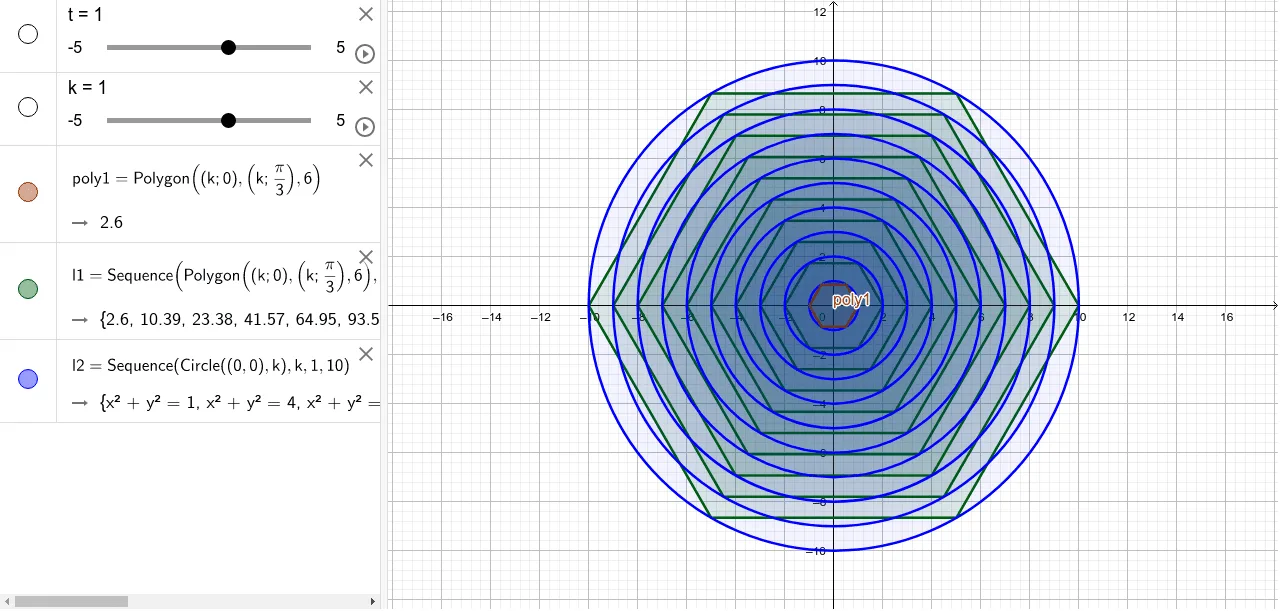
This GeoGebra applet utilizes the Polygon and Sequence commands to construct a dynamic hexagonal geometric optical illusion. By adjusting parameters, users can observe the visual illusion effects produced during the transformation of the hexagon and its internal line segments. This demonstration vividly illustrates the combination of geometric transformations and visual perception, making it ideal for classroom exploration and independent discovery.
The applet is built entirely with GeoGebra's polygon and sequence commands, which generate a recursively structured hexagonal figure whose internal lines shift and reconfigure as sliders are moved. Users can control key parameters such as side length, rotational angle, and subdivision depth, watching in real time how the hexagon and its internal pattern deform while preserving underlying geometric relationships. These interactive controls allow learners to isolate individual variables and directly connect algebraic changes to visible geometric outcomes.
The core mathematical concepts addressed include regular hexagon properties, rotational and reflective symmetry, proportional scaling, and the mathematics behind visual illusions. As the parameters vary, the applet reveals how certain arrangements of lines and angles can trick the eye into perceiving distortions that are not actually present—a direct engagement with the psychological and mathematical principles of Gestalt perception and pattern recognition. Students see first-hand that apparent curvature or misalignment often stems from systematic geometric rules rather than arbitrary design.
The interactive nature of the applet supports multiple learning objectives. Learners can test hypotheses about symmetry, predict how a parameter change will affect the figure, and then immediately verify their predictions. Teachers can use the dynamic visualization to lead discussions on the difference between perceived geometry and measured geometry, encouraging students to rely on deductive reasoning and coordinate verification rather than intuition alone.
Because the construction is parametric, the same applet can be adapted for various grade levels. Younger students benefit from the visual appeal and the opportunity to explore symmetry informally, while older students can examine the recursive structure produced by the sequence command and connect it to topics in transformations, similarity, and even introductory fractal geometry.
Overall, this hexagon optical illusion applet serves as an engaging bridge between pure geometry and perceptual psychology. It invites curiosity, rewards careful observation, and provides a hands-on environment where abstract geometric ideas become visible, manipulable, and memorable.
In collections
My First GeoGebra Interactive Book
Loading the math board and drawing, please wait…