
Volume of Solid of Revolution: Washer Method
2015-01-02 22:21
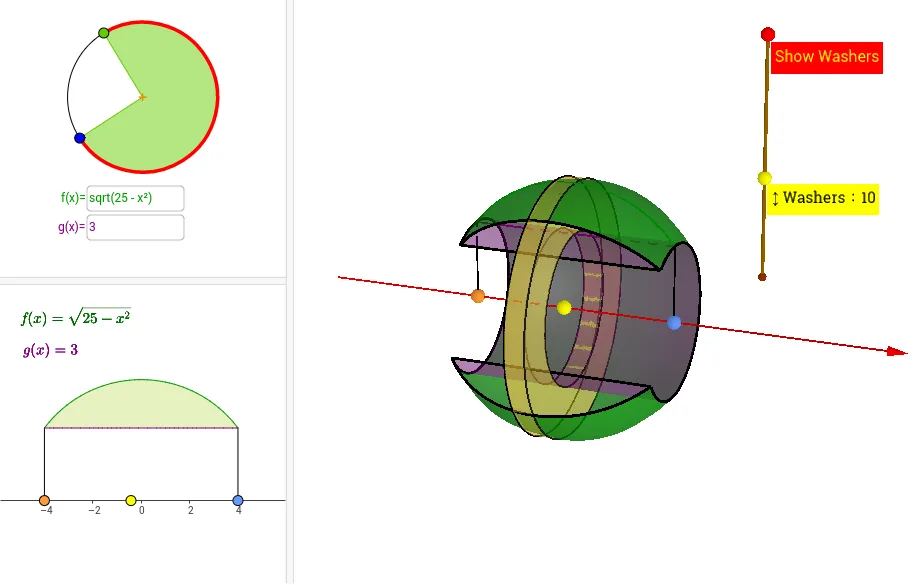
This applet demonstrates the Washer Method for calculating the volume of a hollow solid of revolution. It uses the integral formula π∫[a,b]([f(x)]²-[g(x)]²)dx to illustrate the three-dimensional solid generated by rotating the region between two curves f(x) and g(x) about an axis. The applet provides an interactive, visual approach to understanding how definite integrals apply to solid geometry. Users can adjust the functions f(x) and g(x), as well as the integration bounds a and b, to dynamically observe how the cross-sections of the solid change. Each cross-section appears as an annular washer—a disk with a hole in the center—whose outer radius is determined by f(x) and inner radius by g(x). The visualization shows how these washers stack together to form the complete solid of revolution. As parameters are modified, the displayed volume updates in real time, allowing students to see the direct relationship between the algebraic integral and the geometric solid it represents. This hands-on exploration helps learners develop intuition for when to apply the Washer Method versus other techniques, such as the Disk Method or Shell Method. By manipulating the curves and limits, students can verify their analytical calculations against the computed volume, reinforcing the connection between symbolic integration and its geometric interpretation. The applet is particularly valuable for calculus courses covering applications of definite integrals, as it transforms an abstract formula into a tangible, observable process.
In collections
微積分
Loading the math board and drawing, please wait…
<?xml version="1.0" encoding="utf-8"?>
<geogebra format="5.0" version="5.0.42.0" id="b8b968e3-bcc2-4694-9d6e-f4076e062e29" xsi:noNamespaceSchemaLocation="http://www.geogebra.org/ggb.xsd" xmlns="" xmlns:xsi="http://www.w3.org/2001/XMLSchema-instance" >
<gui>
<window width="914" height="682" />
<perspectives>
<perspective id="tmp">
<panes>
<pane location="" divider="0.31291028446389496" orientation="1" />
<pane location="0" divider="0.10940919037199125" orientation="1" />
<pane location="0,1" divider="0.40615835777126097" orientation="0" />
</panes>
<views>
<view id="1" visible="true" inframe="false" stylebar="false" location="3,1,2" size="286" window="100,100,600,400" />
<view id="16" visible="true" inframe="false" stylebar="false" location="3,1,0" size="277" window="50,50,500,500" />
<view id="4097" visible="false" inframe="true" stylebar="true" location="1,1,1" size="400" window="740,350,700,550" />
<view id="4" toolbar="0 59 || 2020 , 2021 , 2022 , 66 || 2001 , 2003 , 2002 , 2004 , 2005 || 2040 , 2041 , 2042 , 2044 , 2043" visible="false" inframe="false" stylebar="true" location="1,1" size="300" window="100,100,600,400" />
<view id="8" toolbar="1001 | 1002 | 1003 || 1005 | 1004 || 1006 | 1007 | 1010 | 1011 || 1008 1009 || 6" visible="false" inframe="false" stylebar="false" location="1,3" size="300" window="100,100,600,400" />
<view id="2" visible="false" inframe="true" stylebar="true" location="3" size="509" window="974,25,250,867" />
<view id="32" visible="false" inframe="false" stylebar="true" location="1" size="150" window="50,50,500,500" />
<view id="64" visible="false" inframe="true" stylebar="true" location="1" size="150" window="50,50,500,500" />
<view id="70" toolbar="0 || 2020 || 2021 || 2022" visible="false" inframe="true" stylebar="true" location="1" size="150" window="50,50,500,500" />
<view id="512" toolbar="0 | 1 501 5 19 , 67 , 72 | 2 15 18 , 7 | 4 3 | 16 | 551 550 11 | 69 | 510 511 | 512 513 | 533 531 , 534 532 , 537 536 , 535 | 521 520 , 522 523 | 36 , 38 49 560 | 571 30 29 570 31 33 | 17 | 540 40 41 42 , 27 28 35 , 6 | 502" visible="true" inframe="false" stylebar="false" location="1" size="608" window="67,272,800,618" />
</views>
<toolbar show="true" items="0 39 59 | 1 501 67 , 5 19 , 72 | 2 15 45 , 18 65 , 7 37 | 4 3 8 9 , 13 44 , 58 , 47 | 16 51 64 , 70 | 10 34 53 11 , 24 20 22 , 21 23 | 55 56 57 , 12 | 36 46 , 38 49 50 , 71 | 30 29 54 32 31 33 | 17 26 62 73 , 14 66 68 | 25 52 60 61 | 40 41 42 , 27 28 35 , 6 || 100001 100002" position="1" help="false" />
<input show="true" cmd="true" top="false" />
<dockBar show="true" east="true" />
</perspective>
</perspectives>
<labelingStyle val="3"/>
<font size="12"/>
<graphicsSettings javaLatexFonts="false"/>
<consProtColumns col0="true" col1="true" col2="false" col3="true" col4="false" col5="true" col6="true" col7="false"/>
<consProtocol useColors="true" addIcons="false" showOnlyBreakpoints="false"/>
</gui>
<euclidianView>
<size width="286" height="267"/>
<coordSystem xZero="141.19492066286668" yZero="215.5801630103441" scale="24.192621173738722" yscale="24.192621173738743"/>
<evSettings axes="true" grid="false" gridIsBold="false" pointCapturing="3" rightAngleStyle="1" checkboxSize="13" gridType="0"/>
<bgColor r="255" g="255" b="255"/>
<axesColor r="64" g="64" b="64"/>
<gridColor r="192" g="192" b="192"/>
<lineStyle axes="0" grid="10"/>
<axis id="0" show="true" label="" unitLabel="" tickStyle="1" showNumbers="true"/>
<axis id="1" show="false" label="" unitLabel="" tickStyle="1" showNumbers="true"/>
</euclidianView>
<euclidianView>
<viewNumber viewNo="2"/>
<size width="286" height="258"/>
<coordSystem xZero="252.3333333333335" yZero="284.00000000000006" scale="49.99999999999998" yscale="49.99999999999998"/>
<evSettings axes="false" grid="false" gridIsBold="false" pointCapturing="3" rightAngleStyle="1" checkboxSize="13" gridType="0"/>
<bgColor r="255" g="255" b="255"/>
<axesColor r="0" g="0" b="0"/>
<gridColor r="192" g="192" b="192"/>
<lineStyle axes="1" grid="10"/>
<axis id="0" show="false" label="" unitLabel="" tickStyle="1" showNumbers="true"/>
<axis id="1" show="false" label="" unitLabel="" tickStyle="1" showNumbers="true"/>
</euclidianView>
<kernel>
<uses3D val="true"/>
<continuous val="false"/>
<usePathAndRegionParameters val="true"/>
<decimals val="2"/>
<angleUnit val="degree"/>
<algebraStyle val="0"/>
<coordStyle val="0"/>
<angleFromInvTrig val="false"/>
</kernel>
<scripting blocked="false" disabled="false"/>
<euclidianView3D>
<coordSystem xZero="-1.5137151937317914" yZero="-1.2229276250028613" zZero="-0.9420575436161134" scale="26.851247158674905" xAngle="20.0" zAngle="-1868.9701723113485"/>
<evSettings axes="true" grid="false" gridIsBold="false" pointCapturing="3" rightAngleStyle="1" gridType="0"/>
<axis id="0" show="true" label="" unitLabel="" tickStyle="2" showNumbers="false"/>
<axis id="1" show="false" label="y" unitLabel="" tickStyle="2" showNumbers="false"/>
<axis id="2" show="false" label="z" unitLabel="" tickStyle="0" showNumbers="true" positiveAxis="true"/>
<plate show="false"/>
<bgColor r="255" g="255" b="255"/>
<yAxisVertical val="true"/>
<clipping use="false" show="false" size="2"/>
<projection type="1"/>
</euclidianView3D>
<construction title="" author="" date="">
<expression label ="g" exp="g(x) = 3"/>
<element type="function" label="g">
<show object="false" label="false"/>
<objColor r="128" g="0" b="128" alpha="0.0"/>
<layer val="1"/>
<labelMode val="0"/>
<animation step="0.1" speed="1" type="0" playing="false"/>
<selectionAllowed val="false"/>
<lineStyle thickness="2" type="0" typeHidden="1"/>
</element>
<command name="PointIn">
<input a0="y + 0z = 0"/>
<output a0="P1"/>
</command>
<element type="point3d" label="P1">
<show object="true" label="false"/>
<objColor r="153" g="51" b="0" alpha="0.0"/>
<layer val="2"/>
<labelMode val="0"/>
<animation step="0.1" speed="1" type="0" playing="false"/>
<coords x="5.5533402292628855" y="0.0" z="-6.0" w="1.0"/>
<pointSize val="3"/>
</element>
<command name="Point">
<input a0="Line[P1, P1 + (0, 1, 0)]"/>
<output a0="P2"/>
</command>
<element type="point3d" label="P2">
<show object="true" label="false"/>
<objColor r="255" g="0" b="0" alpha="0.0"/>
<layer val="2"/>
<labelMode val="0"/>
<animation step="0.1" speed="1" type="0" playing="false"/>
<ggbscript val="SetValue[showWashers, !showWashers]"/>
<coords x="5.5533402292628855" y="9.775360496031597" z="-6.0" w="1.0"/>
<pointSize val="5"/>
</element>
<command name="Segment">
<input a0="P1" a1="P2"/>
<output a0="pole"/>
</command>
<element type="segment3d" label="pole">
<show object="true" label="false"/>
<objColor r="153" g="102" b="0" alpha="0.0"/>
<layer val="2"/>
<labelMode val="0"/>
<selectionAllowed val="false"/>
<lineStyle thickness="4" type="0" typeHidden="1"/>
<outlyingIntersections val="false"/>
<keepTypeOnTransform val="true"/>
</element>
<command name="Point">
<input a0="pole"/>
<output a0="P32"/>
</command>
<element type="point3d" label="P32">
<show object="false" label="true"/>
<objColor r="125" g="125" b="255" alpha="0.0"/>
<layer val="3"/>
<labelMode val="0"/>
<animation step="0.1" speed="1" type="0" playing="false"/>
<coords x="5.5533402292628855" y="2.6201206197876834" z="-6.0" w="1.0"/>
<pointSize val="3"/>
</element>
<command name="Point">
<input a0="pole"/>
<output a0="P3"/>
</command>
<element type="point3d" label="P3">
<show object="false" label="true"/>
<objColor r="125" g="125" b="255" alpha="0.0"/>
<layer val="2"/>
<labelMode val="0"/>
<animation step="0.1" speed="1" type="0" playing="false"/>
<coords x="5.5533402292628855" y="7.161252666036927" z="-6.0" w="1.0"/>
<pointSize val="3"/>
</element>
<expression label ="f" exp="f(x) = sqrt(25 - x^(2))"/>
<element type="function" label="f">
<show object="false" label="false"/>
<objColor r="0" g="153" b="0" alpha="0.0"/>
<layer val="0"/>
<labelMode val="0"/>
<animation step="0.1" speed="1" type="0" playing="false"/>
<selectionAllowed val="false"/>
<lineStyle thickness="2" type="0" typeHidden="1"/>
</element>
<element type="numeric" label="n">
<value val="10.0"/>
<show object="false" label="true" ev="3"/>
<objColor r="0" g="0" b="255" alpha="0.1"/>
<layer val="0"/>
<labelOffset x="3" y="33"/>
<labelMode val="2"/>
<slider min="1" max="30" absoluteScreenLocation="true" width="100.0" x="53.0" y="283.0" fixed="false" horizontal="true"/>
<lineStyle thickness="2" type="0" typeHidden="1"/>
<animation step="1" speed="1" type="0" playing="false"/>
</element>
<element type="numeric" label="b">
<value val="4.0"/>
<show object="false" label="true"/>
<objColor r="0" g="0" b="0" alpha="0.1"/>
<layer val="0"/>
<labelMode val="1"/>
<animation step="1" speed="1" type="0" playing="false"/>
</element>
<element type="numeric" label="a">
<value val="-4.0"/>
<show object="false" label="true"/>
<objColor r="0" g="0" b="0" alpha="0.1"/>
<layer val="0"/>
<labelMode val="1"/>
<animation step="1" speed="1" type="0" playing="false"/>
</element>
<command name="Min">
<input a0="a" a1="b"/>
<output a0="x1"/>
</command>
<element type="numeric" label="x1">
<value val="-4.0"/>
<objColor r="0" g="0" b="0" alpha="0.1"/>
</element>
<command name="Max">
<input a0="a" a1="b"/>
<output a0="x2"/>
</command>
<element type="numeric" label="x2">
<value val="4.0"/>
<objColor r="0" g="0" b="0" alpha="0.1"/>
</element>
<expression label="dx" exp="(x2 - x1) / n" />
<element type="numeric" label="dx">
<value val="0.8"/>
<objColor r="0" g="0" b="0" alpha="0.1"/>
</element>
<command name="Point">
<input a0="Segment[(a, 0, 0), (b, 0, 0)]"/>
<output a0="P"/>
</command>
<element type="point3d" label="P">
<show object="true" label="false"/>
<objColor r="255" g="255" b="0" alpha="0.0"/>
<layer val="0"/>
<labelMode val="0"/>
<animation step="0.1" speed="1" type="0" playing="false"/>
<coords x="-0.42215541425530567" y="0.0" z="0.0" w="1.0"/>
<pointSize val="5"/>
</element>
<expression label="k" exp="ceil(((x(P) - a) / (b - a) * n))" />
<element type="numeric" label="k">
<value val="5.0"/>
<objColor r="0" g="0" b="0" alpha="0.1"/>
</element>
<expression label="xk" exp="a + ((k - 1 / 2) * dx)" />
<element type="numeric" label="xk">
<value val="-0.3999999999999999"/>
<objColor r="0" g="0" b="0" alpha="0.1"/>
</element>
<element type="point" label="C">
<show object="true" label="false" ev="3"/>
<objColor r="255" g="127" b="0" alpha="0.0"/>
<layer val="0"/>
<labelMode val="0"/>
<animation step="0.1" speed="1" type="1" playing="false"/>
<coords x="-2.1954" y="3.7364" z="1.0"/>
<pointSize val="3"/>
<pointStyle val="3"/>
</element>
<command name="Circle">
<input a0="C" a1="1.5"/>
<output a0="thetaCircle"/>
</command>
<element type="conic" label="thetaCircle">
<show object="true" label="false" ev="3"/>
<objColor r="0" g="0" b="0" alpha="0.0"/>
<layer val="0"/>
<labelMode val="0"/>
<selectionAllowed val="false"/>
<lineStyle thickness="2" type="0" typeHidden="1"/>
<eigenvectors x0="1.0" y0="0.0" z0="1.0" x1="-0.0" y1="1.0" z1="1.0"/>
<matrix A0="1.0" A1="1.0" A2="16.53046612" A3="0.0" A4="2.1954" A5="-3.7364"/>
<eqnStyle style="specific"/>
</element>
<command name="Point">
<input a0="thetaCircle"/>
<output a0="D"/>
</command>
<element type="point" label="D">
<show object="true" label="false" ev="3"/>
<objColor r="102" g="204" b="0" alpha="0.0"/>
<layer val="2"/>
<labelMode val="0"/>
<animation step="0.1" speed="1" type="1" playing="false"/>
<coords x="-2.9713544081267065" y="5.020103531392172" z="1.0"/>
<pointSize val="5"/>
<pointStyle val="0"/>
</element>
<command name="Point">
<input a0="thetaCircle"/>
<output a0="E"/>
</command>
<element type="point" label="E">
<show object="true" label="false" ev="3"/>
<objColor r="0" g="0" b="255" alpha="0.0"/>
<layer val="2"/>
<labelMode val="0"/>
<animation step="0.1" speed="1" type="1" playing="false"/>
<coords x="-3.4526092988993273" y="2.9182161705575806" z="1.0"/>
<pointSize val="5"/>
<pointStyle val="0"/>
</element>
<command name="Angle">
<input a0="E" a1="C" a2="D"/>
<output a0="γ"/>
</command>
<element type="angle" label="γ">
<angleStyle val="0"/>
<value val="4.679152473179621"/>
<show object="false" label="false" ev="3"/>
<objColor r="0" g="100" b="0" alpha="0.1"/>
<layer val="0"/>
<labelOffset x="-28" y="9"/>
<labelMode val="1"/>
<lineStyle thickness="2" type="0" typeHidden="2"/>
<arcSize val="30"/>
</element>
<expression label="θ1" exp="Angle[Vector[C, E]] - π / 2" />
<element type="numeric" label="θ1">
<value val="2.147729271812357"/>
<objColor r="0" g="0" b="0" alpha="0.1"/>
</element>
<command name="Washer">
<input a0="(xk - dx / 2, 0, 0)" a1="(xk + dx / 2, 0, 0)" a2="g(xk)" a3="f(xk)"/>
<output a0="washerC4" a1="washerC1" a2="washerC3" a3="washerC2" a4="poly1" a5="poly2" a6="washerSide1" a7="washerSide2"/>
</command>
<element type="conic3d" label="washerC4">
<show object="true" label="false"/>
<objColor r="0" g="0" b="0" alpha="0.0"/>
<layer val="0"/>
<labelMode val="0"/>
<selectionAllowed val="false"/>
<lineStyle thickness="2" type="0" typeHidden="2"/>
<eigenvectors x0="1.0" y0="0.0" z0="1.0" x1="-0.0" y1="1.0" z1="1.0"/>
<matrix A0="1.0" A1="1.0" A2="-24.840000000000003" A3="0.0" A4="0.0" A5="0.0"/>
<eqnStyle style="implicit"/>
<lineStyle thickness="2" type="0" typeHidden="2"/>
</element>
<element type="conic3d" label="washerC1">
<show object="true" label="false"/>
<objColor r="32" g="32" b="32" alpha="0.0"/>
<layer val="2"/>
<labelMode val="0"/>
<selectionAllowed val="false"/>
<lineStyle thickness="2" type="0" typeHidden="2"/>
<eigenvectors x0="1.0" y0="0.0" z0="1.0" x1="-0.0" y1="1.0" z1="1.0"/>
<matrix A0="1.0" A1="1.0" A2="-24.840000000000003" A3="0.0" A4="0.0" A5="0.0"/>
<eqnStyle style="implicit"/>
<lineStyle thickness="2" type="0" typeHidden="2"/>
</element>
<element type="conic3d" label="washerC3">
<show object="true" label="false"/>
<objColor r="32" g="32" b="32" alpha="0.0"/>
<layer val="2"/>
<labelMode val="0"/>
<selectionAllowed val="false"/>
<lineStyle thickness="2" type="0" typeHidden="2"/>
<eigenvectors x0="1.0" y0="0.0" z0="1.0" x1="-0.0" y1="1.0" z1="1.0"/>
<matrix A0="1.0" A1="1.0" A2="-9.0" A3="0.0" A4="0.0" A5="0.0"/>
<eqnStyle style="implicit"/>
<lineStyle thickness="2" type="0" typeHidden="2"/>
</element>
<element type="conic3d" label="washerC2">
<show object="true" label="false"/>
<objColor r="32" g="32" b="32" alpha="0.0"/>
<layer val="2"/>
<labelMode val="0"/>
<selectionAllowed val="false"/>
<lineStyle thickness="2" type="0" typeHidden="2"/>
<eigenvectors x0="1.0" y0="0.0" z0="1.0" x1="-0.0" y1="1.0" z1="1.0"/>
<matrix A0="1.0" A1="1.0" A2="-9.0" A3="0.0" A4="0.0" A5="0.0"/>
<eqnStyle style="implicit"/>
<lineStyle thickness="2" type="0" typeHidden="2"/>
</element>
<element type="polygon3d" label="poly1">
<lineStyle thickness="0" type="0" typeHidden="1" opacity="0"/>
<show object="true" label="false"/>
<objColor r="255" g="204" b="51" alpha="0.5"/>
<layer val="2"/>
<labelMode val="0"/>
<selectionAllowed val="false"/>
</element>
<element type="polygon3d" label="poly2">
<lineStyle thickness="0" type="0" typeHidden="1" opacity="0"/>
<show object="true" label="false"/>
<objColor r="255" g="204" b="51" alpha="0.5"/>
<layer val="2"/>
<labelMode val="0"/>
<selectionAllowed val="false"/>
</element>
<element type="quadricpart" label="washerSide1">
<show object="true" label="false"/>
<objColor r="255" g="204" b="51" alpha="0.5"/>
<layer val="3"/>
<labelMode val="0"/>
<selectionAllowed val="false"/>
</element>
<element type="quadricpart" label="washerSide2">
<show object="true" label="false"/>
<objColor r="255" g="204" b="51" alpha="0.5"/>
<layer val="3"/>
<labelMode val="0"/>
<selectionAllowed val="false"/>
</element>
<command name="Circle">
<input a0="(b, 0, 0)" a1="f(b)" a2="xAxis"/>
<output a0="c"/>
</command>
<element type="conic3d" label="c">
<show object="false" label="false"/>
<objColor r="102" g="153" b="0" alpha="0.5"/>
<layer val="0"/>
<labelMode val="0"/>
<selectionAllowed val="false"/>
<lineStyle thickness="1" type="0" typeHidden="2"/>
<eigenvectors x0="1.0" y0="0.0" z0="1.0" x1="-0.0" y1="1.0" z1="1.0"/>
<matrix A0="1.0" A1="1.0" A2="-9.0" A3="0.0" A4="-0.0" A5="-0.0"/>
<eqnStyle style="implicit"/>
<lineStyle thickness="1" type="0" typeHidden="2"/>
</element>
<expression label="θ2" exp="θ1 + γ" />
<element type="numeric" label="θ2">
<value val="6.826881744991978"/>
<objColor r="0" g="0" b="0" alpha="0.1"/>
</element>
<command name="Surface">
<input a0="t" a1="(f(t) * cos(s))" a2="(f(t) * sin(s))" a3="t" a4="a" a5="b" a6="s" a7="θ1" a8="θ2"/>
<output a0="surfaceF"/>
</command>
<element type="surfacecartesian3d" label="surfaceF">
<show object="true" label="false" ev="2"/>
<objColor r="0" g="153" b="0" alpha="0.75"/>
<layer val="0"/>
<labelMode val="0"/>
<selectionAllowed val="false"/>
<levelOfDetail val="9"/>
</element>
<command name="Textfield">
<input a0="f"/>
<output a0="inputBox1"/>
</command>
<element type="textfield" label="inputBox1">
<show object="true" label="true" ev="3"/>
<objColor r="0" g="153" b="0" alpha="1.0"/>
<layer val="0"/>
<labelOffset x="61" y="186"/>
<labelMode val="0"/>
<animation step="1" speed="1" type="0" playing="false"/>
<auxiliary val="true"/>
<linkedGeo exp="f"/>
<length val="10"/>
<caption val="f(x)="/>
</element>
<command name="CurveCartesian">
<input a0="t" a1="(f(t) * cos(θ1))" a2="(f(t) * sin(θ1))" a3="t" a4="x1" a5="x2"/>
<output a0="fCurveT1"/>
</command>
<element type="curvecartesian3d" label="fCurveT1">
<show object="true" label="false"/>
<objColor r="0" g="0" b="0" alpha="0.0"/>
<layer val="0"/>
<labelMode val="0"/>
<selectionAllowed val="false"/>
<lineStyle thickness="3" type="0" typeHidden="2"/>
</element>
<command name="CurveCartesian">
<input a0="t" a1="(f(t) * cos(θ2))" a2="(f(t) * sin(θ2))" a3="t" a4="x1" a5="x2"/>
<output a0="fCurveT2"/>
</command>
<element type="curvecartesian3d" label="fCurveT2">
<show object="true" label="false"/>
<objColor r="0" g="0" b="0" alpha="0.0"/>
<layer val="0"/>
<labelMode val="0"/>
<selectionAllowed val="false"/>
<lineStyle thickness="3" type="0" typeHidden="2"/>
</element>
<command name="CurveCartesian">
<input a0="x2" a1="(f(x2) * cos(t))" a2="(f(x2) * sin(t))" a3="t" a4="θ1" a5="θ2"/>
<output a0="fCurveB"/>
</command>
<element type="curvecartesian3d" label="fCurveB">
<show object="true" label="false"/>
<objColor r="0" g="0" b="0" alpha="0.0"/>
<layer val="0"/>
<labelMode val="0"/>
<selectionAllowed val="false"/>
<lineStyle thickness="3" type="0" typeHidden="2"/>
</element>
<command name="CurveCartesian">
<input a0="x1" a1="(f(x1) * cos(t))" a2="(f(x1) * sin(t))" a3="t" a4="θ1" a5="θ2"/>
<output a0="fCurveA"/>
</command>
<element type="curvecartesian3d" label="fCurveA">
<show object="true" label="false"/>
<objColor r="0" g="0" b="0" alpha="0.0"/>
<layer val="0"/>
<labelMode val="0"/>
<selectionAllowed val="false"/>
<lineStyle thickness="3" type="0" typeHidden="2"/>
</element>
<command name="Sequence">
<input a0="Cylinder[(x1 + ((k - 1) * dx), 0, 0), (x1 + (k * dx), 0, 0), abs(f(x1 + ((k - 1 / 2) * dx)))]" a1="k" a2="1" a3="n"/>
<output a0="list1"/>
</command>
<element type="list" label="list1">
<show object="false" label="false"/>
<objColor r="125" g="125" b="255" alpha="0.25"/>
<layer val="0"/>
<labelMode val="0"/>
<selectionAllowed val="false"/>
<lineStyle thickness="1" type="0" typeHidden="1"/>
<pointSize val="3"/>
<pointStyle val="-1"/>
</element>
<element type="boolean" label="showWashers">
<value val="false"/>
<show object="false" label="true" ev="3"/>
<objColor r="255" g="0" b="0" alpha="0.0"/>
<layer val="0"/>
<labelOffset x="55" y="228"/>
<labelMode val="0"/>
<caption val="顯示圓盤切片"/>
</element>
<command name="Sequence">
<input a0="Circle[xAxis, (a + (k * dx), f(a + ((k - 1 / 2) * dx)), 0)]" a1="k" a2="1" a3="n"/>
<output a0="cs"/>
</command>
<element type="list" label="cs">
<show object="true" label="false"/>
<condition showObject="showWashers"/>
<objColor r="0" g="0" b="0" alpha="0.0"/>
<layer val="0"/>
<labelMode val="0"/>
<selectionAllowed val="false"/>
<lineStyle thickness="1" type="0" typeHidden="1"/>
<pointSize val="3"/>
<pointStyle val="-1"/>
</element>
<command name="Sequence">
<input a0="Circle[xAxis, (a + (k * dx), f(a + ((k + 1 / 2) * dx)), 0)]" a1="k" a2="0" a3="n - 1"/>
<output a0="cs2"/>
</command>
<element type="list" label="cs2">
<show object="true" label="false"/>
<condition showObject="showWashers"/>
<objColor r="0" g="0" b="0" alpha="0.0"/>
<layer val="0"/>
<labelMode val="0"/>
<selectionAllowed val="false"/>
<lineStyle thickness="1" type="0" typeHidden="1"/>
<pointSize val="3"/>
<pointStyle val="-1"/>
</element>
<command name="Point">
<input a0="xAxis"/>
<output a0="A"/>
</command>
<element type="point" label="A">
<show object="true" label="false"/>
<objColor r="255" g="153" b="51" alpha="0.0"/>
<layer val="1"/>
<labelMode val="0"/>
<animation step="0.1" speed="1" type="1" playing="false"/>
<ggbscript onUpdate="SetValue[a, x(A)]"/>
<coords x="-4.0" y="0.0" z="1.0"/>
<coordStyle style="cartesian3d"/>
<pointSize val="5"/>
<pointStyle val="0"/>
</element>
<command name="Point">
<input a0="xAxis"/>
<output a0="B"/>
</command>
<element type="point" label="B">
<show object="true" label="false"/>
<objColor r="102" g="153" b="255" alpha="0.0"/>
<layer val="1"/>
<labelMode val="0"/>
<animation step="0.1" speed="1" type="1" playing="false"/>
<ggbscript onUpdate="SetValue[b, x(B)]"/>
<coords x="4.0" y="0.0" z="1.0"/>
<coordStyle style="cartesian3d"/>
<pointSize val="5"/>
<pointStyle val="0"/>
</element>
<command name="CircleSector">
<input a0="C" a1="E" a2="D"/>
<output a0="thetaSector"/>
</command>
<element type="conicpart" label="thetaSector">
<show object="true" label="false" ev="3"/>
<objColor r="102" g="204" b="0" alpha="0.5"/>
<layer val="0"/>
<labelMode val="0"/>
<selectionAllowed val="false"/>
<lineStyle thickness="2" type="0" typeHidden="1"/>
<eigenvectors x0="1.0" y0="0.0" z0="1.0" x1="-0.0" y1="1.0" z1="1.0"/>
<matrix A0="1.0" A1="1.0" A2="16.53046612" A3="0.0" A4="2.1954" A5="-3.7364"/>
<eqnStyle style="implicit"/>
<outlyingIntersections val="false"/>
<keepTypeOnTransform val="true"/>
</element>
<expression label="txtShowDisks" exp=""Show Washers""/>
<element type="text" label="txtShowDisks">
<show object="true" label="false"/>
<objColor r="255" g="255" b="0" alpha="0.0"/>
<bgColor r="255" g="0" b="0" alpha="255"/>
<layer val="2"/>
<labelMode val="0"/>
<font serif="false" sizeM="1.4" size="5" style="0"/>
<startPoint exp="P2"/>
<labelOffset x="7" y="27"/>
<ggbscript val="RunClickScript[P2]"/>
</element>
<element type="numeric" label="maxDisks">
<value val="30.0"/>
<show object="false" label="true"/>
<objColor r="0" g="0" b="0" alpha="0.1"/>
<layer val="2"/>
<labelMode val="1"/>
<animation step="0.1" speed="1" type="0" playing="false"/>
</element>
<command name="Point">
<input a0="Segment[P32, P3]"/>
<output a0="P4"/>
</command>
<element type="point3d" label="P4">
<show object="true" label="false"/>
<objColor r="255" g="255" b="0" alpha="0.0"/>
<layer val="2"/>
<labelMode val="0"/>
<animation step="1" speed="1" type="0" playing="false"/>
<coords x="5.5533402292628855" y="4.06986602937292" z="-6.0" w="1.0"/>
<pointSize val="5"/>
</element>
<expression label="txtIntegral" exp=""V=\pi\int_{a}^{b}{ [f(x)]^2}dx""/>
<element type="text" label="txtIntegral">
<show object="false" label="false" ev="2"/>
<objColor r="0" g="0" b="0" alpha="0.0"/>
<bgColor r="255" g="255" b="153" alpha="255"/>
<layer val="2"/>
<labelMode val="0"/>
<selectionAllowed val="false"/>
<isLaTeX val="true"/>
<font serif="true" sizeM="1.4" size="5" style="0"/>
<startPoint x="-1.3753999999999995" y="2.0363999999999987" z="1.0"/>
</element>
<command name="Segment">
<input a0="A" a1="(x(A), f(x(A)))"/>
<output a0="segA"/>
</command>
<element type="segment" label="segA">
<show object="true" label="false"/>
<objColor r="0" g="0" b="0" alpha="0.0"/>
<layer val="0"/>
<labelMode val="0"/>
<selectionAllowed val="false"/>
<coords x="-3.0" y="0.0" z="-12.0"/>
<lineStyle thickness="2" type="0" typeHidden="1"/>
<outlyingIntersections val="false"/>
<keepTypeOnTransform val="true"/>
</element>
<command name="Segment">
<input a0="B" a1="(x(B), f(x(B)))"/>
<output a0="segB"/>
</command>
<element type="segment" label="segB">
<show object="true" label="false"/>
<objColor r="0" g="0" b="0" alpha="0.0"/>
<layer val="0"/>
<labelMode val="0"/>
<selectionAllowed val="false"/>
<coords x="-3.0" y="0.0" z="12.0"/>
<lineStyle thickness="2" type="0" typeHidden="1"/>
<outlyingIntersections val="false"/>
<keepTypeOnTransform val="true"/>
</element>
<expression label="text1" exp=""f(x)=" + (LaTeX[f]) + """ />
<element type="text" label="text1">
<show object="true" label="false"/>
<objColor r="0" g="100" b="0" alpha="0.0"/>
<layer val="2"/>
<labelMode val="0"/>
<selectionAllowed val="false"/>
<isLaTeX val="true"/>
<font serif="true" sizeM="1.0" size="0" style="0"/>
<absoluteScreenLocation x="17" y="19"/>
</element>
<command name="CurveCartesian">
<input a0="t" a1="(g(t) * cos(θ1))" a2="(g(t) * sin(θ1))" a3="t" a4="x1" a5="x2"/>
<output a0="gCurveT1"/>
</command>
<element type="curvecartesian3d" label="gCurveT1">
<show object="true" label="false"/>
<objColor r="0" g="0" b="0" alpha="0.0"/>
<layer val="2"/>
<labelMode val="0"/>
<selectionAllowed val="false"/>
<lineStyle thickness="3" type="0" typeHidden="2"/>
</element>
<command name="CircleArc">
<input a0="C" a1="E" a2="D"/>
<output a0="thetaArc"/>
</command>
<element type="conicpart" label="thetaArc">
<show object="true" label="false" ev="3"/>
<objColor r="255" g="0" b="0" alpha="0.0"/>
<layer val="1"/>
<labelMode val="0"/>
<selectionAllowed val="false"/>
<lineStyle thickness="7" type="0" typeHidden="1"/>
<eigenvectors x0="1.0" y0="0.0" z0="1.0" x1="-0.0" y1="1.0" z1="1.0"/>
<matrix A0="1.0" A1="1.0" A2="16.53046612" A3="0.0" A4="2.1954" A5="-3.7364"/>
<eqnStyle style="implicit"/>
<outlyingIntersections val="false"/>
<keepTypeOnTransform val="true"/>
</element>
<command name="CurveCartesian">
<input a0="t" a1="(g(t) * cos(θ2))" a2="(g(t) * sin(θ2))" a3="t" a4="x1" a5="x2"/>
<output a0="gCurveT2"/>
</command>
<element type="curvecartesian3d" label="gCurveT2">
<show object="true" label="false"/>
<objColor r="0" g="0" b="0" alpha="0.0"/>
<layer val="2"/>
<labelMode val="0"/>
<selectionAllowed val="false"/>
<lineStyle thickness="3" type="0" typeHidden="2"/>
</element>
<command name="Surface">
<input a0="t" a1="(g(t) * cos(s))" a2="(g(t) * sin(s))" a3="t" a4="a" a5="b" a6="s" a7="θ1" a8="θ2"/>
<output a0="surfaceG"/>
</command>
<element type="surfacecartesian3d" label="surfaceG">
<show object="true" label="false"/>
<objColor r="128" g="0" b="128" alpha="0.5"/>
<layer val="2"/>
<labelMode val="0"/>
<selectionAllowed val="false"/>
<levelOfDetail val="5"/>
</element>
<command name="Sequence">
<input a0="QuadricSide[Cylinder[(x1 + ((k - 1) * dx), 0, 0), (x1 + (k * dx), 0, 0), f(x1 + ((k - 1 / 2) * dx))]]" a1="k" a2="1" a3="n"/>
<output a0="sidesF"/>
</command>
<element type="list" label="sidesF">
<show object="true" label="false"/>
<condition showObject="showWashers"/>
<objColor r="102" g="153" b="255" alpha="0.5"/>
<layer val="2"/>
<labelMode val="0"/>
<selectionAllowed val="false"/>
<lineStyle thickness="2" type="0" typeHidden="1"/>
<pointSize val="3"/>
<pointStyle val="-1"/>
</element>
<command name="Sequence">
<input a0="Ring[(x1 + ((k - 1) * dx), 0, 0), (x1 + (k * dx), 0, 0), g(x1 + ((k - 1 / 2) * dx)), f(x1 + ((k - 1 / 2) * dx))]" a1="k" a2="1" a3="n"/>
<output a0="ringsL"/>
</command>
<element type="list" label="ringsL">
<show object="true" label="false"/>
<condition showObject="showWashers"/>
<objColor r="102" g="153" b="255" alpha="0.5"/>
<layer val="2"/>
<labelMode val="0"/>
<selectionAllowed val="false"/>
<lineStyle thickness="1" type="0" typeHidden="1"/>
<pointSize val="3"/>
<pointStyle val="-1"/>
</element>
<expression label="f2" exp="f2(x) = If[x1 ≤ x ≤ x2,f]" />
<element type="function" label="f2">
<show object="true" label="false"/>
<objColor r="0" g="153" b="0" alpha="0.0"/>
<layer val="3"/>
<labelMode val="0"/>
<selectionAllowed val="false"/>
<lineStyle thickness="2" type="0" typeHidden="1"/>
</element>
<expression label="g2" exp="g2(x) = If[x1 ≤ x ≤ x2,g]" />
<element type="function" label="g2">
<show object="true" label="false"/>
<objColor r="128" g="0" b="128" alpha="0.0"/>
<layer val="3"/>
<labelMode val="0"/>
<selectionAllowed val="false"/>
<lineStyle thickness="2" type="0" typeHidden="1"/>
</element>
<expression label="text2" exp=""g(x)=" + (LaTeX[g]) + """ />
<element type="text" label="text2">
<show object="true" label="false"/>
<objColor r="128" g="0" b="128" alpha="0.0"/>
<layer val="3"/>
<labelMode val="0"/>
<selectionAllowed val="false"/>
<isLaTeX val="true"/>
<font serif="true" sizeM="1.0" size="0" style="0"/>
<absoluteScreenLocation x="20" y="55"/>
</element>
<command name="Textfield">
<input a0="g"/>
<output a0="inputBox2"/>
</command>
<element type="textfield" label="inputBox2">
<show object="true" label="true" ev="3"/>
<objColor r="128" g="0" b="128" alpha="1.0"/>
<layer val="3"/>
<labelOffset x="58" y="215"/>
<labelMode val="0"/>
<animation step="1" speed="1" type="0" playing="false"/>
<auxiliary val="true"/>
<linkedGeo exp="g"/>
<length val="10"/>
<caption val="g(x)="/>
</element>
<expression label="n2" exp="ceil((y(P4 - P32) / y(P3 - P32) * maxDisks))" />
<element type="numeric" label="n2">
<value val="10.0"/>
<objColor r="0" g="0" b="0" alpha="0.1"/>
<ggbscript onUpdate="SetValue[n, Max[n2, 1]]"/>
</element>
<expression label="txtNumDisks" exp=""↕ Washers:" + n + """ />
<element type="text" label="txtNumDisks">
<show object="true" label="false"/>
<objColor r="0" g="0" b="0" alpha="0.0"/>
<bgColor r="255" g="255" b="0" alpha="255"/>
<layer val="2"/>
<labelMode val="0"/>
<font serif="true" sizeM="1.4" size="5" style="0"/>
<startPoint exp="P4"/>
<labelOffset x="7" y="26"/>
</element>
<command name="IntegralBetween">
<input a0="f" a1="g" a2="x1" a3="x2" a4="false"/>
<output a0="d"/>
</command>
<element type="numeric" label="d">
<value val="0.0"/>
<show object="true" label="false"/>
<objColor r="153" g="204" b="0" alpha="0.25"/>
<layer val="0"/>
<labelMode val="1"/>
<lineStyle thickness="0" type="0" typeHidden="1"/>
<selectionAllowed val="false"/>
</element>
</construction>
</geogebra>