
Triangle Angle Bisectors, Tangent Function, and Definite Integrals
2013-03-11 03:31
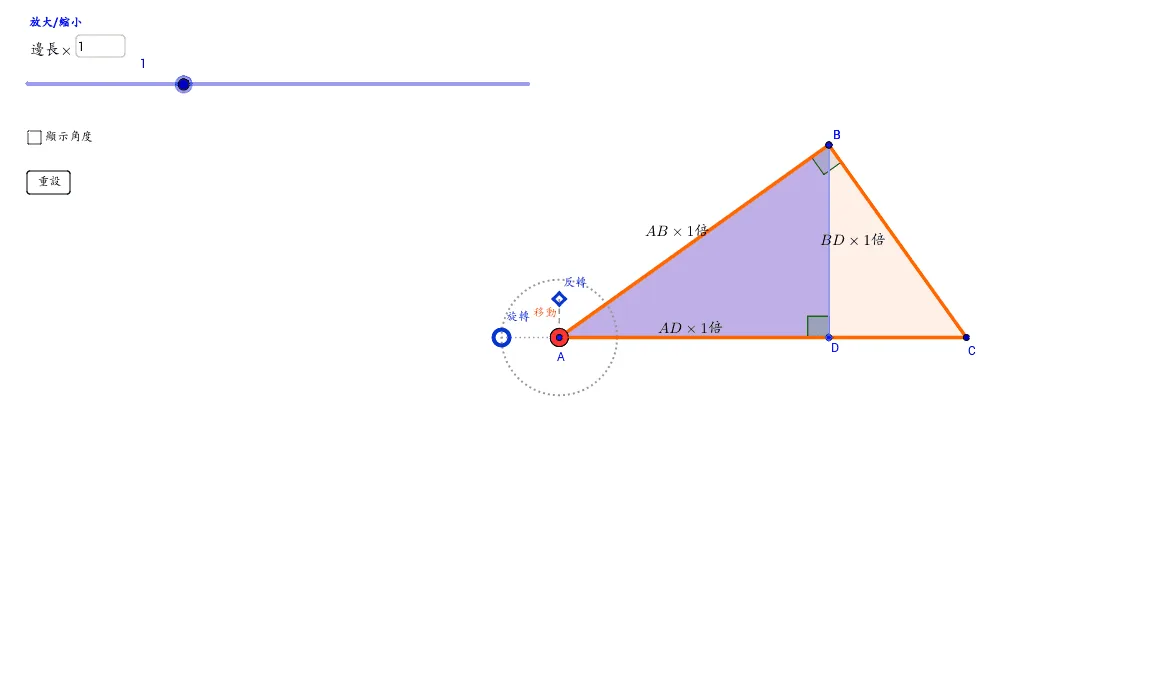
This applet demonstrates the integration of triangle geometry with calculus concepts, specifically the tangent function and definite integrals. The construction begins with creating a polygon representing a triangle, where angle bisectors are drawn from each vertex to divide the internal angles into equal parts. Key geometric points such as midpoints are constructed on each side of the triangle, and rotational transformations are applied to reveal symmetry properties and relationships between different parts of the figure. Students can dynamically manipulate the vertices of the triangle to observe how the angle bisectors, midpoints, and constructed polygons respond to changes in shape and size.
The applet then introduces the tangent function, plotting its graph on a coordinate plane. The characteristic behavior of the tangent function is illustrated through its periodicity, asymptotes, and rate of change. By overlaying the tangent curve with the triangle construction or using it in conjunction with measured lengths from the geometric figure, the applet helps students connect trigonometric ratios with the sides and angles of triangles, reinforcing the relationship between trigonometry and geometry.
Following the geometric exploration, the applet transitions to definite integrals. Using the tangent function as an example, the region under the curve is shaded to represent the area computed by the definite integral. Students can observe how the integral accumulates the area as the upper limit of integration changes, with numerical values updating in real time. This provides an intuitive understanding of the fundamental theorem of calculus, linking the abstract notion of an integral to the concrete concept of area.
Additionally, the applet demonstrates the application of definite integrals in calculating the volume of a solid of revolution. By rotating the area under the tangent curve around the x-axis or another axis, the resulting three-dimensional solid is generated. The volume formula based on the disk method is shown, and the integral computation produces the exact volume value. This allows students to see how single-variable calculus serves practical purposes beyond area calculation.
The comprehensive nature of this applet makes it valuable for mathematics instruction at the intersection of geometry and calculus. It helps learners bridge the gap between elementary topics such as angle bisectors and polygon constructions with advanced subjects like trigonometric functions and integral calculus. By combining dynamic geometry with functional analysis, the demonstration encourages deeper conceptual understanding and supports inquiry-based learning where students can explore, hypothesize, and verify mathematical relationships visually and computationally.
Loading the math board and drawing, please wait…
<?xml version="1.0" encoding="utf-8"?>
<geogebra format="4.0" id="bcbef449-8fa1-47d3-8106-54273c3be580" xsi:noNamespaceSchemaLocation="http://www.geogebra.org/ggb.xsd" xmlns="" xmlns:xsi="http://www.w3.org/2001/XMLSchema-instance" >
<gui>
<window width="1074" height="727" />
<perspectives>
<perspective id="tmp">
<panes>
<pane location="" divider="0.22439478584729983" orientation="1" />
</panes>
<views>
<view id="4" toolbar="0 || 2020 , 2021 , 2022 , 66 || 2001 , 2003 , 2002 , 2004 , 2005 || 2040 , 2041 , 2042 , 2044 , 2043" visible="false" inframe="false" stylebar="false" location="1,1" size="300" window="100,100,600,400" />
<view id="1" visible="true" inframe="false" stylebar="true" location="1" size="1058" window="100,100,600,400" />
<view id="2" visible="false" inframe="false" stylebar="false" location="3" size="241" window="12,160,250,400" />
<view id="16" visible="false" inframe="true" stylebar="false" location="1" size="150" window="50,50,500,500" />
<view id="32" visible="false" inframe="true" stylebar="true" location="1" size="150" window="50,50,500,500" />
<view id="64" visible="false" inframe="true" stylebar="false" location="1" size="150" window="50,50,500,500" />
</views>
<toolbar show="true" items="0 39 59 || 1 501 67 , 5 19 , 72 | 2 15 45 , 18 65 , 7 37 | 4 3 8 9 , 13 44 , 58 , 47 || 16 51 64 , 70 | 10 34 53 11 , 24 20 22 , 21 23 | 55 56 57 , 12 || 36 46 , 38 49 50 , 71 | 30 29 54 32 31 33 | 17 26 62 , 14 66 68 | 25 52 60 61 || 40 41 42 , 27 28 35 , 6" />
<input show="true" cmd="true" top="false" />
</perspective>
</perspectives>
<labelingStyle val="3"/>
<font size="12"/>
<graphicsSettings javaLatexFonts="false"/>
<consProtColumns col0="true" col1="true" col2="false" col3="true" col4="false" col5="true" col6="true" col7="false"/>
<consProtocol useColors="true" addIcons="false" showOnlyBreakpoints="false"/>
</gui>
<euclidianView>
<size width="1058" height="561"/>
<coordSystem xZero="559.3011713644848" yZero="337.4969206917202" scale="19.254614750815907" yscale="19.254614750815726"/>
<evSettings axes="false" grid="false" gridIsBold="false" pointCapturing="1" rightAngleStyle="1" checkboxSize="13" gridType="0"/>
<bgColor r="255" g="255" b="255"/>
<axesColor r="0" g="0" b="0"/>
<gridColor r="192" g="192" b="192"/>
<lineStyle axes="1" grid="10"/>
<axis id="0" show="false" label="" unitLabel="" tickStyle="1" showNumbers="true"/>
<axis id="1" show="false" label="" unitLabel="" tickStyle="1" showNumbers="true"/>
</euclidianView>
<kernel>
<continuous val="false"/>
<decimals val="2"/>
<angleUnit val="degree"/>
<algebraStyle val="0"/>
<coordStyle val="0"/>
<angleFromInvTrig val="false"/>
</kernel>
<scripting blocked="false" disabled="false"/>
<construction title="" author="" date="">
<element type="numeric" label="scale">
<value val="1.0"/>
<show object="true" label="true"/>
<objColor r="0" g="0" b="204" alpha="0.1"/>
<layer val="0"/>
<labelOffset x="-32" y="-1"/>
<labelMode val="2"/>
<slider min="0.1" max="3" absoluteScreenLocation="true" width="500.0" x="28.0" y="85.0" fixed="true" horizontal="true"/>
<lineStyle thickness="8" type="0" typeHidden="1"/>
<animation step="1.0E-4" speed="1" type="0" playing="false"/>
</element>
<element type="point" label="A'">
<show object="true" label="true"/>
<objColor r="255" g="51" b="51" alpha="0.0"/>
<layer val="0"/>
<labelOffset x="-30" y="-2"/>
<labelMode val="3"/>
<animation step="1" speed="1" type="1" playing="false"/>
<coords x="0.0" y="0.0" z="1.0"/>
<pointSize val="9"/>
<pointStyle val="0"/>
<caption val="移動"/>
</element>
<element type="point" label="A">
<show object="true" label="true"/>
<objColor r="0" g="0" b="255" alpha="0.0"/>
<layer val="0"/>
<labelOffset x="-6" y="30"/>
<labelMode val="0"/>
<fixed val="true"/>
<selectionAllowed val="false"/>
<coords x="0.0" y="0.0" z="1.0"/>
<pointSize val="3"/>
<pointStyle val="0"/>
</element>
<element type="point" label="B">
<show object="true" label="true"/>
<objColor r="0" g="0" b="255" alpha="0.0"/>
<layer val="0"/>
<labelMode val="0"/>
<fixed val="true"/>
<coords x="14.0" y="10.0" z="1.0"/>
<pointSize val="3"/>
<pointStyle val="0"/>
</element>
<element type="point" label="D">
<show object="true" label="true"/>
<objColor r="0" g="0" b="255" alpha="0.0"/>
<layer val="0"/>
<labelOffset x="-2" y="21"/>
<labelMode val="0"/>
<fixed val="true"/>
<coords x="14.0" y="0.0" z="1.0"/>
<pointSize val="3"/>
<pointStyle val="0"/>
</element>
<command name="Polygon">
<input a0="A" a1="B" a2="D"/>
<output a0="poly1" a1="c" a2="a" a3="b"/>
</command>
<element type="polygon" label="poly1">
<lineStyle thickness="2" type="0" typeHidden="1"/>
<show object="true" label="false"/>
<objColor r="51" g="51" b="255" alpha="0.2"/>
<layer val="0"/>
<labelOffset x="-12" y="0"/>
<labelMode val="0"/>
</element>
<element type="segment" label="c">
<show object="true" label="false"/>
<objColor r="51" g="51" b="255" alpha="0.0"/>
<layer val="0"/>
<labelMode val="0"/>
<coords x="-10.0" y="14.0" z="0.0"/>
<lineStyle thickness="2" type="0" typeHidden="1"/>
<eqnStyle style="implicit"/>
<outlyingIntersections val="false"/>
<keepTypeOnTransform val="true"/>
</element>
<element type="segment" label="a">
<show object="true" label="false"/>
<objColor r="51" g="51" b="255" alpha="0.0"/>
<layer val="0"/>
<labelMode val="0"/>
<coords x="10.0" y="0.0" z="-140.0"/>
<lineStyle thickness="2" type="0" typeHidden="1"/>
<eqnStyle style="implicit"/>
<outlyingIntersections val="false"/>
<keepTypeOnTransform val="true"/>
</element>
<element type="segment" label="b">
<show object="true" label="false"/>
<objColor r="51" g="51" b="255" alpha="0.0"/>
<layer val="0"/>
<labelMode val="0"/>
<fixed val="true"/>
<coords x="0.0" y="-14.0" z="0.0"/>
<lineStyle thickness="2" type="0" typeHidden="1"/>
<eqnStyle style="implicit"/>
<outlyingIntersections val="false"/>
<keepTypeOnTransform val="true"/>
</element>
<command name="AngularBisector">
<input a0="c" a1="b"/>
<output a0="f" a1="g"/>
</command>
<element type="line" label="f">
<show object="false" label="false"/>
<objColor r="0" g="0" b="0" alpha="0.0"/>
<layer val="0"/>
<labelMode val="0"/>
<coords x="-0.9522955085494038" y="-0.3051774310079835" z="0.0"/>
<lineStyle thickness="2" type="0" typeHidden="1"/>
<eqnStyle style="implicit"/>
</element>
<element type="line" label="g">
<show object="false" label="false"/>
<objColor r="0" g="0" b="0" alpha="0.0"/>
<layer val="0"/>
<labelMode val="0"/>
<coords x="0.3051774310079835" y="-0.9522955085494038" z="-0.0"/>
<lineStyle thickness="2" type="0" typeHidden="1"/>
<eqnStyle style="implicit"/>
</element>
<command name="AngularBisector">
<input a0="c" a1="a"/>
<output a0="d" a1="e"/>
</command>
<element type="line" label="d">
<show object="false" label="false"/>
<objColor r="0" g="0" b="0" alpha="0.0"/>
<layer val="0"/>
<labelMode val="0"/>
<coords x="0.4575815808579403" y="0.88916764271961" z="-15.297818559207265"/>
<lineStyle thickness="2" type="0" typeHidden="1"/>
<eqnStyle style="implicit"/>
</element>
<element type="line" label="e">
<show object="false" label="false"/>
<objColor r="0" g="0" b="0" alpha="0.0"/>
<layer val="0"/>
<labelMode val="0"/>
<coords x="-0.88916764271961" y="0.4575815808579403" z="7.872531189495138"/>
<lineStyle thickness="2" type="0" typeHidden="1"/>
<eqnStyle style="implicit"/>
</element>
<command name="Intersect">
<input a0="e" a1="g"/>
<output a0="E"/>
</command>
<element type="point" label="E">
<show object="false" label="true"/>
<objColor r="64" g="64" b="64" alpha="0.0"/>
<layer val="0"/>
<labelMode val="0"/>
<coords x="7.496976092671315" y="2.4025188439403506" z="0.7071067811865475"/>
<pointSize val="3"/>
<pointStyle val="0"/>
</element>
<command name="Angle">
<input a0="A" a1="B" a2="D"/>
<output a0="α"/>
</command>
<element type="angle" label="α">
<value val="0.9505468408120751"/>
<show object="true" label="true"/>
<condition showObject="showangle"/>
<objColor r="0" g="100" b="0" alpha="0.1"/>
<layer val="0"/>
<labelOffset x="-30" y="29"/>
<labelMode val="2"/>
<lineStyle thickness="2" type="0" typeHidden="1"/>
<arcSize val="30"/>
<allowReflexAngle val="true"/>
</element>
<expression label="B'" exp="A' + (B - A) * scale" type="point" />
<element type="point" label="B'">
<show object="false" label="true"/>
<objColor r="0" g="0" b="255" alpha="0.0"/>
<layer val="0"/>
<labelMode val="0"/>
<coords x="14.0" y="10.0" z="1.0"/>
<pointSize val="3"/>
<pointStyle val="0"/>
</element>
<command name="Angle">
<input a0="B" a1="A" a2="D"/>
<output a0="β"/>
</command>
<element type="angle" label="β">
<value val="5.662935821196765"/>
<show object="true" label="true"/>
<condition showObject="showangle"/>
<objColor r="0" g="100" b="0" alpha="0.1"/>
<layer val="0"/>
<labelOffset x="21" y="-7"/>
<labelMode val="2"/>
<lineStyle thickness="2" type="0" typeHidden="1"/>
<arcSize val="30"/>
<allowReflexAngle val="false"/>
</element>
<command name="Angle">
<input a0="B" a1="D" a2="A"/>
<output a0="γ"/>
</command>
<element type="angle" label="γ">
<value val="1.5707963267948966"/>
<show object="true" label="false"/>
<objColor r="0" g="100" b="0" alpha="0.1"/>
<layer val="0"/>
<labelOffset x="-10" y="-12"/>
<labelMode val="2"/>
<lineStyle thickness="2" type="0" typeHidden="1"/>
<arcSize val="30"/>
<allowReflexAngle val="true"/>
</element>
<expression label="D'" exp="A' + (D - A) * scale" type="point" />
<element type="point" label="D'">
<show object="false" label="true"/>
<objColor r="0" g="0" b="255" alpha="0.0"/>
<layer val="0"/>
<labelMode val="0"/>
<coords x="14.0" y="0.0" z="1.0"/>
<pointSize val="3"/>
<pointStyle val="0"/>
</element>
<command name="Circle">
<input a0="A'" a1="Segment[A', B']"/>
<output a0="h"/>
</command>
<element type="conic" label="h">
<show object="false" label="false"/>
<objColor r="0" g="0" b="0" alpha="0.0"/>
<layer val="0"/>
<labelMode val="0"/>
<lineStyle thickness="2" type="0" typeHidden="1"/>
<eigenvectors x0="1.0" y0="0.0" z0="1.0" x1="-0.0" y1="1.0" z1="1.0"/>
<matrix A0="1.0" A1="1.0" A2="-296.0" A3="0.0" A4="-0.0" A5="-0.0"/>
<eqnStyle style="specific"/>
</element>
<command name="Circle">
<input a0="D'" a1="Segment[D', B']"/>
<output a0="k"/>
</command>
<element type="conic" label="k">
<show object="false" label="false"/>
<objColor r="0" g="0" b="0" alpha="0.0"/>
<layer val="0"/>
<labelMode val="0"/>
<lineStyle thickness="2" type="0" typeHidden="1"/>
<eigenvectors x0="1.0" y0="0.0" z0="1.0" x1="-0.0" y1="1.0" z1="1.0"/>
<matrix A0="1.0" A1="1.0" A2="96.0" A3="0.0" A4="-14.0" A5="-0.0"/>
<eqnStyle style="specific"/>
</element>
<command name="Intersect">
<input a0="h" a1="k" a2="2"/>
<output a0="F"/>
</command>
<element type="point" label="F">
<show object="false" label="true"/>
<objColor r="64" g="64" b="64" alpha="0.0"/>
<layer val="0"/>
<labelMode val="0"/>
<coords x="14.0" y="-10.0" z="1.0"/>
<pointSize val="3"/>
<pointStyle val="0"/>
</element>
<command name="Polygon">
<input a0="B'" a1="A'" a2="F" a3="D'"/>
<output a0="poly2" a1="b'" a2="a'" a3="f_1" a4="d'"/>
</command>
<element type="polygon" label="poly2">
<lineStyle thickness="2" type="0" typeHidden="1"/>
<show object="false" label="false"/>
<objColor r="153" g="153" b="153" alpha="0.1"/>
<layer val="0"/>
<labelMode val="0"/>
</element>
<element type="segment" label="b'">
<show object="false" label="false"/>
<objColor r="153" g="153" b="153" alpha="0.0"/>
<layer val="0"/>
<labelMode val="0"/>
<coords x="10.0" y="-14.0" z="0.0"/>
<lineStyle thickness="2" type="0" typeHidden="1"/>
<eqnStyle style="implicit"/>
<outlyingIntersections val="false"/>
<keepTypeOnTransform val="true"/>
</element>
<element type="segment" label="a'">
<show object="false" label="false"/>
<objColor r="153" g="153" b="153" alpha="0.0"/>
<layer val="0"/>
<labelMode val="0"/>
<coords x="10.0" y="14.0" z="-0.0"/>
<lineStyle thickness="2" type="0" typeHidden="1"/>
<eqnStyle style="implicit"/>
<outlyingIntersections val="false"/>
<keepTypeOnTransform val="true"/>
</element>
<element type="segment" label="f_1">
<show object="false" label="false"/>
<objColor r="153" g="153" b="153" alpha="0.0"/>
<layer val="0"/>
<labelMode val="0"/>
<coords x="-10.0" y="0.0" z="140.0"/>
<lineStyle thickness="2" type="0" typeHidden="1"/>
<eqnStyle style="implicit"/>
<outlyingIntersections val="false"/>
<keepTypeOnTransform val="true"/>
</element>
<element type="segment" label="d'">
<show object="false" label="false"/>
<objColor r="153" g="153" b="153" alpha="0.0"/>
<layer val="0"/>
<labelMode val="0"/>
<coords x="-10.0" y="0.0" z="140.0"/>
<lineStyle thickness="2" type="0" typeHidden="1"/>
<eqnStyle style="implicit"/>
<outlyingIntersections val="false"/>
<keepTypeOnTransform val="true"/>
</element>
<command name="Segment">
<input a0="A'" a1="D'"/>
<output a0="i"/>
</command>
<element type="segment" label="i">
<show object="false" label="false"/>
<objColor r="0" g="0" b="0" alpha="0.0"/>
<layer val="0"/>
<labelMode val="0"/>
<coords x="0.0" y="14.0" z="0.0"/>
<lineStyle thickness="2" type="0" typeHidden="1"/>
<eqnStyle style="implicit"/>
<outlyingIntersections val="false"/>
<keepTypeOnTransform val="true"/>
</element>
<command name="Circle">
<input a0="A'" a1="3"/>
<output a0="p"/>
</command>
<element type="conic" label="p">
<show object="true" label="false"/>
<objColor r="153" g="153" b="153" alpha="0.0"/>
<layer val="0"/>
<labelMode val="0"/>
<lineStyle thickness="4" type="20" typeHidden="1"/>
<eigenvectors x0="1.0" y0="0.0" z0="1.0" x1="-0.0" y1="1.0" z1="1.0"/>
<matrix A0="1.0" A1="1.0" A2="-9.0" A3="0.0" A4="-0.0" A5="-0.0"/>
<eqnStyle style="specific"/>
</element>
<command name="Point">
<input a0="p"/>
<output a0="G"/>
</command>
<element type="point" label="G">
<show object="true" label="true"/>
<objColor r="0" g="51" b="204" alpha="0.0"/>
<layer val="0"/>
<labelMode val="3"/>
<animation step="0.1" speed="1" type="1" playing="false"/>
<coords x="-3.0" y="3.6739403974420594E-16" z="1.0"/>
<pointSize val="8"/>
<pointStyle val="2"/>
<caption val="旋轉"/>
</element>
<command name="Segment">
<input a0="G" a1="A'"/>
<output a0="j"/>
</command>
<element type="segment" label="j">
<show object="true" label="false"/>
<objColor r="153" g="153" b="153" alpha="0.0"/>
<layer val="0"/>
<labelMode val="0"/>
<coords x="3.6739403974420594E-16" y="3.0" z="-0.0"/>
<lineStyle thickness="3" type="20" typeHidden="1"/>
<eqnStyle style="implicit"/>
<outlyingIntersections val="false"/>
<keepTypeOnTransform val="true"/>
</element>
<command name="Angle">
<input a0="D'" a1="A'" a2="G"/>
<output a0="Θ"/>
</command>
<element type="angle" label="Θ">
<value val="3.141592653589793"/>
<show object="false" label="true"/>
<objColor r="0" g="100" b="0" alpha="0.1"/>
<layer val="0"/>
<labelOffset x="-30" y="-12"/>
<labelMode val="2"/>
<lineStyle thickness="2" type="0" typeHidden="1"/>
<arcSize val="30"/>
<allowReflexAngle val="true"/>
</element>
<command name="Rotate">
<input a0="B'" a1="Θ - 180°" a2="A'"/>
<output a0="B''"/>
</command>
<element type="point" label="B''">
<show object="false" label="false"/>
<condition showObject="isFlip < 0"/>
<objColor r="0" g="102" b="255" alpha="0.0"/>
<layer val="0"/>
<labelMode val="0"/>
<coords x="14.0" y="10.0" z="1.0"/>
<pointSize val="3"/>
<pointStyle val="5"/>
</element>
<command name="Rotate">
<input a0="A'" a1="Θ - 180°" a2="A'"/>
<output a0="A''"/>
</command>
<element type="point" label="A''">
<show object="true" label="false"/>
<objColor r="255" g="51" b="51" alpha="0.0"/>
<layer val="0"/>
<labelOffset x="-35" y="67"/>
<labelMode val="0"/>
<coords x="0.0" y="0.0" z="1.0"/>
<pointSize val="9"/>
<pointStyle val="0"/>
</element>
<command name="Rotate">
<input a0="F" a1="Θ - 180°" a2="A'"/>
<output a0="F'"/>
</command>
<element type="point" label="F'">
<show object="true" label="false"/>
<condition showObject="isFlip ≥ 0"/>
<objColor r="0" g="102" b="255" alpha="0.0"/>
<layer val="0"/>
<labelMode val="0"/>
<coords x="14.0" y="-10.0" z="1.0"/>
<pointSize val="3"/>
<pointStyle val="5"/>
</element>
<command name="Rotate">
<input a0="D'" a1="Θ - 180°" a2="A'"/>
<output a0="D''"/>
</command>
<element type="point" label="D''">
<show object="true" label="false"/>
<objColor r="0" g="102" b="255" alpha="0.0"/>
<layer val="0"/>
<labelMode val="0"/>
<coords x="14.0" y="0.0" z="1.0"/>
<pointSize val="3"/>
<pointStyle val="5"/>
</element>
<command name="Polygon">
<input a0="B''" a1="A''" a2="F'" a3="D''"/>
<output a0="poly2'" a1="b''" a2="a''" a3="f'" a4="d''"/>
</command>
<element type="polygon" label="poly2'">
<lineStyle thickness="2" type="0" typeHidden="1"/>
<show object="false" label="false"/>
<objColor r="153" g="153" b="153" alpha="0.1"/>
<layer val="0"/>
<labelMode val="0"/>
</element>
<element type="segment" label="b''">
<show object="false" label="false"/>
<objColor r="153" g="153" b="153" alpha="0.1"/>
<layer val="0"/>
<labelMode val="0"/>
<coords x="10.0" y="-14.0" z="0.0"/>
<lineStyle thickness="2" type="0" typeHidden="1"/>
<eqnStyle style="implicit"/>
<outlyingIntersections val="false"/>
<keepTypeOnTransform val="true"/>
</element>
<element type="segment" label="a''">
<show object="false" label="false"/>
<objColor r="153" g="153" b="153" alpha="0.1"/>
<layer val="0"/>
<labelMode val="0"/>
<coords x="10.0" y="14.0" z="-0.0"/>
<lineStyle thickness="2" type="0" typeHidden="1"/>
<eqnStyle style="implicit"/>
<outlyingIntersections val="false"/>
<keepTypeOnTransform val="true"/>
</element>
<element type="segment" label="f'">
<show object="false" label="false"/>
<objColor r="153" g="153" b="153" alpha="0.1"/>
<layer val="0"/>
<labelMode val="0"/>
<coords x="-10.0" y="0.0" z="140.0"/>
<lineStyle thickness="2" type="0" typeHidden="1"/>
<eqnStyle style="implicit"/>
<outlyingIntersections val="false"/>
<keepTypeOnTransform val="true"/>
</element>
<element type="segment" label="d''">
<show object="false" label="false"/>
<objColor r="153" g="153" b="153" alpha="0.1"/>
<layer val="0"/>
<labelMode val="0"/>
<coords x="-10.0" y="0.0" z="140.0"/>
<lineStyle thickness="2" type="0" typeHidden="1"/>
<eqnStyle style="implicit"/>
<outlyingIntersections val="false"/>
<keepTypeOnTransform val="true"/>
</element>
<command name="Polygon">
<input a0="B''" a1="A'" a2="D''"/>
<output a0="poly3" a1="d''_1" a2="b''_1" a3="a'_1"/>
</command>
<element type="polygon" label="poly3">
<lineStyle thickness="3" type="0" typeHidden="1"/>
<show object="false" label="false"/>
<condition showObject="isFlip < 0"/>
<objColor r="153" g="153" b="255" alpha="0.5"/>
<layer val="0"/>
<labelMode val="0"/>
</element>
<element type="segment" label="d''_1">
<show object="false" label="false"/>
<condition showObject="isFlip < 0"/>
<objColor r="153" g="153" b="255" alpha="0.0"/>
<layer val="0"/>
<labelMode val="2"/>
<coords x="10.0" y="-14.0" z="0.0"/>
<lineStyle thickness="3" type="0" typeHidden="1"/>
<eqnStyle style="implicit"/>
<outlyingIntersections val="false"/>
<keepTypeOnTransform val="true"/>
</element>
<element type="segment" label="b''_1">
<show object="false" label="false"/>
<condition showObject="isFlip < 0"/>
<objColor r="153" g="153" b="255" alpha="0.0"/>
<layer val="0"/>
<labelMode val="0"/>
<coords x="0.0" y="14.0" z="0.0"/>
<lineStyle thickness="3" type="0" typeHidden="1"/>
<eqnStyle style="implicit"/>
<outlyingIntersections val="false"/>
<keepTypeOnTransform val="true"/>
</element>
<element type="segment" label="a'_1">
<show object="false" label="false"/>
<condition showObject="isFlip < 0"/>
<objColor r="153" g="153" b="255" alpha="0.0"/>
<layer val="0"/>
<labelMode val="0"/>
<coords x="-10.0" y="0.0" z="140.0"/>
<lineStyle thickness="3" type="0" typeHidden="1"/>
<eqnStyle style="implicit"/>
<outlyingIntersections val="false"/>
<keepTypeOnTransform val="true"/>
</element>
<command name="Polygon">
<input a0="A'" a1="F'" a2="D''"/>
<output a0="poly4" a1="d''_2" a2="a'_2" a3="f'_1"/>
</command>
<element type="polygon" label="poly4">
<lineStyle thickness="3" type="0" typeHidden="1"/>
<show object="true" label="false"/>
<condition showObject="isFlip ≥ 0"/>
<objColor r="153" g="153" b="255" alpha="0.5"/>
<layer val="0"/>
<labelMode val="0"/>
</element>
<element type="segment" label="d''_2">
<show object="true" label="false"/>
<condition showObject="isFlip ≥ 0"/>
<objColor r="153" g="153" b="255" alpha="0.0"/>
<layer val="0"/>
<labelMode val="0"/>
<coords x="10.0" y="14.0" z="-0.0"/>
<lineStyle thickness="3" type="0" typeHidden="1"/>
<eqnStyle style="implicit"/>
<outlyingIntersections val="false"/>
<keepTypeOnTransform val="true"/>
</element>
<element type="segment" label="a'_2">
<show object="false" label="false"/>
<condition showObject="isFlip ≥ 0"/>
<objColor r="153" g="153" b="255" alpha="0.0"/>
<layer val="0"/>
<labelMode val="0"/>
<coords x="-10.0" y="0.0" z="140.0"/>
<lineStyle thickness="3" type="0" typeHidden="1"/>
<eqnStyle style="implicit"/>
<outlyingIntersections val="false"/>
<keepTypeOnTransform val="true"/>
</element>
<element type="segment" label="f'_1">
<show object="true" label="false"/>
<condition showObject="isFlip ≥ 0"/>
<objColor r="153" g="153" b="255" alpha="0.0"/>
<layer val="0"/>
<labelMode val="0"/>
<coords x="0.0" y="-14.0" z="0.0"/>
<lineStyle thickness="3" type="0" typeHidden="1"/>
<eqnStyle style="implicit"/>
<outlyingIntersections val="false"/>
<keepTypeOnTransform val="true"/>
</element>
<command name="OrthogonalLine">
<input a0="A'" a1="b''_1"/>
<output a0="l"/>
</command>
<element type="line" label="l">
<show object="false" label="false"/>
<objColor r="0" g="0" b="0" alpha="0.0"/>
<layer val="0"/>
<labelMode val="0"/>
<coords x="-14.0" y="0.0" z="0.0"/>
<lineStyle thickness="2" type="0" typeHidden="1"/>
<eqnStyle style="implicit"/>
</element>
<command name="Point">
<input a0="l"/>
<output a0="H"/>
</command>
<element type="point" label="H">
<show object="true" label="true"/>
<objColor r="0" g="51" b="204" alpha="0.0"/>
<layer val="0"/>
<labelMode val="3"/>
<animation step="0.1" speed="1" type="1" playing="false"/>
<coords x="0.0" y="2.0" z="1.0"/>
<pointSize val="6"/>
<pointStyle val="5"/>
<caption val="反轉"/>
</element>
<expression label="isFlip" exp="Distance[H, B''] - Distance[H, F']" />
<element type="numeric" label="isFlip">
<value val="-2.314573417988676"/>
<objColor r="0" g="0" b="0" alpha="0.1"/>
</element>
<command name="Segment">
<input a0="H" a1="A'"/>
<output a0="m"/>
</command>
<element type="segment" label="m">
<show object="true" label="false"/>
<objColor r="153" g="153" b="153" alpha="0.0"/>
<layer val="0"/>
<labelMode val="0"/>
<coords x="2.0" y="0.0" z="0.0"/>
<lineStyle thickness="3" type="10" typeHidden="1"/>
<eqnStyle style="implicit"/>
<outlyingIntersections val="false"/>
<keepTypeOnTransform val="true"/>
</element>
<command name="Angle">
<input a0="D''" a1="A'" a2="B''"/>
<output a0="δ"/>
</command>
<element type="angle" label="δ">
<value val="0.6202494859828215"/>
<show object="true" label="true"/>
<condition showObject="(isFlip < 0) ∧ showangle"/>
<objColor r="0" g="100" b="0" alpha="0.1"/>
<layer val="0"/>
<labelOffset x="17" y="2"/>
<labelMode val="2"/>
<lineStyle thickness="2" type="0" typeHidden="1"/>
<arcSize val="30"/>
<allowReflexAngle val="true"/>
</element>
<command name="Angle">
<input a0="A'" a1="B''" a2="D''"/>
<output a0="ε"/>
</command>
<element type="angle" label="ε">
<value val="0.9505468408120751"/>
<show object="false" label="true"/>
<condition showObject="(isFlip < 0) ∧ showangle"/>
<objColor r="0" g="100" b="0" alpha="0.1"/>
<layer val="0"/>
<labelOffset x="-34" y="23"/>
<labelMode val="2"/>
<lineStyle thickness="2" type="0" typeHidden="1"/>
<arcSize val="30"/>
<allowReflexAngle val="true"/>
</element>
<command name="Angle">
<input a0="B''" a1="D''" a2="A'"/>
<output a0="ζ"/>
</command>
<element type="angle" label="ζ">
<value val="1.5707963267948966"/>
<show object="true" label="false"/>
<condition showObject="isFlip < 0"/>
<objColor r="0" g="100" b="0" alpha="0.1"/>
<layer val="0"/>
<labelMode val="2"/>
<lineStyle thickness="2" type="0" typeHidden="1"/>
<arcSize val="30"/>
<allowReflexAngle val="true"/>
</element>
<command name="Midpoint">
<input a0="d''_1"/>
<output a0="I"/>
</command>
<element type="point" label="I">
<show object="false" label="true"/>
<objColor r="64" g="64" b="64" alpha="0.0"/>
<layer val="0"/>
<labelMode val="0"/>
<coords x="7.0" y="5.0" z="1.0"/>
<pointSize val="3"/>
<pointStyle val="0"/>
</element>
<command name="Midpoint">
<input a0="a'_1"/>
<output a0="J"/>
</command>
<element type="point" label="J">
<show object="false" label="true"/>
<objColor r="64" g="64" b="64" alpha="0.0"/>
<layer val="0"/>
<labelMode val="0"/>
<coords x="14.0" y="5.0" z="1.0"/>
<pointSize val="3"/>
<pointStyle val="0"/>
</element>
<command name="Midpoint">
<input a0="b''_1"/>
<output a0="K"/>
</command>
<element type="point" label="K">
<show object="false" label="true"/>
<objColor r="64" g="64" b="64" alpha="0.0"/>
<layer val="0"/>
<labelMode val="0"/>
<coords x="7.0" y="0.0" z="1.0"/>
<pointSize val="3"/>
<pointStyle val="0"/>
</element>
<expression label="text1" exp=""$ AB\times" + (LaTeX[scale]) + "倍 $"" />
<element type="text" label="text1">
<show object="true" label="false"/>
<condition showObject="isFlip < 0"/>
<objColor r="0" g="0" b="0" alpha="0.0"/>
<layer val="0"/>
<labelMode val="0"/>
<isLaTeX val="true"/>
<font serif="true" size="0" style="0"/>
<startPoint exp="I"/>
<labelOffset x="-52" y="-23"/>
</element>
<expression label="text2" exp=""$ BD\times" + (LaTeX[scale]) + "倍$"" />
<element type="text" label="text2">
<show object="true" label="false"/>
<condition showObject="isFlip < 0"/>
<objColor r="0" g="0" b="0" alpha="0.0"/>
<layer val="0"/>
<labelMode val="0"/>
<isLaTeX val="true"/>
<font serif="true" size="0" style="0"/>
<startPoint exp="J"/>
<labelOffset x="-12" y="-14"/>
</element>
<expression label="text3" exp=""$ AD\times" + (LaTeX[scale]) + "倍 $"" />
<element type="text" label="text3">
<show object="true" label="false"/>
<objColor r="0" g="0" b="0" alpha="0.0"/>
<layer val="0"/>
<labelMode val="0"/>
<isLaTeX val="true"/>
<font serif="true" size="0" style="0"/>
<startPoint exp="K"/>
<labelOffset x="-39" y="-22"/>
</element>
<command name="Midpoint">
<input a0="d''_2"/>
<output a0="L"/>
</command>
<element type="point" label="L">
<show object="false" label="true"/>
<objColor r="64" g="64" b="64" alpha="0.0"/>
<layer val="0"/>
<labelMode val="0"/>
<coords x="7.0" y="-5.0" z="1.0"/>
<pointSize val="3"/>
<pointStyle val="0"/>
</element>
<command name="Midpoint">
<input a0="a'_2"/>
<output a0="M"/>
</command>
<element type="point" label="M">
<show object="false" label="true"/>
<objColor r="64" g="64" b="64" alpha="0.0"/>
<layer val="0"/>
<labelMode val="0"/>
<coords x="14.0" y="-5.0" z="1.0"/>
<pointSize val="3"/>
<pointStyle val="0"/>
</element>
<expression label="text4" exp=""$ AB\times" + (LaTeX[scale]) + "倍 $"" />
<element type="text" label="text4">
<show object="true" label="false"/>
<condition showObject="isFlip ≥ 0"/>
<objColor r="0" g="0" b="0" alpha="0.0"/>
<layer val="0"/>
<labelMode val="0"/>
<isLaTeX val="true"/>
<font serif="true" size="0" style="0"/>
<startPoint exp="L"/>
<labelOffset x="-37" y="5"/>
</element>
<expression label="text5" exp=""$ BD\times" + (LaTeX[scale]) + "倍 $"" />
<element type="text" label="text5">
<show object="true" label="false"/>
<condition showObject="isFlip ≥ 0"/>
<objColor r="0" g="0" b="0" alpha="0.0"/>
<layer val="0"/>
<labelMode val="0"/>
<isLaTeX val="true"/>
<font serif="true" size="0" style="0"/>
<startPoint exp="M"/>
<labelOffset x="-9" y="-28"/>
</element>
<element type="point" label="A_0">
<show object="true" label="false"/>
<objColor r="0" g="0" b="255" alpha="0.0"/>
<layer val="0"/>
<labelMode val="0"/>
<animation step="1" speed="1" type="1" playing="false"/>
<selectionAllowed val="false"/>
<coords x="0.0" y="0.0" z="1.0"/>
<pointSize val="3"/>
<pointStyle val="0"/>
</element>
<element type="point" label="B_0">
<show object="true" label="true"/>
<objColor r="0" g="0" b="255" alpha="0.0"/>
<layer val="0"/>
<labelMode val="3"/>
<animation step="1" speed="1" type="1" playing="false"/>
<selectionAllowed val="false"/>
<coords x="14.0" y="10.0" z="1.0"/>
<pointSize val="3"/>
<pointStyle val="0"/>
<caption val="B"/>
</element>
<command name="Rotate">
<input a0="A_0" a1="90*°" a2="B_0"/>
<output a0="N"/>
</command>
<element type="point" label="N">
<show object="false" label="true"/>
<objColor r="0" g="0" b="255" alpha="0.0"/>
<layer val="0"/>
<labelMode val="3"/>
<coords x="24.0" y="-4.0" z="1.0"/>
<pointSize val="3"/>
<pointStyle val="0"/>
</element>
<command name="Angle">
<input a0="A_0" a1="B_0" a2="N"/>
<output a0="η"/>
</command>
<element type="angle" label="η">
<value val="1.5707963267948966"/>
<show object="true" label="false"/>
<objColor r="0" g="100" b="0" alpha="0.1"/>
<layer val="0"/>
<labelMode val="2"/>
<lineStyle thickness="2" type="0" typeHidden="1"/>
<arcSize val="30"/>
<allowReflexAngle val="true"/>
</element>
<command name="Segment">
<input a0="B_0" a1="N"/>
<output a0="r"/>
</command>
<element type="segment" label="r">
<show object="false" label="false"/>
<objColor r="0" g="0" b="0" alpha="0.0"/>
<layer val="0"/>
<labelMode val="0"/>
<coords x="14.0" y="10.0" z="-296.0"/>
<lineStyle thickness="2" type="0" typeHidden="1"/>
<eqnStyle style="implicit"/>
<outlyingIntersections val="false"/>
<keepTypeOnTransform val="true"/>
</element>
<command name="Point">
<input a0="r"/>
<output a0="C"/>
</command>
<element type="point" label="C">
<show object="true" label="true"/>
<objColor r="0" g="0" b="204" alpha="0.0"/>
<layer val="0"/>
<labelOffset x="-2" y="24"/>
<labelMode val="0"/>
<fixed val="true"/>
<selectionAllowed val="false"/>
<coords x="21.142929113252656" y="-1.007585537191602E-4" z="1.0"/>
<pointSize val="3"/>
<pointStyle val="0"/>
</element>
<command name="Polygon">
<input a0="A_0" a1="B_0" a2="C"/>
<output a0="poly5" a1="c_1" a2="a_0" a3="b_0"/>
</command>
<element type="polygon" label="poly5">
<lineStyle thickness="7" type="0" typeHidden="1"/>
<show object="true" label="false"/>
<objColor r="255" g="102" b="0" alpha="0.1"/>
<layer val="0"/>
<labelMode val="0"/>
<fixed val="true"/>
</element>
<element type="segment" label="c_1">
<show object="true" label="false"/>
<objColor r="255" g="102" b="0" alpha="0.0"/>
<layer val="0"/>
<labelMode val="0"/>
<coords x="-10.0" y="14.0" z="0.0"/>
<lineStyle thickness="7" type="0" typeHidden="1"/>
<eqnStyle style="implicit"/>
<outlyingIntersections val="false"/>
<keepTypeOnTransform val="true"/>
</element>
<element type="segment" label="a_0">
<show object="true" label="false"/>
<objColor r="255" g="102" b="0" alpha="0.0"/>
<layer val="0"/>
<labelMode val="0"/>
<coords x="10.00010075855372" y="7.142929113252656" z="-211.43070175227862"/>
<lineStyle thickness="7" type="0" typeHidden="1"/>
<eqnStyle style="implicit"/>
<outlyingIntersections val="false"/>
<keepTypeOnTransform val="true"/>
</element>
<element type="segment" label="b_0">
<show object="true" label="false"/>
<objColor r="255" g="102" b="0" alpha="0.0"/>
<layer val="0"/>
<labelMode val="0"/>
<coords x="-1.007585537191602E-4" y="-21.142929113252656" z="0.0"/>
<lineStyle thickness="7" type="0" typeHidden="1"/>
<eqnStyle style="implicit"/>
<outlyingIntersections val="false"/>
<keepTypeOnTransform val="true"/>
</element>
<command name="Angle">
<input a0="A'" a1="D''" a2="F'"/>
<output a0="θ"/>
</command>
<element type="angle" label="θ">
<value val="1.5707963267948966"/>
<show object="true" label="false"/>
<condition showObject="isFlip ≥ 0"/>
<objColor r="0" g="100" b="0" alpha="0.1"/>
<layer val="0"/>
<labelMode val="2"/>
<lineStyle thickness="2" type="0" typeHidden="1"/>
<arcSize val="30"/>
<allowReflexAngle val="true"/>
</element>
<command name="Segment">
<input a0="B''" a1="A'"/>
<output a0="n"/>
</command>
<element type="segment" label="n">
<show object="true" label="false"/>
<condition showObject="(isFlip < 0) ∧ (abs(Length[n] - Length[b_0]) < 0.04)"/>
<objColor r="255" g="102" b="0" alpha="0.0"/>
<layer val="0"/>
<labelMode val="0"/>
<coords x="10.0" y="-14.0" z="0.0"/>
<lineStyle thickness="6" type="15" typeHidden="1"/>
<eqnStyle style="implicit"/>
<outlyingIntersections val="false"/>
<keepTypeOnTransform val="true"/>
</element>
<command name="Segment">
<input a0="B''" a1="D''"/>
<output a0="q"/>
</command>
<element type="segment" label="q">
<show object="true" label="false"/>
<condition showObject="(isFlip < 0) ∧ (abs(Length[q] - Length[a_0]) < 0.03)"/>
<objColor r="255" g="102" b="0" alpha="0.0"/>
<layer val="0"/>
<labelMode val="0"/>
<coords x="10.0" y="0.0" z="-140.0"/>
<lineStyle thickness="5" type="15" typeHidden="1"/>
<eqnStyle style="implicit"/>
<outlyingIntersections val="false"/>
<keepTypeOnTransform val="true"/>
</element>
<command name="Segment">
<input a0="D''" a1="A'"/>
<output a0="s"/>
</command>
<element type="segment" label="s">
<show object="true" label="false"/>
<condition showObject="abs(Length[q] - Length[a_0]) < 0.03"/>
<objColor r="255" g="102" b="0" alpha="0.0"/>
<layer val="0"/>
<labelMode val="0"/>
<coords x="0.0" y="-14.0" z="0.0"/>
<lineStyle thickness="5" type="15" typeHidden="1"/>
<eqnStyle style="implicit"/>
<outlyingIntersections val="false"/>
<keepTypeOnTransform val="true"/>
</element>
<command name="Segment">
<input a0="F'" a1="A'"/>
<output a0="t"/>
</command>
<element type="segment" label="t">
<show object="true" label="false"/>
<condition showObject="(isFlip ≥ 0) ∧ (abs(Length[d''_2] - Length[b_0]) < 0.04)"/>
<objColor r="255" g="102" b="0" alpha="0.0"/>
<layer val="0"/>
<labelMode val="0"/>
<coords x="-10.0" y="-14.0" z="0.0"/>
<lineStyle thickness="5" type="15" typeHidden="1"/>
<eqnStyle style="implicit"/>
<outlyingIntersections val="false"/>
<keepTypeOnTransform val="true"/>
</element>
<command name="Segment">
<input a0="D''" a1="F'"/>
<output a0="a_1"/>
</command>
<element type="segment" label="a_1">
<show object="true" label="false"/>
<condition showObject="(isFlip ≥ 0) ∧ (abs(Length[a_0] - Length[a_1]) < 0.03)"/>
<objColor r="255" g="102" b="0" alpha="0.0"/>
<layer val="0"/>
<labelMode val="0"/>
<coords x="10.0" y="0.0" z="-140.0"/>
<lineStyle thickness="5" type="15" typeHidden="1"/>
<eqnStyle style="implicit"/>
<outlyingIntersections val="false"/>
<keepTypeOnTransform val="true"/>
</element>
<element type="button" label="button1">
<show object="true" label="true"/>
<objColor r="0" g="0" b="0" alpha="0.0"/>
<layer val="0"/>
<labelOffset x="27" y="171"/>
<labelMode val="0"/>
<fixed val="true"/>
<auxiliary val="true"/>
<ggbscript val="SetValue[scale,1] SetValue[G,O] SetValue[H,A'+(0,2)] SetValue[A', (0,0)]"/>
<caption val="重設"/>
</element>
<command name="Line">
<input a0="A'" a1="xAxis"/>
<output a0="b_1"/>
</command>
<element type="line" label="b_1">
<show object="false" label="false"/>
<objColor r="0" g="0" b="0" alpha="0.0"/>
<layer val="0"/>
<labelMode val="0"/>
<coords x="0.0" y="1.0" z="-0.0"/>
<lineStyle thickness="2" type="0" typeHidden="1"/>
<eqnStyle style="implicit"/>
</element>
<command name="Intersect">
<input a0="p" a1="b_1" a2="1"/>
<output a0="O"/>
</command>
<element type="point" label="O">
<show object="false" label="true"/>
<objColor r="64" g="64" b="64" alpha="0.0"/>
<layer val="0"/>
<labelMode val="0"/>
<coords x="-3.0" y="0.0" z="1.0"/>
<pointSize val="3"/>
<pointStyle val="0"/>
</element>
<command name="Angle">
<input a0="F'" a1="A'" a2="D''"/>
<output a0="ι"/>
</command>
<element type="angle" label="ι">
<value val="0.6202494859828215"/>
<show object="true" label="true"/>
<condition showObject="(isFlip ≥ 0) ∧ showangle"/>
<objColor r="0" g="100" b="0" alpha="0.1"/>
<layer val="0"/>
<labelOffset x="0" y="-4"/>
<labelMode val="2"/>
<lineStyle thickness="2" type="0" typeHidden="1"/>
<arcSize val="30"/>
<allowReflexAngle val="true"/>
</element>
<command name="Angle">
<input a0="D''" a1="F'" a2="A'"/>
<output a0="κ"/>
</command>
<element type="angle" label="κ">
<value val="0.9505468408120751"/>
<show object="true" label="true"/>
<condition showObject="(isFlip ≥ 0) ∧ showangle"/>
<objColor r="0" g="100" b="0" alpha="0.1"/>
<layer val="0"/>
<labelMode val="2"/>
<lineStyle thickness="2" type="0" typeHidden="1"/>
<arcSize val="30"/>
<allowReflexAngle val="true"/>
</element>
<expression label="text6" exp=""$ 邊長\times $""/>
<element type="text" label="text6">
<show object="true" label="false"/>
<objColor r="0" g="0" b="0" alpha="0.0"/>
<layer val="0"/>
<labelMode val="0"/>
<fixed val="true"/>
<isLaTeX val="true"/>
<font serif="true" size="0" style="0"/>
<absoluteScreenLocation x="27" y="37"/>
</element>
<command name="Textfield">
<input a0="scale"/>
<output a0="inputBox1"/>
</command>
<element type="textfield" label="inputBox1">
<show object="true" label="false"/>
<objColor r="0" g="0" b="0" alpha="0.0"/>
<layer val="0"/>
<labelOffset x="74" y="35"/>
<labelMode val="0"/>
<animation step="1" speed="1" type="0" playing="false"/>
<linkedGeo exp="scale"/>
<length val="5"/>
</element>
<element type="boolean" label="showangle">
<value val="false"/>
<show object="true" label="true"/>
<objColor r="0" g="0" b="0" alpha="0.0"/>
<layer val="0"/>
<labelOffset x="23" y="126"/>
<labelMode val="0"/>
<checkbox fixed="true"/>
<caption val="顯示角度"/>
</element>
<expression label="text7" exp=""放大/縮小""/>
<element type="text" label="text7">
<show object="true" label="false"/>
<objColor r="0" g="0" b="255" alpha="0.0"/>
<layer val="0"/>
<labelMode val="0"/>
<font serif="false" size="0" style="1"/>
<absoluteScreenLocation x="29" y="27"/>
</element>
<expression label="text8" exp=""A'""/>
<element type="text" label="text8">
<show object="true" label="false"/>
<condition showObject="(A' ≠ (0, 0)) ∨ (scale ≠ 1) ∨ (Θ ≠ 180°)"/>
<objColor r="153" g="153" b="255" alpha="0.0"/>
<layer val="0"/>
<labelMode val="0"/>
<font serif="false" size="0" style="1"/>
<startPoint exp="A'"/>
<labelOffset x="-21" y="1"/>
</element>
<expression label="text9" exp=""B'""/>
<element type="text" label="text9">
<show object="true" label="false"/>
<condition showObject="(isFlip < 0) ∧ ((A' ≠ (0, 0)) ∨ (scale ≠ 1) ∨ (Θ ≠ 180°))"/>
<objColor r="153" g="153" b="255" alpha="0.0"/>
<layer val="0"/>
<labelMode val="0"/>
<font serif="false" size="0" style="1"/>
<startPoint exp="B''"/>
<labelOffset x="9" y="-8"/>
</element>
<expression label="text10" exp=""D'""/>
<element type="text" label="text10">
<show object="true" label="false"/>
<condition showObject="(A' ≠ (0, 0)) ∨ (scale ≠ 1) ∨ (Θ ≠ 180°)"/>
<objColor r="153" g="153" b="255" alpha="0.0"/>
<layer val="0"/>
<labelMode val="0"/>
<font serif="false" size="0" style="1"/>
<startPoint exp="D''"/>
<labelOffset x="11" y="7"/>
</element>
<expression label="text11" exp=""B'""/>
<element type="text" label="text11">
<show object="true" label="false"/>
<condition showObject="isFlip ≥ 0"/>
<objColor r="153" g="153" b="255" alpha="0.0"/>
<layer val="0"/>
<labelMode val="0"/>
<font serif="false" size="0" style="1"/>
<startPoint exp="F'"/>
<labelOffset x="7" y="-2"/>
</element>
<command name="Angle">
<input a0="B_0" a1="C" a2="A_0"/>
<output a0="λ"/>
</command>
<element type="angle" label="λ">
<value val="0.9505420752210268"/>
<show object="true" label="true"/>
<condition showObject="showangle"/>
<objColor r="0" g="100" b="0" alpha="0.1"/>
<layer val="0"/>
<labelOffset x="-45" y="-11"/>
<labelMode val="2"/>
<lineStyle thickness="2" type="0" typeHidden="1"/>
<arcSize val="30"/>
<allowReflexAngle val="true"/>
</element>
</construction>
</geogebra>