
Percentage of a Whole: Example 2
2014-02-10 16:31
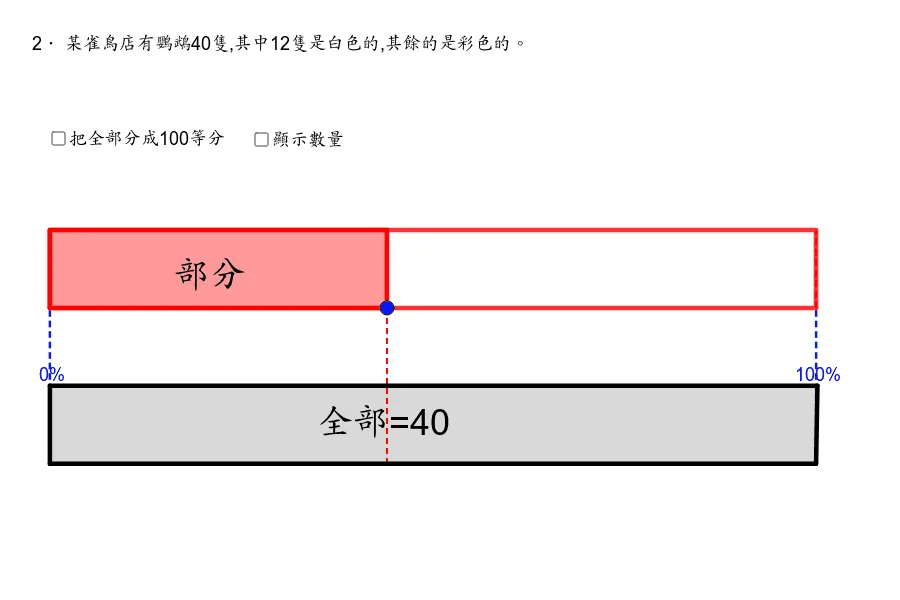
Percentage of a Whole: Example 2 is an interactive GeoGebra applet designed to help students understand and practice calculating what percentage a part represents of a whole. The applet uses geometric constructions such as polygons, line segments, and other visual elements to provide a clear, intuitive representation of the relationship between a part and its corresponding whole. Rather than relying solely on abstract numbers, students can see proportionality made visible through dynamic geometry, making the concept of percentages more concrete and accessible.
The applet features interactive input boxes that allow users to enter values for the part and the whole, and it dynamically computes the resulting percentage in real time. A text display area shows the calculated result alongside the step-by-step mathematical expression, so learners can follow exactly how the percentage is derived. This immediate feedback loop supports both discovery-based learning and verification of student work.
Through manipulating the geometric figures and adjusting input values, students explore how changing the size of the part or the whole affects the percentage. They can observe patterns such as what happens when the part equals the whole, when the part is smaller than the whole, and how equivalent ratios produce the same percentage. The visual component reinforces the idea that percentage is fundamentally a ratio expressed per hundred, bridging the gap between geometric reasoning and arithmetic computation.
This applet is particularly valuable for learners who benefit from visual and hands-on approaches to mathematics. By combining dynamic geometry with numeric calculation, it addresses multiple learning styles and helps students build a deeper conceptual foundation in percentages. Teachers can use it in classroom settings as a demonstration tool or assign it for independent practice, allowing students to experiment freely and develop confidence in solving percentage problems involving parts and wholes.
Loading the math board and drawing, please wait…
<?xml version="1.0" encoding="utf-8"?>
<geogebra format="4.0" id="5f1187aa-c2d7-44ea-9cae-c3816fe0acc4" xsi:noNamespaceSchemaLocation="http://www.geogebra.org/ggb.xsd" xmlns="" xmlns:xsi="http://www.w3.org/2001/XMLSchema-instance" >
<gui>
<window width="920" height="734" />
<perspectives>
<perspective id="tmp">
<panes>
<pane location="" divider="0.21630434782608696" orientation="1" />
</panes>
<views>
<view id="4" toolbar="0 || 2020 , 2021 , 2022 , 66 || 2001 , 2003 , 2002 , 2004 , 2005 || 2040 , 2041 , 2042 , 2044 , 2043" visible="false" inframe="false" stylebar="false" location="1,0" size="400" window="747,253,364,423" />
<view id="1" visible="true" inframe="false" stylebar="true" location="1" size="902" window="558,188,465,548" />
<view id="2" visible="false" inframe="false" stylebar="true" location="3" size="199" window="100,100,250,400" />
<view id="16" visible="false" inframe="false" stylebar="false" location="1" size="239" window="497,141,588,675" />
<view id="32" visible="false" inframe="true" stylebar="true" location="1" size="150" window="50,50,500,500" />
<view id="64" visible="false" inframe="true" stylebar="false" location="1" size="150" window="50,50,500,500" />
</views>
<toolbar show="true" items="0 39 59 || 1 501 67 , 5 19 , 72 | 2 15 45 , 18 65 , 7 37 | 4 3 8 9 , 13 44 , 58 , 47 || 16 51 64 , 70 | 10 34 53 11 , 24 20 22 , 21 23 | 55 56 57 , 12 || 36 46 , 38 49 50 , 71 | 30 29 54 32 31 33 | 17 26 62 , 14 66 68 | 25 52 60 61 || 40 41 42 , 27 28 35 , 6" />
<input show="true" cmd="true" top="false" />
</perspective>
</perspectives>
<labelingStyle val="2"/>
<font size="18"/>
<graphicsSettings javaLatexFonts="false"/>
<consProtColumns col0="true" col1="true" col2="false" col3="true" col4="false" col5="true" col6="true" col7="false"/>
<consProtocol useColors="true" addIcons="false" showOnlyBreakpoints="false"/>
</gui>
<euclidianView>
<size width="902" height="544"/>
<coordSystem xZero="49.877268442725494" yZero="385.79225628842187" scale="76.62060003128079" yscale="77.90079019694127"/>
<evSettings axes="false" grid="false" gridIsBold="false" pointCapturing="3" rightAngleStyle="1" checkboxSize="13" gridType="0"/>
<bgColor r="255" g="255" b="255"/>
<axesColor r="0" g="0" b="0"/>
<gridColor r="192" g="192" b="192"/>
<lineStyle axes="1" grid="10"/>
<axis id="0" show="false" label="" unitLabel="" tickStyle="1" showNumbers="true" tickDistance="1.0"/>
<axis id="1" show="false" label="" unitLabel="" tickStyle="1" showNumbers="true" tickDistance="1.0"/>
<grid distX="1.0" distY="1.0" distTheta="0.5235987755982988"/>
</euclidianView>
<kernel>
<continuous val="false"/>
<decimals val="3"/>
<angleUnit val="degree"/>
<algebraStyle val="0"/>
<coordStyle val="0"/>
<angleFromInvTrig val="false"/>
</kernel>
<scripting blocked="false" disabled="false"/>
<construction title="" author="Education Infrastructure Division, Education Bureau" date="">
<element type="point" label="E">
<show object="false" label="false"/>
<objColor r="255" g="51" b="51" alpha="0.0"/>
<layer val="0"/>
<labelOffset x="-20" y="-13"/>
<labelMode val="3"/>
<animation step="0.1" speed="1" type="1" playing="false"/>
<coords x="0.0" y="2.0" z="1.0"/>
<pointSize val="3"/>
<pointStyle val="0"/>
<caption val="0%"/>
</element>
<expression label="F" exp="E - (0, 1)" type="point" />
<element type="point" label="F">
<show object="false" label="true"/>
<objColor r="0" g="0" b="255" alpha="0.0"/>
<layer val="0"/>
<labelOffset x="-19" y="57"/>
<labelMode val="3"/>
<coords x="0.0" y="1.0" z="1.0"/>
<pointSize val="3"/>
<pointStyle val="0"/>
<caption val="0%"/>
</element>
<command name="Point">
<input a0="Sequence[F + (0.1 * i, 0), i, 0, 100]"/>
<output a0="I"/>
</command>
<element type="point" label="I">
<show object="true" label="false"/>
<objColor r="0" g="51" b="255" alpha="0.0"/>
<layer val="0"/>
<labelOffset x="73" y="32"/>
<labelMode val="2"/>
<animation step="1" speed="1" type="1" playing="false"/>
<coords x="4.4" y="1.0" z="1.0"/>
<pointSize val="7"/>
<pointStyle val="0"/>
</element>
<expression label="H" exp="E + (10, 0)" type="point" />
<element type="point" label="H">
<show object="false" label="false"/>
<objColor r="255" g="51" b="51" alpha="0.0"/>
<layer val="0"/>
<labelOffset x="-32" y="-13"/>
<labelMode val="3"/>
<coords x="10.0" y="2.0" z="1.0"/>
<pointSize val="3"/>
<pointStyle val="0"/>
<caption val="100%"/>
</element>
<expression label="G" exp="E + (10, -1)" type="point" />
<element type="point" label="G">
<show object="false" label="true"/>
<objColor r="51" g="51" b="255" alpha="0.0"/>
<layer val="0"/>
<labelOffset x="-24" y="55"/>
<labelMode val="3"/>
<coords x="10.0" y="1.0" z="1.0"/>
<pointSize val="3"/>
<pointStyle val="0"/>
<caption val="100%"/>
</element>
<command name="Polygon">
<input a0="E" a1="F" a2="G" a3="H"/>
<output a0="poly2" a1="e" a2="f" a3="g" a4="h"/>
</command>
<element type="polygon" label="poly2">
<lineStyle thickness="9" type="0" typeHidden="1"/>
<show object="true" label="false"/>
<objColor r="255" g="51" b="51" alpha="0.0"/>
<layer val="0"/>
<labelMode val="0"/>
<fixed val="true"/>
</element>
<element type="segment" label="e">
<show object="true" label="false"/>
<objColor r="255" g="51" b="51" alpha="0.0"/>
<layer val="0"/>
<labelMode val="0"/>
<fixed val="true"/>
<coords x="1.0" y="0.0" z="0.0"/>
<lineStyle thickness="9" type="0" typeHidden="1"/>
<eqnStyle style="implicit"/>
<outlyingIntersections val="false"/>
<keepTypeOnTransform val="true"/>
</element>
<element type="segment" label="f">
<show object="true" label="false"/>
<objColor r="255" g="51" b="51" alpha="0.0"/>
<layer val="0"/>
<labelMode val="0"/>
<fixed val="true"/>
<coords x="0.0" y="10.0" z="-10.0"/>
<lineStyle thickness="9" type="0" typeHidden="1"/>
<eqnStyle style="implicit"/>
<outlyingIntersections val="false"/>
<keepTypeOnTransform val="true"/>
</element>
<element type="segment" label="g">
<show object="true" label="false"/>
<condition showObject="percent < 100"/>
<objColor r="255" g="51" b="51" alpha="0.0"/>
<layer val="0"/>
<labelMode val="0"/>
<fixed val="true"/>
<coords x="-1.0" y="0.0" z="10.0"/>
<lineStyle thickness="9" type="0" typeHidden="1"/>
<eqnStyle style="implicit"/>
<outlyingIntersections val="false"/>
<keepTypeOnTransform val="true"/>
</element>
<element type="segment" label="h">
<show object="true" label="false"/>
<objColor r="255" g="51" b="51" alpha="0.0"/>
<layer val="0"/>
<labelMode val="0"/>
<fixed val="true"/>
<coords x="0.0" y="-10.0" z="20.0"/>
<lineStyle thickness="9" type="0" typeHidden="1"/>
<eqnStyle style="implicit"/>
<outlyingIntersections val="false"/>
<keepTypeOnTransform val="true"/>
</element>
<element type="point" label="A">
<show object="true" label="true"/>
<objColor r="0" g="0" b="255" alpha="0.0"/>
<layer val="0"/>
<labelOffset x="-15" y="-3"/>
<labelMode val="3"/>
<animation step="0.1" speed="1" type="1" playing="false"/>
<coords x="0.0" y="0.0" z="1.0"/>
<pointSize val="1"/>
<pointStyle val="0"/>
<caption val="0%"/>
</element>
<element type="point" label="B">
<show object="true" label="true"/>
<objColor r="0" g="0" b="255" alpha="0.0"/>
<layer val="0"/>
<labelOffset x="-26" y="-3"/>
<labelMode val="3"/>
<fixed val="true"/>
<coords x="10.017834975997866" y="0.0" z="1.0"/>
<pointSize val="1"/>
<pointStyle val="0"/>
<caption val="100%"/>
</element>
<element type="point" label="C">
<show object="false" label="false"/>
<objColor r="0" g="0" b="255" alpha="0.0"/>
<layer val="0"/>
<labelMode val="0"/>
<animation step="0.1" speed="1" type="1" playing="false"/>
<coords x="10.0" y="-1.0" z="1.0"/>
<pointSize val="3"/>
<pointStyle val="0"/>
</element>
<element type="point" label="D">
<show object="false" label="false"/>
<objColor r="0" g="0" b="255" alpha="0.0"/>
<layer val="0"/>
<labelMode val="0"/>
<animation step="0.1" speed="1" type="1" playing="false"/>
<coords x="0.0" y="-1.0" z="1.0"/>
<pointSize val="3"/>
<pointStyle val="0"/>
</element>
<command name="Polygon">
<input a0="A" a1="B" a2="C" a3="D"/>
<output a0="poly1" a1="a" a2="b" a3="c" a4="d"/>
</command>
<element type="polygon" label="poly1">
<lineStyle thickness="9" type="0" typeHidden="1"/>
<show object="true" label="false"/>
<objColor r="0" g="0" b="0" alpha="0.15"/>
<layer val="0"/>
<labelMode val="0"/>
<fixed val="true"/>
</element>
<element type="segment" label="a">
<show object="true" label="false"/>
<objColor r="0" g="0" b="0" alpha="0.0"/>
<layer val="1"/>
<labelMode val="0"/>
<fixed val="true"/>
<coords x="0.0" y="10.017834975997866" z="0.0"/>
<lineStyle thickness="9" type="0" typeHidden="1"/>
<eqnStyle style="implicit"/>
<outlyingIntersections val="false"/>
<keepTypeOnTransform val="true"/>
</element>
<element type="segment" label="b">
<show object="true" label="false"/>
<objColor r="0" g="0" b="0" alpha="0.0"/>
<layer val="1"/>
<labelMode val="0"/>
<fixed val="true"/>
<coords x="1.0" y="-0.01783497599786621" z="-10.017834975997866"/>
<lineStyle thickness="9" type="0" typeHidden="1"/>
<eqnStyle style="implicit"/>
<outlyingIntersections val="false"/>
<keepTypeOnTransform val="true"/>
</element>
<element type="segment" label="c">
<show object="true" label="false"/>
<objColor r="0" g="0" b="0" alpha="0.0"/>
<layer val="1"/>
<labelMode val="0"/>
<fixed val="true"/>
<coords x="0.0" y="-10.0" z="-10.0"/>
<lineStyle thickness="9" type="0" typeHidden="1"/>
<eqnStyle style="implicit"/>
<outlyingIntersections val="false"/>
<keepTypeOnTransform val="true"/>
</element>
<element type="segment" label="d">
<show object="true" label="false"/>
<objColor r="0" g="0" b="0" alpha="0.0"/>
<layer val="1"/>
<labelMode val="0"/>
<fixed val="true"/>
<coords x="-1.0" y="0.0" z="0.0"/>
<lineStyle thickness="9" type="0" typeHidden="1"/>
<eqnStyle style="implicit"/>
<outlyingIntersections val="false"/>
<keepTypeOnTransform val="true"/>
</element>
<expression label="J" exp="I + (0, 1)" type="point" />
<element type="point" label="J">
<show object="false" label="false"/>
<objColor r="0" g="0" b="255" alpha="0.0"/>
<layer val="0"/>
<labelMode val="0"/>
<ggbscript onUpdate="SetValue[I,(x(J),y(I))]"/>
<coords x="4.4" y="2.0" z="1.0"/>
<pointSize val="5"/>
<pointStyle val="0"/>
</element>
<command name="Polygon">
<input a0="E" a1="J" a2="I" a3="F"/>
<output a0="poly3" a1="e_1" a2="j" a3="i" a4="f_1"/>
</command>
<element type="polygon" label="poly3">
<lineStyle thickness="2" type="0" typeHidden="1"/>
<show object="true" label="false"/>
<objColor r="255" g="51" b="51" alpha="0.5"/>
<layer val="0"/>
<labelMode val="0"/>
<fixed val="true"/>
</element>
<element type="segment" label="e_1">
<show object="true" label="false"/>
<objColor r="255" g="51" b="51" alpha="0.0"/>
<layer val="0"/>
<labelMode val="0"/>
<fixed val="true"/>
<coords x="0.0" y="4.4" z="-8.8"/>
<lineStyle thickness="2" type="0" typeHidden="1"/>
<eqnStyle style="implicit"/>
<outlyingIntersections val="false"/>
<keepTypeOnTransform val="true"/>
</element>
<element type="segment" label="j">
<show object="true" label="false"/>
<objColor r="255" g="51" b="51" alpha="0.0"/>
<layer val="0"/>
<labelMode val="0"/>
<fixed val="true"/>
<coords x="1.0" y="0.0" z="-4.4"/>
<lineStyle thickness="2" type="0" typeHidden="1"/>
<eqnStyle style="implicit"/>
<outlyingIntersections val="false"/>
<keepTypeOnTransform val="true"/>
</element>
<element type="segment" label="i">
<show object="true" label="false"/>
<objColor r="255" g="51" b="51" alpha="0.0"/>
<layer val="0"/>
<labelMode val="0"/>
<fixed val="true"/>
<coords x="0.0" y="-4.4" z="4.4"/>
<lineStyle thickness="2" type="0" typeHidden="1"/>
<eqnStyle style="implicit"/>
<outlyingIntersections val="false"/>
<keepTypeOnTransform val="true"/>
</element>
<element type="segment" label="f_1">
<show object="false" label="false"/>
<objColor r="255" g="51" b="51" alpha="0.0"/>
<layer val="0"/>
<labelMode val="0"/>
<fixed val="true"/>
<coords x="-1.0" y="0.0" z="0.0"/>
<lineStyle thickness="2" type="0" typeHidden="1"/>
<eqnStyle style="implicit"/>
<outlyingIntersections val="false"/>
<keepTypeOnTransform val="true"/>
</element>
<expression label="u1" exp="(x(G) - x(F)) / 100" />
<element type="numeric" label="u1">
<value val="0.1"/>
<objColor r="0" g="0" b="0" alpha="0.1"/>
</element>
<expression label="percent" exp="round((x(I) - x(F)) / u1)" />
<element type="numeric" label="percent">
<value val="44.0"/>
<objColor r="0" g="0" b="0" alpha="0.1"/>
</element>
<element type="numeric" label="p">
<value val="40.0"/>
<show object="false" label="false"/>
<objColor r="0" g="0" b="0" alpha="0.1"/>
<layer val="0"/>
<labelMode val="1"/>
<slider min="-5" max="800" absoluteScreenLocation="true" width="100.0" x="30.0" y="50.0" fixed="false" horizontal="true"/>
<lineStyle thickness="2" type="0" typeHidden="1"/>
<animation step="1" speed="1" type="0" playing="false"/>
</element>
<element type="numeric" label="q">
<value val="235.0"/>
<show object="false" label="false"/>
<objColor r="0" g="0" b="0" alpha="0.1"/>
<layer val="0"/>
<labelMode val="1"/>
<slider min="-5" max="240" absoluteScreenLocation="true" width="100.0" x="30.0" y="90.0" fixed="false" horizontal="true"/>
<lineStyle thickness="2" type="0" typeHidden="1"/>
<animation step="1" speed="1" type="0" playing="false"/>
</element>
<element type="numeric" label="r">
<value val="200.0"/>
<show object="false" label="false"/>
<objColor r="0" g="0" b="0" alpha="0.1"/>
<layer val="0"/>
<labelMode val="1"/>
<slider min="-5" max="200" absoluteScreenLocation="true" width="100.0" x="30.0" y="130.0" fixed="false" horizontal="true"/>
<lineStyle thickness="2" type="0" typeHidden="1"/>
<animation step="1" speed="1" type="0" playing="false"/>
</element>
<element type="boolean" label="k">
<value val="true"/>
<show object="false" label="true"/>
<objColor r="0" g="0" b="0" alpha="0.0"/>
<layer val="0"/>
<labelOffset x="551" y="156"/>
<labelMode val="0"/>
<caption val="顯示所佔百分率"/>
</element>
<expression label="u2" exp="percent * p / 100" />
<element type="numeric" label="u2">
<value val="17.6"/>
<objColor r="0" g="0" b="0" alpha="0.1"/>
</element>
<expression label="text2" exp=""百分率=" + percent + "%"" />
<element type="text" label="text2">
<show object="true" label="false"/>
<condition showObject="z"/>
<objColor r="0" g="0" b="255" alpha="0.0"/>
<layer val="0"/>
<labelMode val="0"/>
<fixed val="true"/>
<font serif="false" size="16" style="1"/>
<startPoint exp="I"/>
<labelOffset x="-69" y="41"/>
</element>
<element type="point" label="K">
<show object="true" label="false"/>
<objColor r="0" g="0" b="255" alpha="0.0"/>
<layer val="0"/>
<labelMode val="0"/>
<animation step="0.1" speed="1" type="1" playing="false"/>
<coords x="0.72" y="17.54" z="1.0"/>
<pointSize val="3"/>
<pointStyle val="0"/>
</element>
<command name="OrthogonalLine">
<input a0="J" a1="f"/>
<output a0="t"/>
</command>
<element type="line" label="t">
<show object="false" label="false"/>
<objColor r="0" g="0" b="0" alpha="0.0"/>
<layer val="0"/>
<labelMode val="0"/>
<coords x="-10.0" y="0.0" z="44.0"/>
<lineStyle thickness="2" type="0" typeHidden="1"/>
<eqnStyle style="implicit"/>
</element>
<command name="Segment">
<input a0="D" a1="F"/>
<output a0="n"/>
</command>
<element type="segment" label="n">
<show object="true" label="false"/>
<objColor r="0" g="0" b="255" alpha="0.0"/>
<layer val="0"/>
<labelMode val="0"/>
<fixed val="true"/>
<coords x="-2.0" y="0.0" z="0.0"/>
<lineStyle thickness="5" type="10" typeHidden="1"/>
<eqnStyle style="implicit"/>
<outlyingIntersections val="false"/>
<keepTypeOnTransform val="true"/>
</element>
<command name="Segment">
<input a0="C" a1="G"/>
<output a0="s"/>
</command>
<element type="segment" label="s">
<show object="true" label="false"/>
<objColor r="0" g="0" b="255" alpha="0.0"/>
<layer val="0"/>
<labelMode val="0"/>
<fixed val="true"/>
<coords x="-2.0" y="0.0" z="20.0"/>
<lineStyle thickness="5" type="10" typeHidden="1"/>
<eqnStyle style="implicit"/>
<outlyingIntersections val="false"/>
<keepTypeOnTransform val="true"/>
</element>
<element type="boolean" label="l">
<value val="false"/>
<show object="false" label="true"/>
<objColor r="0" g="0" b="0" alpha="0.0"/>
<layer val="0"/>
<labelOffset x="31" y="63"/>
<labelMode val="0"/>
<caption val="顯示百分率"/>
</element>
<command name="Textfield">
<input a0="p"/>
<output a0="inputBox1"/>
</command>
<element type="textfield" label="inputBox1">
<show object="false" label="true"/>
<objColor r="0" g="0" b="0" alpha="0.0"/>
<layer val="0"/>
<labelOffset x="48" y="20"/>
<labelMode val="0"/>
<animation step="1" speed="1" type="0" playing="false"/>
<auxiliary val="true"/>
<font size="16"/>
<linkedGeo exp="p"/>
<length val="5"/>
<caption val="全部:"/>
</element>
<element type="boolean" label="m">
<value val="false"/>
<show object="true" label="true"/>
<objColor r="0" g="0" b="0" alpha="0.0"/>
<layer val="0"/>
<labelOffset x="250" y="128"/>
<labelMode val="0"/>
<caption val="顯示數量"/>
</element>
<command name="Sequence">
<input a0="Segment[A + (i, 0), A + (i, -1)]" a1="i" a2="1" a3="9"/>
<output a0="list1"/>
</command>
<element type="list" label="list1">
<show object="true" label="false"/>
<condition showObject="u"/>
<objColor r="0" g="0" b="255" alpha="0.0"/>
<layer val="0"/>
<labelMode val="0"/>
<lineStyle thickness="4" type="0" typeHidden="1"/>
<pointSize val="3"/>
<pointStyle val="-1"/>
</element>
<command name="Sequence">
<input a0="Sequence[Segment[A + (0.5 * i + 0.1 * j, 0), A + (0.5 * i + 0.1 * j, -1)], j, 1, 5]" a1="i" a2="0" a3="19"/>
<output a0="list2"/>
</command>
<element type="list" label="list2">
<show object="true" label="false"/>
<condition showObject="u"/>
<objColor r="0" g="0" b="255" alpha="0.0"/>
<layer val="0"/>
<labelMode val="0"/>
<lineStyle thickness="2" type="0" typeHidden="1"/>
<pointSize val="3"/>
<pointStyle val="-1"/>
</element>
<element type="boolean" label="u">
<value val="false"/>
<show object="true" label="true"/>
<objColor r="0" g="0" b="0" alpha="0.0"/>
<layer val="0"/>
<labelOffset x="47" y="127"/>
<labelMode val="0"/>
<caption val="把全部分成100等分"/>
</element>
<command name="OrthogonalLine">
<input a0="I" a1="a"/>
<output a0="a_1"/>
</command>
<element type="line" label="a_1">
<show object="false" label="false"/>
<objColor r="0" g="0" b="0" alpha="0.0"/>
<layer val="0"/>
<labelMode val="0"/>
<coords x="-10.017834975997866" y="0.0" z="44.07847389439061"/>
<lineStyle thickness="2" type="0" typeHidden="1"/>
<eqnStyle style="implicit"/>
</element>
<expression label="L" exp="I - (0, 2)" type="point" />
<element type="point" label="L">
<show object="false" label="false"/>
<objColor r="64" g="64" b="64" alpha="0.0"/>
<layer val="0"/>
<labelMode val="0"/>
<coords x="4.4" y="-1.0" z="1.0"/>
<pointSize val="3"/>
<pointStyle val="0"/>
</element>
<command name="Segment">
<input a0="I" a1="L"/>
<output a0="c_1"/>
</command>
<element type="segment" label="c_1">
<show object="true" label="false"/>
<objColor r="255" g="0" b="0" alpha="0.0"/>
<layer val="0"/>
<labelMode val="0"/>
<coords x="2.0" y="0.0" z="-8.8"/>
<lineStyle thickness="4" type="10" typeHidden="1"/>
<eqnStyle style="implicit"/>
<outlyingIntersections val="false"/>
<keepTypeOnTransform val="true"/>
</element>
<command name="Polygon">
<input a0="E" a1="F" a2="I" a3="J"/>
<output a0="poly4" a1="e_2" a2="f_2" a3="i_1" a4="j_1"/>
</command>
<element type="polygon" label="poly4">
<lineStyle thickness="9" type="0" typeHidden="1"/>
<show object="true" label="false"/>
<objColor r="255" g="51" b="51" alpha="0.0"/>
<layer val="0"/>
<labelMode val="0"/>
</element>
<element type="segment" label="e_2">
<show object="true" label="false"/>
<objColor r="255" g="0" b="0" alpha="0.0"/>
<layer val="0"/>
<labelMode val="0"/>
<coords x="1.0" y="0.0" z="0.0"/>
<lineStyle thickness="9" type="0" typeHidden="1"/>
<eqnStyle style="implicit"/>
<outlyingIntersections val="false"/>
<keepTypeOnTransform val="true"/>
</element>
<element type="segment" label="f_2">
<show object="true" label="false"/>
<objColor r="255" g="0" b="0" alpha="0.0"/>
<layer val="0"/>
<labelMode val="0"/>
<coords x="0.0" y="4.4" z="-4.4"/>
<lineStyle thickness="9" type="0" typeHidden="1"/>
<eqnStyle style="implicit"/>
<outlyingIntersections val="false"/>
<keepTypeOnTransform val="true"/>
</element>
<element type="segment" label="i_1">
<show object="true" label="false"/>
<objColor r="255" g="0" b="0" alpha="0.0"/>
<layer val="0"/>
<labelMode val="0"/>
<coords x="-1.0" y="0.0" z="4.4"/>
<lineStyle thickness="9" type="0" typeHidden="1"/>
<eqnStyle style="implicit"/>
<outlyingIntersections val="false"/>
<keepTypeOnTransform val="true"/>
</element>
<element type="segment" label="j_1">
<show object="true" label="false"/>
<objColor r="255" g="0" b="0" alpha="0.0"/>
<layer val="0"/>
<labelMode val="0"/>
<coords x="0.0" y="-4.4" z="8.8"/>
<lineStyle thickness="9" type="0" typeHidden="1"/>
<eqnStyle style="implicit"/>
<outlyingIntersections val="false"/>
<keepTypeOnTransform val="true"/>
</element>
<command name="Polygon">
<input a0="B" a1="I - (0, 1)" a2="I - (0, 2)" a3="B - (0, 1)"/>
<output a0="poly5" a1="b_1" a2="d_1" a3="g_1" a4="h_1"/>
</command>
<element type="polygon" label="poly5">
<lineStyle thickness="9" type="0" typeHidden="1"/>
<show object="true" label="false"/>
<condition showObject="percent > 100"/>
<objColor r="191" g="255" b="0" alpha="0.0"/>
<layer val="0"/>
<labelMode val="0"/>
</element>
<element type="segment" label="b_1">
<show object="true" label="false"/>
<condition showObject="percent > 100"/>
<objColor r="0" g="0" b="0" alpha="0.0"/>
<layer val="1"/>
<labelMode val="0"/>
<coords x="0.0" y="-5.617834975997866" z="0.0"/>
<lineStyle thickness="9" type="0" typeHidden="1"/>
<eqnStyle style="implicit"/>
<outlyingIntersections val="false"/>
<keepTypeOnTransform val="true"/>
</element>
<element type="segment" label="d_1">
<show object="true" label="false"/>
<condition showObject="percent > 100"/>
<objColor r="0" g="0" b="0" alpha="0.0"/>
<layer val="1"/>
<labelMode val="0"/>
<coords x="1.0" y="0.0" z="-4.4"/>
<lineStyle thickness="9" type="0" typeHidden="1"/>
<eqnStyle style="implicit"/>
<outlyingIntersections val="false"/>
<keepTypeOnTransform val="true"/>
</element>
<element type="segment" label="g_1">
<show object="true" label="false"/>
<condition showObject="percent > 100"/>
<objColor r="0" g="0" b="0" alpha="0.0"/>
<layer val="1"/>
<labelMode val="0"/>
<coords x="0.0" y="5.617834975997866" z="5.617834975997866"/>
<lineStyle thickness="9" type="0" typeHidden="1"/>
<eqnStyle style="implicit"/>
<outlyingIntersections val="false"/>
<keepTypeOnTransform val="true"/>
</element>
<element type="segment" label="h_1">
<show object="true" label="false"/>
<condition showObject="percent > 100"/>
<objColor r="0" g="0" b="0" alpha="0.0"/>
<layer val="1"/>
<labelMode val="0"/>
<coords x="-1.0" y="0.0" z="10.017834975997866"/>
<lineStyle thickness="9" type="0" typeHidden="1"/>
<eqnStyle style="implicit"/>
<outlyingIntersections val="false"/>
<keepTypeOnTransform val="true"/>
</element>
<command name="Sequence">
<input a0="Segment[A + (10 + i, 0), A + (10 + i, -1)]" a1="i" a2="0" a3="floor(percent / 10) - 10"/>
<output a0="list3"/>
</command>
<element type="list" label="list3">
<show object="true" label="false"/>
<condition showObject="u"/>
<objColor r="0" g="0" b="255" alpha="0.0"/>
<layer val="0"/>
<labelMode val="0"/>
<lineStyle thickness="4" type="0" typeHidden="1"/>
<pointSize val="3"/>
<pointStyle val="-1"/>
</element>
<command name="Sequence">
<input a0="Sequence[Segment[A + (10 + i + 0.1 * j, 0), A + (10 + i + 0.1 * j, -1)], j, 1, 9]" a1="i" a2="0" a3="floor(percent / 10) - 11"/>
<output a0="list4"/>
</command>
<element type="list" label="list4">
<show object="true" label="false"/>
<condition showObject="u"/>
<objColor r="0" g="0" b="255" alpha="0.0"/>
<layer val="0"/>
<labelMode val="0"/>
<lineStyle thickness="2" type="0" typeHidden="1"/>
<pointSize val="3"/>
<pointStyle val="-1"/>
</element>
<command name="Sequence">
<input a0="Segment[A + (floor(percent / 10) + 0.1 * j, 0), A + (floor(percent / 10) + 0.1 * j, -1)]" a1="j" a2="0" a3="percent - 10 * floor(percent / 10)"/>
<output a0="list5"/>
</command>
<element type="list" label="list5">
<show object="true" label="false"/>
<condition showObject="u"/>
<objColor r="0" g="0" b="255" alpha="0.0"/>
<layer val="0"/>
<labelMode val="0"/>
<lineStyle thickness="2" type="0" typeHidden="1"/>
<pointSize val="3"/>
<pointStyle val="-1"/>
</element>
<command name="Segment">
<input a0="G" a1="H"/>
<output a0="k_1"/>
</command>
<element type="segment" label="k_1">
<show object="true" label="false"/>
<objColor r="255" g="0" b="0" alpha="0.0"/>
<layer val="0"/>
<labelMode val="0"/>
<coords x="-1.0" y="0.0" z="10.0"/>
<lineStyle thickness="5" type="10" typeHidden="1"/>
<eqnStyle style="implicit"/>
<outlyingIntersections val="false"/>
<keepTypeOnTransform val="true"/>
</element>
<command name="Vector">
<input a0="I - (0, 0.5)" a1="G - (0, 0.5)"/>
<output a0="v"/>
</command>
<element type="vector" label="v">
<show object="true" label="false"/>
<condition showObject="o"/>
<objColor r="0" g="0" b="255" alpha="0.0"/>
<layer val="1"/>
<labelMode val="0"/>
<coords x="5.6" y="0.0" z="0.0"/>
<lineStyle thickness="2" type="0" typeHidden="1"/>
<coordStyle style="cartesian"/>
<startPoint x="4.4" y="0.5" z="1.0"/>
</element>
<command name="Vector">
<input a0="G - (0, 0.5)" a1="I - (0, 0.5)"/>
<output a0="w"/>
</command>
<element type="vector" label="w">
<show object="true" label="false"/>
<condition showObject="o"/>
<objColor r="0" g="0" b="255" alpha="0.0"/>
<layer val="1"/>
<labelMode val="0"/>
<coords x="-5.6" y="0.0" z="0.0"/>
<lineStyle thickness="2" type="0" typeHidden="1"/>
<coordStyle style="cartesian"/>
<startPoint x="10.0" y="0.5" z="1.0"/>
</element>
<expression label="text1" exp=""" + (abs(percent - 100)) + "%"" />
<element type="text" label="text1">
<show object="true" label="false"/>
<condition showObject="o"/>
<objColor r="0" g="0" b="255" alpha="0.0"/>
<layer val="1"/>
<labelMode val="0"/>
<startPoint exp="Midpoint[I - (0, 0.5), G - (0, 0.5)]"/>
<labelOffset x="-15" y="-3"/>
</element>
<expression label="text6" exp=""部分""/>
<element type="text" label="text6">
<show object="true" label="false"/>
<objColor r="0" g="0" b="0" alpha="0.0"/>
<layer val="1"/>
<labelMode val="0"/>
<fixed val="true"/>
<font serif="false" size="18" style="0"/>
<startPoint exp="Midpoint[I, F]"/>
<labelOffset x="-44" y="-20"/>
</element>
<element type="boolean" label="o">
<value val="false"/>
<show object="false" label="true"/>
<objColor r="0" g="0" b="0" alpha="0.0"/>
<layer val="1"/>
<labelOffset x="491" y="132"/>
<labelMode val="0"/>
<caption val="顯示相差百分率"/>
</element>
<expression label="text5" exp=""全部=" + p + """ />
<element type="text" label="text5">
<show object="true" label="false"/>
<objColor r="0" g="0" b="0" alpha="0.0"/>
<layer val="0"/>
<labelMode val="0"/>
<fixed val="true"/>
<font serif="false" size="18" style="0"/>
<startPoint x="3.4831937080830313" y="-0.6339785419843915" z="1.0"/>
</element>
<expression label="text3" exp=""部分=" + u2 + """ />
<element type="text" label="text3">
<show object="true" label="false"/>
<condition showObject="m"/>
<objColor r="0" g="0" b="0" alpha="0.0"/>
<layer val="0"/>
<labelMode val="0"/>
<fixed val="true"/>
<font serif="false" size="18" style="0"/>
<startPoint exp="Midpoint[I, F]"/>
<labelOffset x="-44" y="-20"/>
</element>
<expression label="text4" exp=""部分=" + q + """ />
<element type="text" label="text4">
<show object="false" label="false"/>
<objColor r="0" g="0" b="0" alpha="0.0"/>
<layer val="0"/>
<labelMode val="0"/>
<startPoint exp="J"/>
<labelOffset x="-42" y="-10"/>
</element>
<expression label="text8" exp=""2. 某雀鳥店有鸚鵡40隻,其中12隻是白色的,其餘的是彩色的。""/>
<element type="text" label="text8">
<show object="true" label="false"/>
<objColor r="0" g="0" b="0" alpha="0.0"/>
<layer val="1"/>
<labelMode val="0"/>
<startPoint x="-0.23778349096441254" y="4.313344806117456" z="1.0"/>
</element>
<element type="boolean" label="z">
<value val="false"/>
<show object="false" label="true"/>
<objColor r="0" g="0" b="0" alpha="0.0"/>
<layer val="1"/>
<labelOffset x="365" y="131"/>
<labelMode val="0"/>
<caption val="顯示百分率"/>
</element>
</construction>
</geogebra>