
Finding Quantities Based on Percentages (II): Example 2
2014-02-20 11:09
This example demonstrates how to find specific quantities based on given percentages. Through interactive input boxes and text prompts, users can intuitively understand the quantitative relationships among percentages, wholes, and parts. The example combines algebraic calculations with auxiliary geometric representations, such as polygons and vectors, to help students master the application and calculation methods of percentages in real-world problems. Users can adjust the percentage value or the whole amount through the interactive controls, and the applet immediately displays the corresponding part quantity both numerically and visually. The geometric visualization provides a spatial representation of the percentage relationship, reinforcing the connection between abstract numerical computations and concrete visual models. This dual approach supports diverse learning styles and deepens conceptual understanding. The algebraic component walks students through the proportional reasoning process, showing how the formula part equals percentage times whole is derived and applied. As learners manipulate the input values, they observe how changes in the percentage or the whole directly affect the resulting part, building an intuitive grasp of proportional thinking. The vector and polygon illustrations serve as visual scaffolding, making abstract percentage relationships more tangible and easier to comprehend. This applet is designed for middle school mathematics instruction, particularly when introducing percentage calculations and their practical applications. It encourages exploratory learning, allowing students to experiment with different values and self-discover the underlying mathematical relationships. Teachers can use it as a demonstration tool during lessons or as a practice resource for independent student work. By engaging with the interactive elements, students develop not only computational fluency but also a deeper conceptual foundation in ratios and percentages that will support their future studies in proportional reasoning, algebra, and statistics.
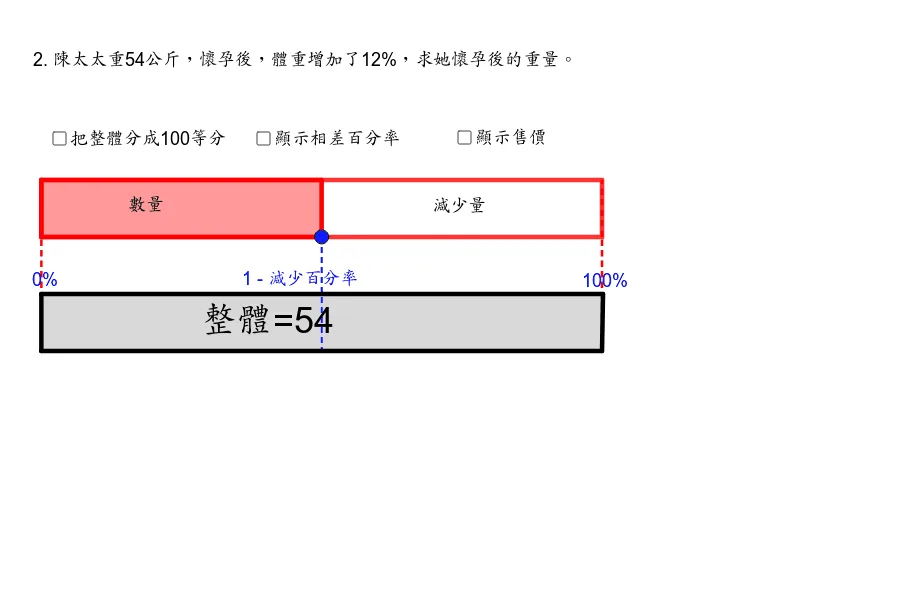
Loading the math board and drawing, please wait…
<?xml version="1.0" encoding="utf-8"?>
<geogebra format="4.0" id="5f1187aa-c2d7-44ea-9cae-c3816fe0acc4" xsi:noNamespaceSchemaLocation="http://www.geogebra.org/ggb.xsd" xmlns="" xmlns:xsi="http://www.w3.org/2001/XMLSchema-instance" >
<gui>
<window width="1024" height="734" />
<perspectives>
<perspective id="tmp">
<panes>
<pane location="" divider="0.328125" orientation="1" />
</panes>
<views>
<view id="4" toolbar="0 || 2020 , 2021 , 2022 , 66 || 2001 , 2003 , 2002 , 2004 , 2005 || 2040 , 2041 , 2042 , 2044 , 2043" visible="false" inframe="false" stylebar="false" location="1,0" size="400" window="747,253,364,423" />
<view id="1" visible="true" inframe="false" stylebar="true" location="1" size="1006" window="558,188,465,548" />
<view id="2" visible="false" inframe="false" stylebar="true" location="3" size="336" window="18,196,250,400" />
<view id="16" visible="false" inframe="false" stylebar="false" location="1" size="239" window="497,141,588,675" />
<view id="32" visible="false" inframe="true" stylebar="true" location="1" size="150" window="50,50,500,500" />
<view id="64" visible="false" inframe="true" stylebar="false" location="1" size="150" window="50,50,500,500" />
</views>
<toolbar show="true" items="0 39 59 || 1 501 67 , 5 19 , 72 | 2 15 45 , 18 65 , 7 37 | 4 3 8 9 , 13 44 , 58 , 47 || 16 51 64 , 70 | 10 34 53 11 , 24 20 22 , 21 23 | 55 56 57 , 12 || 36 46 , 38 49 50 , 71 | 30 29 54 32 31 33 | 17 26 62 , 14 66 68 | 25 52 60 61 || 40 41 42 , 27 28 35 , 6" />
<input show="true" cmd="true" top="false" />
</perspective>
</perspectives>
<labelingStyle val="2"/>
<font size="18"/>
<graphicsSettings javaLatexFonts="false"/>
<consProtColumns col0="true" col1="true" col2="false" col3="true" col4="false" col5="true" col6="true" col7="false"/>
<consProtocol useColors="true" addIcons="false" showOnlyBreakpoints="false"/>
</gui>
<euclidianView>
<size width="1006" height="544"/>
<coordSystem xZero="41.332425622151746" yZero="293.888355198673" scale="56.06960167031556" yscale="57.00642222016168"/>
<evSettings axes="false" grid="false" gridIsBold="false" pointCapturing="3" rightAngleStyle="1" checkboxSize="13" gridType="0"/>
<bgColor r="255" g="255" b="255"/>
<axesColor r="0" g="0" b="0"/>
<gridColor r="192" g="192" b="192"/>
<lineStyle axes="1" grid="10"/>
<axis id="0" show="false" label="" unitLabel="" tickStyle="1" showNumbers="true" tickDistance="1.0"/>
<axis id="1" show="false" label="" unitLabel="" tickStyle="1" showNumbers="true" tickDistance="1.0"/>
<grid distX="1.0" distY="1.0" distTheta="0.5235987755982988"/>
</euclidianView>
<kernel>
<continuous val="false"/>
<decimals val="3"/>
<angleUnit val="degree"/>
<algebraStyle val="0"/>
<coordStyle val="0"/>
<angleFromInvTrig val="false"/>
</kernel>
<scripting blocked="false" disabled="false"/>
<construction title="" author="Education Infrastructure Division, Education Bureau" date="">
<element type="point" label="E">
<show object="false" label="false"/>
<objColor r="255" g="51" b="51" alpha="0.0"/>
<layer val="0"/>
<labelOffset x="-20" y="-13"/>
<labelMode val="3"/>
<animation step="0.1" speed="1" type="1" playing="false"/>
<coords x="0.0" y="2.0" z="1.0"/>
<pointSize val="3"/>
<pointStyle val="0"/>
<caption val="0%"/>
</element>
<expression label="F" exp="E - (0, 1)" type="point" />
<element type="point" label="F">
<show object="false" label="true"/>
<objColor r="0" g="0" b="255" alpha="0.0"/>
<layer val="0"/>
<labelOffset x="-19" y="57"/>
<labelMode val="3"/>
<coords x="0.0" y="1.0" z="1.0"/>
<pointSize val="3"/>
<pointStyle val="0"/>
<caption val="0%"/>
</element>
<command name="Point">
<input a0="Sequence[F + (0.1 * i, 0), i, 0, 200]"/>
<output a0="I"/>
</command>
<element type="point" label="I">
<show object="true" label="false"/>
<objColor r="0" g="51" b="255" alpha="0.0"/>
<layer val="0"/>
<labelOffset x="73" y="32"/>
<labelMode val="2"/>
<animation step="1" speed="1" type="1" playing="false"/>
<ggbscript onUpdate="SetValue[J,(x(I),y(J))]"/>
<coords x="5.0" y="1.0" z="1.0"/>
<pointSize val="7"/>
<pointStyle val="0"/>
</element>
<expression label="H" exp="E + (10, 0)" type="point" />
<element type="point" label="H">
<show object="false" label="false"/>
<objColor r="255" g="51" b="51" alpha="0.0"/>
<layer val="0"/>
<labelOffset x="-32" y="-13"/>
<labelMode val="3"/>
<coords x="10.0" y="2.0" z="1.0"/>
<pointSize val="3"/>
<pointStyle val="0"/>
<caption val="100%"/>
</element>
<expression label="G" exp="E + (10, -1)" type="point" />
<element type="point" label="G">
<show object="false" label="true"/>
<objColor r="51" g="51" b="255" alpha="0.0"/>
<layer val="0"/>
<labelOffset x="-24" y="55"/>
<labelMode val="3"/>
<coords x="10.0" y="1.0" z="1.0"/>
<pointSize val="3"/>
<pointStyle val="0"/>
<caption val="100%"/>
</element>
<command name="Polygon">
<input a0="E" a1="F" a2="G" a3="H"/>
<output a0="poly2" a1="e" a2="f" a3="g" a4="h"/>
</command>
<element type="polygon" label="poly2">
<lineStyle thickness="9" type="0" typeHidden="1"/>
<show object="true" label="false"/>
<objColor r="255" g="51" b="51" alpha="0.0"/>
<layer val="0"/>
<labelMode val="0"/>
<fixed val="true"/>
</element>
<element type="segment" label="e">
<show object="true" label="false"/>
<objColor r="255" g="51" b="51" alpha="0.0"/>
<layer val="0"/>
<labelMode val="0"/>
<fixed val="true"/>
<coords x="1.0" y="0.0" z="0.0"/>
<lineStyle thickness="9" type="0" typeHidden="1"/>
<eqnStyle style="implicit"/>
<outlyingIntersections val="false"/>
<keepTypeOnTransform val="true"/>
</element>
<element type="segment" label="f">
<show object="true" label="false"/>
<objColor r="255" g="51" b="51" alpha="0.0"/>
<layer val="0"/>
<labelMode val="0"/>
<fixed val="true"/>
<coords x="0.0" y="10.0" z="-10.0"/>
<lineStyle thickness="9" type="0" typeHidden="1"/>
<eqnStyle style="implicit"/>
<outlyingIntersections val="false"/>
<keepTypeOnTransform val="true"/>
</element>
<element type="segment" label="g">
<show object="true" label="false"/>
<condition showObject="percent < 100"/>
<objColor r="255" g="51" b="51" alpha="0.0"/>
<layer val="0"/>
<labelMode val="0"/>
<fixed val="true"/>
<coords x="-1.0" y="0.0" z="10.0"/>
<lineStyle thickness="9" type="0" typeHidden="1"/>
<eqnStyle style="implicit"/>
<outlyingIntersections val="false"/>
<keepTypeOnTransform val="true"/>
</element>
<element type="segment" label="h">
<show object="true" label="false"/>
<objColor r="255" g="51" b="51" alpha="0.0"/>
<layer val="0"/>
<labelMode val="0"/>
<fixed val="true"/>
<coords x="0.0" y="-10.0" z="20.0"/>
<lineStyle thickness="9" type="0" typeHidden="1"/>
<eqnStyle style="implicit"/>
<outlyingIntersections val="false"/>
<keepTypeOnTransform val="true"/>
</element>
<element type="point" label="A">
<show object="true" label="true"/>
<objColor r="0" g="0" b="255" alpha="0.0"/>
<layer val="0"/>
<labelOffset x="-13" y="-6"/>
<labelMode val="3"/>
<animation step="0.1" speed="1" type="1" playing="false"/>
<coords x="0.0" y="0.0" z="1.0"/>
<pointSize val="1"/>
<pointStyle val="0"/>
<caption val="0%"/>
</element>
<element type="point" label="B">
<show object="true" label="true"/>
<objColor r="0" g="0" b="255" alpha="0.0"/>
<layer val="0"/>
<labelOffset x="-25" y="-5"/>
<labelMode val="3"/>
<animation step="0.1" speed="1" type="1" playing="false"/>
<coords x="10.017834975997866" y="0.0" z="1.0"/>
<pointSize val="1"/>
<pointStyle val="0"/>
<caption val="100%"/>
</element>
<element type="point" label="C">
<show object="false" label="false"/>
<objColor r="0" g="0" b="255" alpha="0.0"/>
<layer val="0"/>
<labelMode val="0"/>
<animation step="0.1" speed="1" type="1" playing="false"/>
<coords x="10.0" y="-1.0" z="1.0"/>
<pointSize val="3"/>
<pointStyle val="0"/>
</element>
<element type="point" label="D">
<show object="false" label="false"/>
<objColor r="0" g="0" b="255" alpha="0.0"/>
<layer val="0"/>
<labelMode val="0"/>
<animation step="0.1" speed="1" type="1" playing="false"/>
<coords x="0.0" y="-1.0" z="1.0"/>
<pointSize val="3"/>
<pointStyle val="0"/>
</element>
<command name="Polygon">
<input a0="A" a1="B" a2="C" a3="D"/>
<output a0="poly1" a1="a" a2="b" a3="c" a4="d"/>
</command>
<element type="polygon" label="poly1">
<lineStyle thickness="9" type="0" typeHidden="1"/>
<show object="true" label="false"/>
<objColor r="0" g="0" b="0" alpha="0.15"/>
<layer val="0"/>
<labelMode val="0"/>
</element>
<element type="segment" label="a">
<show object="true" label="false"/>
<objColor r="0" g="0" b="0" alpha="0.0"/>
<layer val="1"/>
<labelMode val="0"/>
<fixed val="true"/>
<coords x="0.0" y="10.017834975997866" z="0.0"/>
<lineStyle thickness="9" type="0" typeHidden="1"/>
<eqnStyle style="implicit"/>
<outlyingIntersections val="false"/>
<keepTypeOnTransform val="true"/>
</element>
<element type="segment" label="b">
<show object="true" label="false"/>
<objColor r="0" g="0" b="0" alpha="0.0"/>
<layer val="1"/>
<labelMode val="0"/>
<fixed val="true"/>
<coords x="1.0" y="-0.01783497599786621" z="-10.017834975997866"/>
<lineStyle thickness="9" type="0" typeHidden="1"/>
<eqnStyle style="implicit"/>
<outlyingIntersections val="false"/>
<keepTypeOnTransform val="true"/>
</element>
<element type="segment" label="c">
<show object="true" label="false"/>
<objColor r="0" g="0" b="0" alpha="0.0"/>
<layer val="1"/>
<labelMode val="0"/>
<fixed val="true"/>
<coords x="0.0" y="-10.0" z="-10.0"/>
<lineStyle thickness="9" type="0" typeHidden="1"/>
<eqnStyle style="implicit"/>
<outlyingIntersections val="false"/>
<keepTypeOnTransform val="true"/>
</element>
<element type="segment" label="d">
<show object="true" label="false"/>
<objColor r="0" g="0" b="0" alpha="0.0"/>
<layer val="1"/>
<labelMode val="0"/>
<fixed val="true"/>
<coords x="-1.0" y="0.0" z="0.0"/>
<lineStyle thickness="9" type="0" typeHidden="1"/>
<eqnStyle style="implicit"/>
<outlyingIntersections val="false"/>
<keepTypeOnTransform val="true"/>
</element>
<expression label="J" exp="I + (0, 1)" type="point" />
<element type="point" label="J">
<show object="false" label="false"/>
<objColor r="0" g="0" b="255" alpha="0.0"/>
<layer val="0"/>
<labelMode val="0"/>
<ggbscript onUpdate="SetValue[I,(x(J),y(I))]"/>
<coords x="5.0" y="2.0" z="1.0"/>
<pointSize val="5"/>
<pointStyle val="0"/>
</element>
<command name="Polygon">
<input a0="E" a1="J" a2="I" a3="F"/>
<output a0="poly3" a1="e_1" a2="j" a3="i" a4="f_1"/>
</command>
<element type="polygon" label="poly3">
<lineStyle thickness="2" type="0" typeHidden="1"/>
<show object="true" label="false"/>
<objColor r="255" g="51" b="51" alpha="0.5"/>
<layer val="0"/>
<labelMode val="0"/>
<fixed val="true"/>
</element>
<element type="segment" label="e_1">
<show object="true" label="false"/>
<objColor r="255" g="51" b="51" alpha="0.0"/>
<layer val="0"/>
<labelMode val="0"/>
<fixed val="true"/>
<coords x="0.0" y="5.0" z="-10.0"/>
<lineStyle thickness="2" type="0" typeHidden="1"/>
<eqnStyle style="implicit"/>
<outlyingIntersections val="false"/>
<keepTypeOnTransform val="true"/>
</element>
<element type="segment" label="j">
<show object="true" label="false"/>
<objColor r="255" g="51" b="51" alpha="0.0"/>
<layer val="0"/>
<labelMode val="0"/>
<fixed val="true"/>
<coords x="1.0" y="0.0" z="-5.0"/>
<lineStyle thickness="2" type="0" typeHidden="1"/>
<eqnStyle style="implicit"/>
<outlyingIntersections val="false"/>
<keepTypeOnTransform val="true"/>
</element>
<element type="segment" label="i">
<show object="true" label="false"/>
<objColor r="255" g="51" b="51" alpha="0.0"/>
<layer val="0"/>
<labelMode val="0"/>
<fixed val="true"/>
<coords x="0.0" y="-5.0" z="5.0"/>
<lineStyle thickness="2" type="0" typeHidden="1"/>
<eqnStyle style="implicit"/>
<outlyingIntersections val="false"/>
<keepTypeOnTransform val="true"/>
</element>
<element type="segment" label="f_1">
<show object="false" label="false"/>
<objColor r="255" g="51" b="51" alpha="0.0"/>
<layer val="0"/>
<labelMode val="0"/>
<fixed val="true"/>
<coords x="-1.0" y="0.0" z="0.0"/>
<lineStyle thickness="2" type="0" typeHidden="1"/>
<eqnStyle style="implicit"/>
<outlyingIntersections val="false"/>
<keepTypeOnTransform val="true"/>
</element>
<expression label="u1" exp="(x(G) - x(F)) / 100" />
<element type="numeric" label="u1">
<value val="0.1"/>
<objColor r="0" g="0" b="0" alpha="0.1"/>
</element>
<expression label="percent" exp="round((x(I) - x(F)) / u1)" />
<element type="numeric" label="percent">
<value val="50.0"/>
<objColor r="0" g="0" b="0" alpha="0.1"/>
</element>
<element type="numeric" label="p">
<value val="54.0"/>
<show object="false" label="false"/>
<objColor r="0" g="0" b="0" alpha="0.1"/>
<layer val="0"/>
<labelMode val="1"/>
<animation step="1" speed="1" type="0" playing="false"/>
</element>
<element type="numeric" label="q">
<value val="235.0"/>
<show object="false" label="false"/>
<objColor r="0" g="0" b="0" alpha="0.1"/>
<layer val="0"/>
<labelMode val="1"/>
<slider min="-5" max="240" absoluteScreenLocation="true" width="100.0" x="30.0" y="90.0" fixed="false" horizontal="true"/>
<lineStyle thickness="2" type="0" typeHidden="1"/>
<animation step="1" speed="1" type="0" playing="false"/>
</element>
<element type="numeric" label="r">
<value val="200.0"/>
<show object="false" label="false"/>
<objColor r="0" g="0" b="0" alpha="0.1"/>
<layer val="0"/>
<labelMode val="1"/>
<slider min="-5" max="200" absoluteScreenLocation="true" width="100.0" x="30.0" y="130.0" fixed="false" horizontal="true"/>
<lineStyle thickness="2" type="0" typeHidden="1"/>
<animation step="1" speed="1" type="0" playing="false"/>
</element>
<element type="boolean" label="k">
<value val="true"/>
<show object="false" label="true"/>
<objColor r="0" g="0" b="0" alpha="0.0"/>
<layer val="0"/>
<labelOffset x="551" y="156"/>
<labelMode val="0"/>
<caption val="顯示所佔百分率"/>
</element>
<expression label="u2" exp="percent * p / 100" />
<element type="numeric" label="u2">
<value val="27.0"/>
<objColor r="0" g="0" b="0" alpha="0.1"/>
</element>
<expression label="text2" exp=""百分率=" + percent + "%"" />
<element type="text" label="text2">
<show object="true" label="false"/>
<condition showObject="l"/>
<objColor r="0" g="0" b="255" alpha="0.0"/>
<layer val="0"/>
<labelMode val="0"/>
<font serif="false" size="16" style="1"/>
<startPoint exp="I"/>
<labelOffset x="40" y="65"/>
</element>
<element type="point" label="K">
<show object="true" label="false"/>
<objColor r="0" g="0" b="255" alpha="0.0"/>
<layer val="0"/>
<labelMode val="0"/>
<animation step="0.1" speed="1" type="1" playing="false"/>
<coords x="0.72" y="17.54" z="1.0"/>
<pointSize val="3"/>
<pointStyle val="0"/>
</element>
<command name="OrthogonalLine">
<input a0="J" a1="f"/>
<output a0="t"/>
</command>
<element type="line" label="t">
<show object="false" label="false"/>
<objColor r="0" g="0" b="0" alpha="0.0"/>
<layer val="0"/>
<labelMode val="0"/>
<coords x="-10.0" y="0.0" z="50.0"/>
<lineStyle thickness="2" type="0" typeHidden="1"/>
<eqnStyle style="implicit"/>
</element>
<command name="Segment">
<input a0="D" a1="F"/>
<output a0="n"/>
</command>
<element type="segment" label="n">
<show object="true" label="false"/>
<objColor r="255" g="0" b="0" alpha="0.0"/>
<layer val="0"/>
<labelMode val="0"/>
<fixed val="true"/>
<coords x="-2.0" y="0.0" z="0.0"/>
<lineStyle thickness="5" type="10" typeHidden="1"/>
<eqnStyle style="implicit"/>
<outlyingIntersections val="false"/>
<keepTypeOnTransform val="true"/>
</element>
<command name="Segment">
<input a0="C" a1="G"/>
<output a0="s"/>
</command>
<element type="segment" label="s">
<show object="true" label="false"/>
<objColor r="255" g="0" b="0" alpha="0.0"/>
<layer val="0"/>
<labelMode val="0"/>
<fixed val="true"/>
<coords x="-2.0" y="0.0" z="20.0"/>
<lineStyle thickness="5" type="10" typeHidden="1"/>
<eqnStyle style="implicit"/>
<outlyingIntersections val="false"/>
<keepTypeOnTransform val="true"/>
</element>
<element type="boolean" label="l">
<value val="false"/>
<show object="false" label="true"/>
<objColor r="0" g="0" b="0" alpha="0.0"/>
<layer val="0"/>
<labelOffset x="31" y="63"/>
<labelMode val="0"/>
<caption val="顯示百分率"/>
</element>
<command name="Textfield">
<input a0="p"/>
<output a0="inputBox1"/>
</command>
<element type="textfield" label="inputBox1">
<show object="false" label="true"/>
<objColor r="0" g="0" b="0" alpha="0.0"/>
<layer val="0"/>
<labelOffset x="48" y="20"/>
<labelMode val="0"/>
<animation step="1" speed="1" type="0" playing="false"/>
<auxiliary val="true"/>
<font size="16"/>
<linkedGeo exp="p"/>
<length val="5"/>
<caption val="成本=$"/>
</element>
<element type="boolean" label="m">
<value val="false"/>
<show object="true" label="true"/>
<objColor r="0" g="0" b="0" alpha="0.0"/>
<layer val="0"/>
<labelOffset x="453" y="126"/>
<labelMode val="0"/>
<caption val="顯示售價"/>
</element>
<command name="Sequence">
<input a0="Segment[A + (i, 0), A + (i, -1)]" a1="i" a2="1" a3="9"/>
<output a0="list1"/>
</command>
<element type="list" label="list1">
<show object="true" label="false"/>
<condition showObject="u"/>
<objColor r="0" g="0" b="255" alpha="0.0"/>
<layer val="0"/>
<labelMode val="0"/>
<lineStyle thickness="4" type="0" typeHidden="1"/>
<pointSize val="3"/>
<pointStyle val="-1"/>
</element>
<command name="Sequence">
<input a0="Sequence[Segment[A + (0.5 * i + 0.1 * j, 0), A + (0.5 * i + 0.1 * j, -1)], j, 1, 5]" a1="i" a2="0" a3="19"/>
<output a0="list2"/>
</command>
<element type="list" label="list2">
<show object="true" label="false"/>
<condition showObject="u"/>
<objColor r="0" g="0" b="255" alpha="0.0"/>
<layer val="0"/>
<labelMode val="0"/>
<lineStyle thickness="2" type="0" typeHidden="1"/>
<pointSize val="3"/>
<pointStyle val="-1"/>
</element>
<element type="boolean" label="u">
<value val="false"/>
<show object="true" label="true"/>
<objColor r="0" g="0" b="0" alpha="0.0"/>
<layer val="0"/>
<labelOffset x="48" y="127"/>
<labelMode val="0"/>
<caption val="把整體分成100等分"/>
</element>
<command name="OrthogonalLine">
<input a0="I" a1="a"/>
<output a0="a_1"/>
</command>
<element type="line" label="a_1">
<show object="false" label="false"/>
<objColor r="0" g="0" b="0" alpha="0.0"/>
<layer val="0"/>
<labelMode val="0"/>
<coords x="-10.017834975997866" y="0.0" z="50.08917487998933"/>
<lineStyle thickness="2" type="0" typeHidden="1"/>
<eqnStyle style="implicit"/>
</element>
<expression label="L" exp="I - (0, 2)" type="point" />
<element type="point" label="L">
<show object="false" label="false"/>
<objColor r="64" g="64" b="64" alpha="0.0"/>
<layer val="0"/>
<labelMode val="0"/>
<coords x="5.0" y="-1.0" z="1.0"/>
<pointSize val="3"/>
<pointStyle val="0"/>
</element>
<command name="Segment">
<input a0="I" a1="L"/>
<output a0="c_1"/>
</command>
<element type="segment" label="c_1">
<show object="true" label="false"/>
<objColor r="0" g="0" b="255" alpha="0.0"/>
<layer val="0"/>
<labelMode val="0"/>
<coords x="2.0" y="0.0" z="-10.0"/>
<lineStyle thickness="4" type="10" typeHidden="1"/>
<eqnStyle style="implicit"/>
<outlyingIntersections val="false"/>
<keepTypeOnTransform val="true"/>
</element>
<command name="Polygon">
<input a0="E" a1="F" a2="I" a3="J"/>
<output a0="poly4" a1="e_2" a2="f_2" a3="i_1" a4="j_1"/>
</command>
<element type="polygon" label="poly4">
<lineStyle thickness="9" type="0" typeHidden="1"/>
<show object="true" label="false"/>
<objColor r="255" g="51" b="51" alpha="0.0"/>
<layer val="0"/>
<labelMode val="0"/>
</element>
<element type="segment" label="e_2">
<show object="true" label="false"/>
<objColor r="255" g="0" b="0" alpha="0.0"/>
<layer val="0"/>
<labelMode val="0"/>
<coords x="1.0" y="0.0" z="0.0"/>
<lineStyle thickness="9" type="0" typeHidden="1"/>
<eqnStyle style="implicit"/>
<outlyingIntersections val="false"/>
<keepTypeOnTransform val="true"/>
</element>
<element type="segment" label="f_2">
<show object="true" label="false"/>
<objColor r="255" g="0" b="0" alpha="0.0"/>
<layer val="0"/>
<labelMode val="0"/>
<coords x="0.0" y="5.0" z="-5.0"/>
<lineStyle thickness="9" type="0" typeHidden="1"/>
<eqnStyle style="implicit"/>
<outlyingIntersections val="false"/>
<keepTypeOnTransform val="true"/>
</element>
<element type="segment" label="i_1">
<show object="true" label="false"/>
<objColor r="255" g="0" b="0" alpha="0.0"/>
<layer val="0"/>
<labelMode val="0"/>
<coords x="-1.0" y="0.0" z="5.0"/>
<lineStyle thickness="9" type="0" typeHidden="1"/>
<eqnStyle style="implicit"/>
<outlyingIntersections val="false"/>
<keepTypeOnTransform val="true"/>
</element>
<element type="segment" label="j_1">
<show object="true" label="false"/>
<objColor r="255" g="0" b="0" alpha="0.0"/>
<layer val="0"/>
<labelMode val="0"/>
<coords x="0.0" y="-5.0" z="10.0"/>
<lineStyle thickness="9" type="0" typeHidden="1"/>
<eqnStyle style="implicit"/>
<outlyingIntersections val="false"/>
<keepTypeOnTransform val="true"/>
</element>
<command name="Polygon">
<input a0="B" a1="I - (0, 1)" a2="I - (0, 2)" a3="B - (0, 1)"/>
<output a0="poly5" a1="b_1" a2="d_1" a3="g_1" a4="h_1"/>
</command>
<element type="polygon" label="poly5">
<lineStyle thickness="9" type="0" typeHidden="1"/>
<show object="true" label="false"/>
<condition showObject="percent > 100"/>
<objColor r="191" g="255" b="0" alpha="0.0"/>
<layer val="0"/>
<labelMode val="0"/>
</element>
<element type="segment" label="b_1">
<show object="true" label="false"/>
<condition showObject="percent > 100"/>
<objColor r="0" g="0" b="0" alpha="0.0"/>
<layer val="1"/>
<labelMode val="0"/>
<coords x="0.0" y="-5.017834975997866" z="0.0"/>
<lineStyle thickness="9" type="0" typeHidden="1"/>
<eqnStyle style="implicit"/>
<outlyingIntersections val="false"/>
<keepTypeOnTransform val="true"/>
</element>
<element type="segment" label="d_1">
<show object="true" label="false"/>
<condition showObject="percent > 100"/>
<objColor r="0" g="0" b="0" alpha="0.0"/>
<layer val="1"/>
<labelMode val="0"/>
<coords x="1.0" y="0.0" z="-5.0"/>
<lineStyle thickness="9" type="0" typeHidden="1"/>
<eqnStyle style="implicit"/>
<outlyingIntersections val="false"/>
<keepTypeOnTransform val="true"/>
</element>
<element type="segment" label="g_1">
<show object="true" label="false"/>
<condition showObject="percent > 100"/>
<objColor r="0" g="0" b="0" alpha="0.0"/>
<layer val="1"/>
<labelMode val="0"/>
<coords x="0.0" y="5.017834975997866" z="5.017834975997866"/>
<lineStyle thickness="9" type="0" typeHidden="1"/>
<eqnStyle style="implicit"/>
<outlyingIntersections val="false"/>
<keepTypeOnTransform val="true"/>
</element>
<element type="segment" label="h_1">
<show object="true" label="false"/>
<condition showObject="percent > 100"/>
<objColor r="0" g="0" b="0" alpha="0.0"/>
<layer val="1"/>
<labelMode val="0"/>
<coords x="-1.0" y="0.0" z="10.017834975997866"/>
<lineStyle thickness="9" type="0" typeHidden="1"/>
<eqnStyle style="implicit"/>
<outlyingIntersections val="false"/>
<keepTypeOnTransform val="true"/>
</element>
<command name="Sequence">
<input a0="Segment[A + (10 + i, 0), A + (10 + i, -1)]" a1="i" a2="0" a3="floor(percent / 10) - 10"/>
<output a0="list3"/>
</command>
<element type="list" label="list3">
<show object="true" label="false"/>
<condition showObject="u ∧ z"/>
<objColor r="0" g="0" b="255" alpha="0.0"/>
<layer val="0"/>
<labelMode val="0"/>
<lineStyle thickness="4" type="0" typeHidden="1"/>
<pointSize val="3"/>
<pointStyle val="-1"/>
</element>
<command name="Sequence">
<input a0="Sequence[Segment[A + (10 + i + 0.1 * j, 0), A + (10 + i + 0.1 * j, -1)], j, 1, 9]" a1="i" a2="0" a3="floor(percent / 10) - 11"/>
<output a0="list4"/>
</command>
<element type="list" label="list4">
<show object="true" label="false"/>
<condition showObject="u ∧ z"/>
<objColor r="0" g="0" b="255" alpha="0.0"/>
<layer val="0"/>
<labelMode val="0"/>
<lineStyle thickness="2" type="0" typeHidden="1"/>
<pointSize val="3"/>
<pointStyle val="-1"/>
</element>
<command name="Sequence">
<input a0="Segment[A + (floor(percent / 10) + 0.1 * j, 0), A + (floor(percent / 10) + 0.1 * j, -1)]" a1="j" a2="0" a3="percent - 10 * floor(percent / 10)"/>
<output a0="list5"/>
</command>
<element type="list" label="list5">
<show object="true" label="false"/>
<condition showObject="u ∧ z"/>
<objColor r="0" g="0" b="255" alpha="0.0"/>
<layer val="0"/>
<labelMode val="0"/>
<lineStyle thickness="2" type="0" typeHidden="1"/>
<pointSize val="3"/>
<pointStyle val="-1"/>
</element>
<command name="Segment">
<input a0="G" a1="H"/>
<output a0="k_1"/>
</command>
<element type="segment" label="k_1">
<show object="true" label="false"/>
<objColor r="255" g="0" b="0" alpha="0.0"/>
<layer val="0"/>
<labelMode val="0"/>
<coords x="-1.0" y="0.0" z="10.0"/>
<lineStyle thickness="5" type="10" typeHidden="1"/>
<eqnStyle style="implicit"/>
<outlyingIntersections val="false"/>
<keepTypeOnTransform val="true"/>
</element>
<command name="Vector">
<input a0="I - (0, 0.5)" a1="G - (0, 0.5)"/>
<output a0="v"/>
</command>
<element type="vector" label="v">
<show object="true" label="false"/>
<condition showObject="l_1"/>
<objColor r="0" g="0" b="255" alpha="0.0"/>
<layer val="1"/>
<labelMode val="0"/>
<coords x="5.0" y="0.0" z="0.0"/>
<lineStyle thickness="2" type="0" typeHidden="1"/>
<coordStyle style="cartesian"/>
<startPoint x="5.0" y="0.5" z="1.0"/>
</element>
<command name="Vector">
<input a0="G - (0, 0.5)" a1="I - (0, 0.5)"/>
<output a0="w"/>
</command>
<element type="vector" label="w">
<show object="true" label="false"/>
<condition showObject="l_1"/>
<objColor r="0" g="0" b="255" alpha="0.0"/>
<layer val="1"/>
<labelMode val="0"/>
<coords x="-5.0" y="0.0" z="0.0"/>
<lineStyle thickness="2" type="0" typeHidden="1"/>
<coordStyle style="cartesian"/>
<startPoint x="10.0" y="0.5" z="1.0"/>
</element>
<expression label="text6" exp=""數量""/>
<element type="text" label="text6">
<show object="true" label="true"/>
<condition showObject="¬m"/>
<objColor r="0" g="0" b="0" alpha="0.0"/>
<layer val="1"/>
<labelMode val="0"/>
<startPoint exp="Midpoint[I, F]"/>
<labelOffset x="-54" y="-26"/>
</element>
<expression label="text7" exp=""增加量 ""/>
<element type="text" label="text7">
<show object="true" label="false"/>
<condition showObject="percent > 100"/>
<objColor r="0" g="0" b="0" alpha="0.0"/>
<layer val="1"/>
<labelMode val="0"/>
<startPoint exp="Midpoint[I - (0, 2), C]"/>
<labelOffset x="-24" y="-21"/>
</element>
<expression label="text8" exp=""減少量""/>
<element type="text" label="text8">
<show object="true" label="false"/>
<condition showObject="percent < 100"/>
<objColor r="0" g="0" b="0" alpha="0.0"/>
<layer val="1"/>
<labelMode val="0"/>
<startPoint exp="Midpoint[I, G]"/>
<labelOffset x="-30" y="-25"/>
</element>
<element type="boolean" label="z">
<value val="false"/>
<show object="true" label="true"/>
<condition showObject="(percent > 100) ∧ u"/>
<objColor r="0" g="0" b="0" alpha="0.0"/>
<layer val="1"/>
<labelOffset x="636" y="390"/>
<labelMode val="0"/>
<caption val="顯示格綫"/>
</element>
<expression label="pe" exp="p * e" />
<element type="numeric" label="pe">
<value val="54.0"/>
<objColor r="0" g="0" b="0" alpha="0.1"/>
<auxiliary val="true"/>
</element>
<expression label="text9" exp=""1 + 增加百分率""/>
<element type="text" label="text9">
<show object="true" label="false"/>
<condition showObject="percent > 100"/>
<objColor r="0" g="0" b="255" alpha="0.0"/>
<layer val="1"/>
<labelMode val="0"/>
<fixed val="true"/>
<startPoint exp="I - (0, 1)"/>
<labelOffset x="1" y="-4"/>
</element>
<expression label="text10" exp=""1 - 減少百分率""/>
<element type="text" label="text10">
<show object="true" label="false"/>
<condition showObject="percent < 100"/>
<objColor r="0" g="0" b="255" alpha="0.0"/>
<layer val="1"/>
<labelMode val="0"/>
<fixed val="true"/>
<startPoint exp="I - (0, 1)"/>
<labelOffset x="-80" y="-9"/>
</element>
<expression label="text5" exp=""整體=" + p + """ />
<element type="text" label="text5">
<show object="true" label="false"/>
<objColor r="0" g="0" b="0" alpha="0.0"/>
<layer val="0"/>
<labelMode val="0"/>
<font serif="false" size="18" style="0"/>
<startPoint x="2.841134572159846" y="-0.6866041915719738" z="1.0"/>
</element>
<expression label="text4" exp=""數量=" + q + """ />
<element type="text" label="text4">
<show object="false" label="false"/>
<objColor r="0" g="0" b="0" alpha="0.0"/>
<layer val="0"/>
<labelMode val="0"/>
<startPoint exp="J"/>
<labelOffset x="-42" y="-10"/>
</element>
<expression label="text1" exp=""" + (abs(percent - 100)) + "%"" />
<element type="text" label="text1">
<show object="true" label="false"/>
<condition showObject="l_1"/>
<objColor r="0" g="0" b="255" alpha="0.0"/>
<layer val="1"/>
<labelMode val="0"/>
<startPoint exp="Midpoint[I - (0, 0.5), G - (0, 0.5)]"/>
<labelOffset x="-15" y="-3"/>
</element>
<expression label="text3" exp=""數量=" + u2 + """ />
<element type="text" label="text3">
<show object="true" label="false"/>
<condition showObject="m"/>
<objColor r="0" g="0" b="0" alpha="0.0"/>
<layer val="0"/>
<labelMode val="0"/>
<startPoint exp="Midpoint[I, F]"/>
<labelOffset x="-61" y="-29"/>
</element>
<element type="boolean" label="l_1">
<value val="false"/>
<show object="true" label="true"/>
<objColor r="0" g="0" b="0" alpha="0.0"/>
<layer val="1"/>
<labelOffset x="252" y="127"/>
<labelMode val="0"/>
<caption val="顯示相差百分率"/>
</element>
<expression label="text11" exp=""2. 陳太太重54公斤,懷孕後,體重增加了12%,求她懷孕後的重量。""/>
<element type="text" label="text11">
<show object="true" label="false"/>
<objColor r="0" g="0" b="0" alpha="0.0"/>
<layer val="1"/>
<labelMode val="0"/>
<startPoint x="-0.14860861097508238" y="3.9975909085919605" z="1.0"/>
</element>
</construction>
</geogebra>